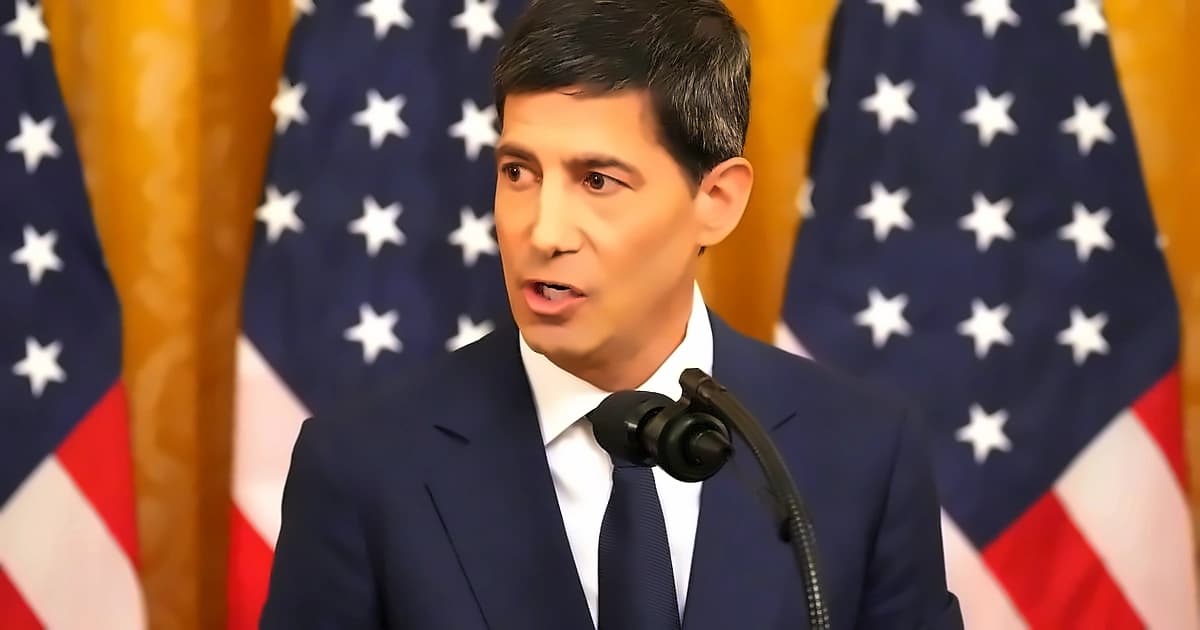
Kevin Warsh chairs his first Federal Reserve policy meeting on Wednesday, marking a pivotal moment for the central bank's direction. According to AP, bond markets are watching particularly closely for any signs of Warsh's policy leanings, as "We expect the press conference to be pivotal," wrote Jonathan Pingle, an economist at investment bank UBS. "This will be Kevin Warsh's first public appearance as Chair. ...We do not really know what his policy views are." The meeting comes as inflation has jumped to a three-year high of 4.2%, mostly due to higher gas prices, with the Fed widely expected to keep its key rate at about 3.6% where it has remained since last December. The Federal Reserve announces its monetary policy decision today after the June 16-17 FOMC meeting wraps up, with the June FOMC meeting announcement at 2 PM ET and Kevin Warsh's press conference at 2.30 PM ET. The live streaming of the FOMC meeting can be watched at the official YouTube channel of the US Fed.
The Federal Reserve is confronting a divided committee as it prepares for Kevin Warsh's first FOMC meeting this week. According to reports from Investing.com India, the debate centers on whether to raise rates amid PCE inflation on track to top 4% in May. The inflation surge stems from an energy supply shock due to Middle East conflict, layered on top of an overshoot of more than five years. While the Fed's standard approach is to 'look through' supply shocks, some officials are advocating for a hawkish stance based on duration concerns - the extended period of elevated inflation above 2% for more than five years. Recent US economic data indicate that growth remains robust and the labour market has not shown meaningful signs of weakness, but both monthly and annual inflation readings have moved higher, creating a complicated backdrop for policymakers. Economic growth remains resilient and the labour market continues to hold firm, but inflation pressures have resurfaced, partly due to elevated energy prices in recent months.
Markets have already priced in a rate hike this year based on worse inflation and better labor market data, as reported by Investing.com India. The Survey of Former Fed Officials and Staff (SOFFOS) shows 17 former Fed respondents favoring a hike this year versus 14 in favor of no change and only 1 in favor of a cut. Most of those favoring a hike put it at 50 basis points or more. However, the actual March SEP showed most Fed officials thought cuts would be appropriate this year. A hawkish lean from the Fed would not be a complete surprise to markets, but a median dot showing a hike as appropriate would signal a shift from the current 3-1/2 to 3-3/4% range. The market is currently pricing in at least one 0.25-percentage-point increase in the federal-funds rate over the next six months from its current target range of 3.50%-3.75%. By year's end, roughly 42% participants expect the target range to be at 3.75%-4.00%, while 14% expect 4.00%-4.25%.
New Fed Chair Kevin Warsh has been skeptical of the dot plot and forward guidance for years, according to Investing.com India reports. He worries that publishing forecasts pushes officials toward a common view and creates a bias against reacting to changing circumstances. Warsh himself said he wants a 'good family fight' on monetary policy around the FOMC table. Warsh is expected to bring a different style to the Fed than Powell, people who've worked with him say. He wants Fed policymakers to give fewer speeches, have more debates behind closed doors, and will likely avoid commenting on the daily ups and downs of the economy. Warsh is expected to attempt to remake certain aspects of the Fed's communication and policymaking stance during his first meeting. He is expected to reduce the forward-looking guidance from the Fed, perhaps do away with the so-called 'dot plot' of member forecasts, and reduce the frequency of press conferences. Warsh also dislikes publishing the widely watched chart of the governors' expectations for the appropriate fed-funds rate, commonly known as the dot plot, arguing that it conveys stale information. Viram Shah, Founder and CEO of Vested Finance, noted that Warsh has previously indicated a preference for reducing the amount of forward guidance offered by the central bank, as a result, investors may receive fewer clues about future policy moves than they have become accustomed to under previous Fed leadership.
The recent decline in oil prices following the new Iran agreement has reduced pressure on the Federal Reserve to alter its current easing bias, according to LiveMint reports. Nachiketa Sawrikar, Boston-based fund manager of the Artha Global Multiplier Fund, believes the Fed is likely to remain in a wait-and-watch mode despite continued economic strength. Without the moderation in oil prices, policymakers may have been forced to move away from their easing bias and adopt a more neutral policy stance. The prolonged disruption in the Strait of Hormuz since the Fed's March meeting had kept energy prices elevated, raising the risk that inflation could stay above the central bank's comfort level for longer than expected. However, the preliminary agreement between the United States and Iran to end their conflict has eased concerns over oil supply disruptions and may help cool inflationary pressures if a lasting deal is eventually reached. Brent oil price is down 30% over the last month, trading at under $80, as reported by The Financial Express. Looking ahead, he expects broad policy continuity under Warsh, at least in the near term. The new Fed Chair is likely to focus on establishing credibility by maintaining a strong anti-inflation stance while preserving flexibility for future policy adjustments.
During his Senate confirmation hearing in April, Warsh said he would focus on quelling inflation, stating "Inflation is a choice, and the Fed must take responsibility for it." However, there's at least a risk that six months down the road, Trump is fulminating about how he didn't get what he wanted from Warsh, and he'd like to fire Warsh, according to William English, an economist at the Yale School of Management. Warsh has criticized the central bank for not preventing the 2021-22 inflation surge, when prices jumped 9.1% in a year, the biggest spike in four decades. While seeking Trump's nomination, Warsh called for "regime change" at the Fed and has so far not sought to fire top staff, with economists saying "He's not there to break things." A Fed that appears to be concealing its own debate could look complacent about inflation, which is exactly the credibility it can't afford to lose. Goldman Sachs economist David Mericle wrote: "We no longer expect the Fed to lower interest rates this year ... Instead, we expect the FOMC to delay further cuts until core PCE inflation nears 2%, likely well into 2027."