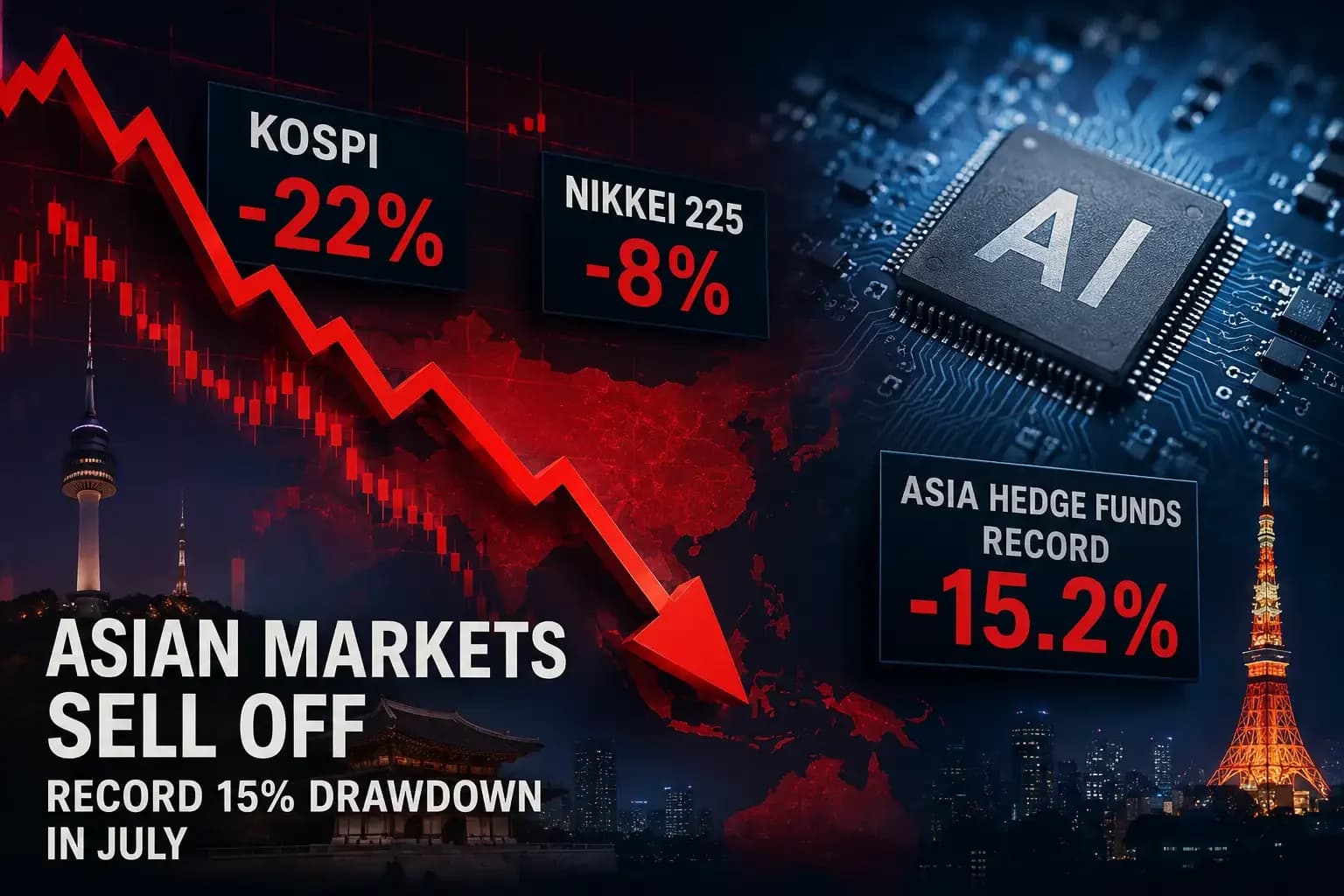
Asia's major multi-strategy funds experienced their steepest drawdowns of the year in July as a sharp selloff in artificial intelligence-linked stocks across Japan, South Korea and China wiped out a sizable portion of the gains accumulated in the first half of 2026. According to a Reuters report, some of the region's largest multi-strategy platforms posted monthly losses of 3% to 9%, while Goldman Sachs estimated that Asia's primary stock-picking hedge funds fell 15.2% in July, marking their steepest monthly decline on record. The decline came as investor sentiment towards AI-related companies weakened amid concerns over technology spending and rising geopolitical tensions in the Middle East. As reported by Reuters, the resulting selloff in semiconductor stocks hit major Asian chipmakers, reversing one of the year's strongest investment themes.
Among individual funds, Hong Kong-based Polymer Capital Management, one of the best-performing Asia-focused multi-strategy funds in the first half, lost 6.9% in July, trimming its year-to-date gain to 11.5%, as reported by Reuters. The fund manages more than $6 billion in assets and had been among the top performers before the July selloff, with part of the decline stemming from its equity exposure in Japan where markets came under heavy selling pressure. Singapore-based Dymon Asia's $9 billion multi-strategy fund fell 6.5% during July, trimming its gains for the January to July period to 7.5%, while Hong Kong-headquartered Pinpoint Asset Management's flagship multi-strategy fund fell 9% during the month. Singapore-based Arrowpoint Investment Partners posted a comparatively modest decline of 2.6% by reducing overall portfolio risk before the July market downturn.
The artificial intelligence-driven rally has transformed emerging markets, with technology heavyweights in South Korea and Taiwan taking center stage as AI hardware and memory chip manufacturers emerged as key beneficiaries. According to Reuters, companies linked to AI hardware and memory chips have helped emerging market equities step out of the shadow of Wall Street's dominant technology stocks, with South Korean firms such as Samsung Electronics and SK Hynix, alongside Taiwan Semiconductor Manufacturing Co. (TSMC), driving strong performances. The rally helped South Korea's KOSPI index nearly double in value before sentiment reversed sharply, while TSMC, the largest company in the MSCI Emerging Markets Index, also came under pressure as investors reassessed valuations. Veteran emerging markets fund manager Carlos von Hardenberg, co-founder of MCP Emerging Markets, told Reuters that investor interest has swung dramatically from an overwhelming focus on U.S. technology stocks to renewed enthusiasm for emerging-market AI leaders.
The rapid gains have been followed by an equally dramatic rise in market volatility, with South Korea's KOSPI index losing around 40% in just six weeks after concerns over regulations and investor positioning triggered heavy selling. According to Reuters, the turbulence has been significant enough that volatility in MSCI's $1.8 trillion Emerging Markets Index exceeded levels seen during the COVID-19 pandemic. The AI boom has also increased concentration risk within emerging markets, with just nine companies—primarily major technology firms from Taiwan and South Korea, along with Chinese internet giants Alibaba and Tencent—now accounting for more than 40% of the MSCI Emerging Markets Index. This concentration has reduced the diversification benefits traditionally associated with emerging-market investing, as noted by MSCI's chief research officer Ashley Lester to Reuters.
International investors have significantly reduced exposure to Asian equity markets, with overseas investors withdrawing money from Asia excluding China at the fastest pace for any first half of the year since at least 2010. According to Reuters, citing JPMorgan estimates, South Korea experienced foreign outflows exceeding $100 billion, while Taiwan saw withdrawals of more than $44 billion. Despite the setback, multi-strategy hedge funds generally outperformed the broader Asian hedge fund industry, with Singapore-based Arrowpoint Investment Partners posting a comparatively modest decline of 2.6% by reducing overall portfolio risk before the July market downturn. According to Reuters, the firm identified signs of excessive leverage building across markets, particularly in South Korea and Taiwan, with sources saying banks had become increasingly reluctant to provide additional leverage for certain positions, prompting the fund to lower exposure before volatility intensified. Portfolio managers are adjusting strategies amid the heightened uncertainty, with many investors remaining cautious about the long-term AI investment theme despite recent corrections.