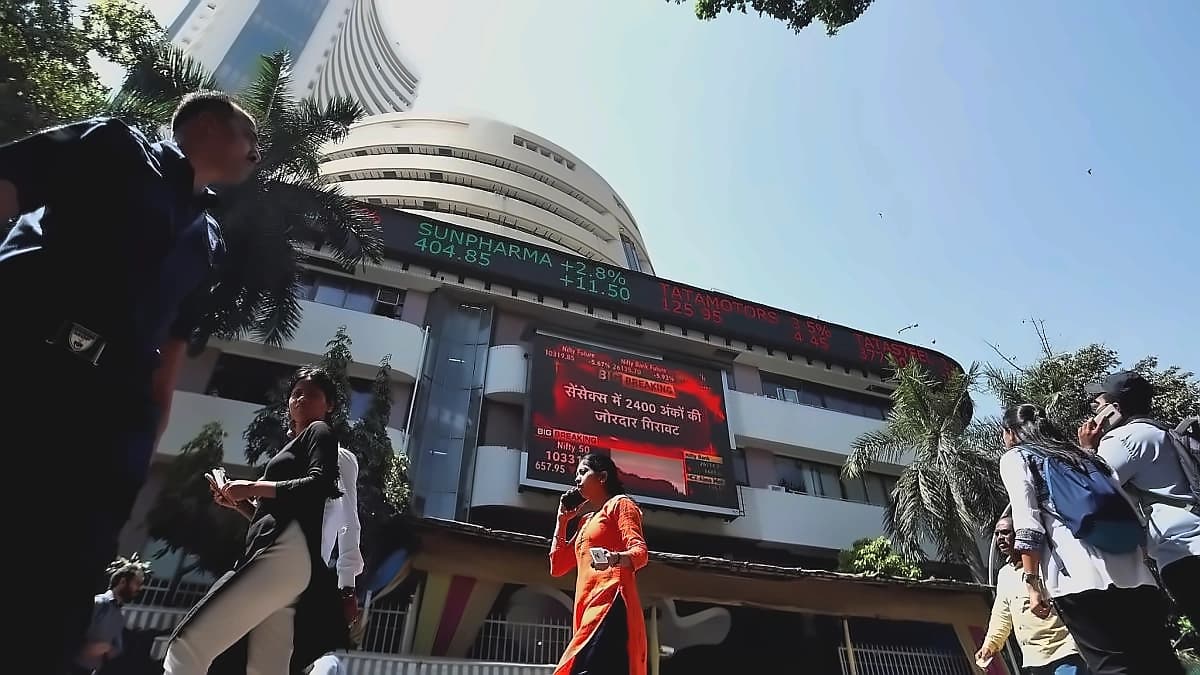
Indian equity markets showed signs of stabilization as the Nifty 50 closed 0.3% lower at 24,570 on Friday, falling 65.35 points after oscillating in a 73-point band through the session. According to The Economic Times, the Sensex declined 455.59 points, or 0.6%, to end at 78,499 points on Friday. However, for the week, the Nifty gained 0.8% while the Sensex climbed 0.5%, showcasing the market's ability to bounce back from initial volatility concerns. The gap between the two benchmarks that had persisted for four straight sessions since the NSE introduced its Closing Auction Session (CAS) on August 3 has now narrowed significantly. This represents a significant improvement from earlier sessions when the Nifty 50 ended almost flat, gaining only 11 points to close at 24,636 while the Sensex jumped nearly 374 points to end at 78,955 on Thursday. Market observers say the divergence reflects differences in institutional order flow and auction-window liquidity between the two index baskets, rather than any fundamental disconnect, with most analysts expecting the distortion to narrow as participants recalibrate their strategies.
The day's real action was concentrated in the defence sector, with the India Defence Index jumping around 3% led by Hindustan Aeronautics and Bharat Electronics, as persistent global geopolitical tensions and sector rotation drove fresh buying. According to The Hindu BusinessLine, PSU Bank stocks also attracted buyers, with the Nifty PSU Bank index gaining 2.2%, partly aided by positive Q1 FY27 earnings showing. On the other hand, Realty fell 1.3% and Auto shed 1%, both among the weakest performers, while Media and Metal also closed in the red. Reliance, SBI, and BEL were the standout gainers in the Nifty pack, while Powergrid, Tata Steel, and TCS weighed on the index. Thursday was also the weekly Sensex expiry day, which added an element of caution and kept volumes from breaching dramatically, though NSE cash market turnover was 3% higher than on Wednesday. The broad-based rally this week was supported by improved global sentiment due to easing geopolitical tensions, with selective strength in financials, pharma, and IT sectors.
The Securities and Exchange Board of India met with top brokers on Wednesday and directed them to ensure indicative equilibrium price was continuously displayed for investors, as per CNBC TV18 sources with direct knowledge of the matter. The regulator also urged brokers to increase retail participation in the new closing window to increase liquidity, addressing concerns about thin trading volumes during the auction window. The Nifty saw abrupt swings at close during the last three days, when the Sensex was relatively stable, with analysts attributing the divergence between the two indexes to concentration of volumes on the National Stock Exchange of India and lack of clarity over where the stocks or indexes might close. Swings on expiry day can trigger heavy losses for options traders, particularly small retail traders, according to market analysts. Since it has only been a few days, it is difficult to make a judgement call on the new methodology as the market takes time to adapt, said Raj Deepak Singh, vice president of derivatives and quantitative research at ICICIDirect. Friday's trading session ended on a normal note, and we expect market functioning to remain stable going forward, according to Rajesh Palviya, head of research at Axis Securities.
The gap between the Sensex and Nifty continued for a fourth consecutive day as investors grappled with changes to the price-discovery mechanism for stocks with futures and options contracts. According to Business Standard, at 3:15 p.m., the Nifty stood at 24,628 but ended Thursday's session at 24,636, a gain of 0.03% from its pre-closing-auction level, while the Sensex was at 78,785.6 at 3:15 p.m. but ended the session at 78,954.8, an increase of 0.21% during the final 20 minutes. Chandan Taparia, Head of Derivatives & Technical Research at Motilal Oswal Financial Services, explained that participation in the closing auction remains thin, allowing a relatively small concentration of orders to have an outsized impact on the final index level. Under the closing auction system, closing prices for stocks with futures and options contracts are determined through an auction conducted between 3:15 p.m. and 3:35 p.m., replacing the earlier method of using the volume-weighted average price of trades during the final 30 minutes of the session. The implementation of CAS created some uncertainty initially, but the teething troubles should end soon, with Friday's trading session ending on a normal note, according to market experts.
India VIX, a gauge of market volatility, marginally climbed to 12.18 on Friday, up from 12.15 on Thursday. According to The Economic Times, the Nifty Midcap 150 was up 0.2%, while the Nifty Small-cap 250 ended flat Friday, but these broader-market indices have risen 1% and 2.4%, respectively, this week. Foreign portfolio investors net bought shares worth ₹480 crore, while domestic institutions were buyers to the tune of ₹236 crore. Brent crude oil futures had fallen to about $81.8 on Friday evening, down nearly 0.9% over the previous day, with the retreat in crude oil prices supporting improved investor sentiment. The markets witnessed a broad-based rally this week, with selective strength in the mid and small caps, as institutional investors, both domestic and foreign, snapped up Indian equities. Aamar Deo Singh, senior vice president at Angel One, said the markets witnessed a broad-based rally this week, with selective strength in the mid and small caps, as improved global sentiment due to the easing of geopolitical tensions supported buying interest in pockets.