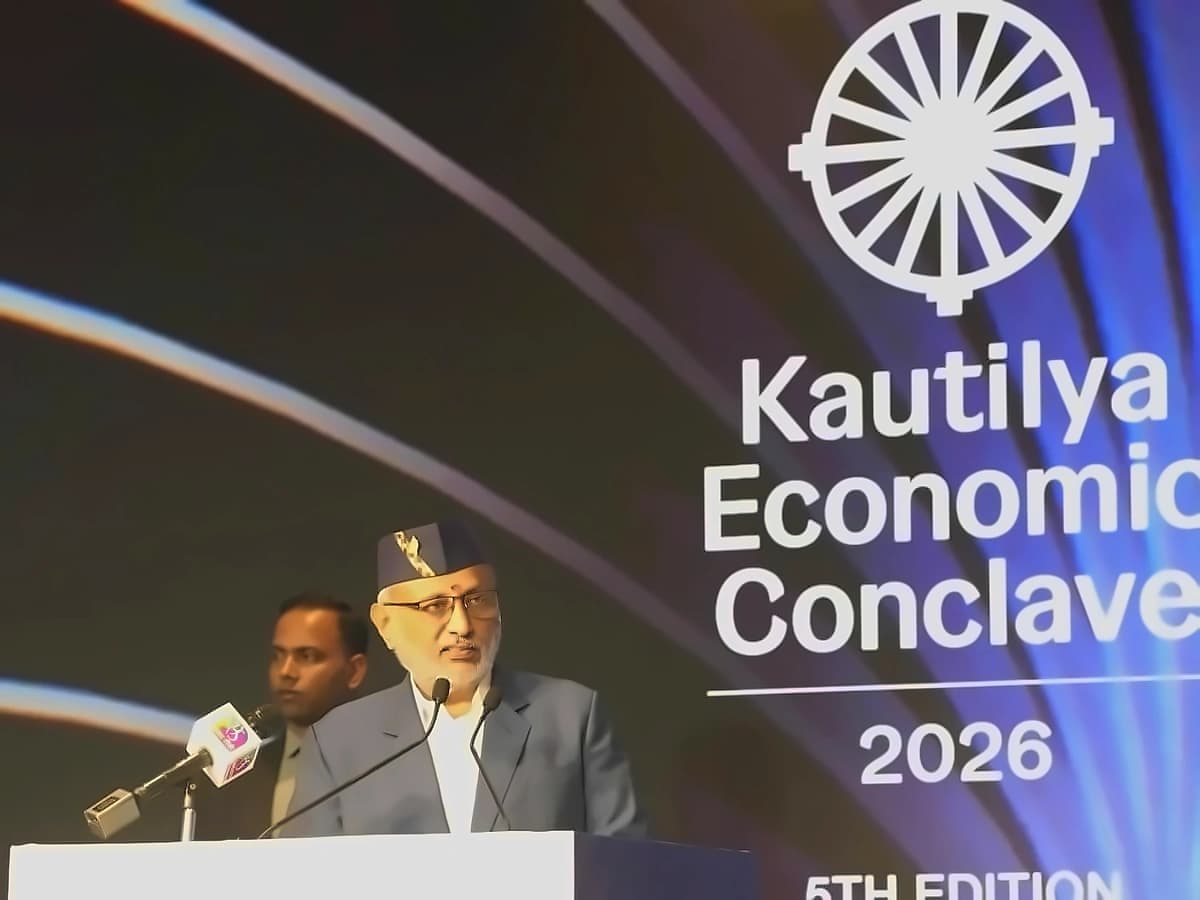
The Purple Economy White Paper, jointly published by EnAble India and Deloitte India, was launched on Tuesday by Union Minister for Skill Development and Entrepreneurship Jayant Chaudhary in New Delhi. The report challenges the biggest misconception surrounding disability by positioning persons with disabilities as customers, workers, entrepreneurs, innovators, taxpayers and contributors to growth rather than welfare beneficiaries. As per the report, this economic framework recognizes disability inclusion as an appeal to common sense rather than charity, with the potential to expand markets, improve productivity and strengthen India's long-term growth. The framework estimates India's total addressable market for disability-linked products and services at around $150 billion, based on a conservative estimate of 100 million persons with disabilities. Chief Economic Adviser V. Anantha Nageswaran emphasized that as India enters its next phase of economic growth, the opportunity lies not only in expanding rights and access but in converting participation into new markets, enterprises, jobs and innovation.
Union Minister Jayant Chaudhary highlighted the economic significance of the Purple Economy opportunity, stating that a $150 billion market is equivalent to nearly 4% of India's GDP. He noted that this represents roughly the size of India's merchandise trade deficit, making it a huge economic opportunity. The report estimates that even the conservative estimate of 100 million persons with disabilities exceeds the population of many countries, creating a market that businesses and policymakers cannot afford to ignore. The opportunity spans healthcare, education, assistive technology, mobility, financial services, housing, hospitality, retail and digital platforms, with global disability-linked consumer spending estimated at more than $18 trillion, making it one of the world's largest underserved consumer markets. Romal Shetty, Chief Executive Officer, Deloitte South Asia, emphasized that India is at a decisive moment in its growth journey, stating that businesses designing for inclusion will not only serve society better but will build better products, stronger talent systems and more resilient markets.

The report highlights significant participation gaps that limit the economic contribution of persons with disabilities. Workforce participation stands at 36%, compared with around 60% among people without disabilities. Less than 25% of workplaces have accessible infrastructure, while fewer than 1% of MSMEs registered on the Udyam portal are owned by persons with disabilities. Nearly 69% of persons with disabilities live in rural India, where access to skilling, healthcare and assistive technologies remains limited. These gaps represent not just social exclusion but also lost economic output, underutilized talent and untapped consumer demand, according to the report. Chaudhary emphasized the need for more purple audits and reports as part of balance sheet reporting and corporate governance laws, asking companies to report how many of their new hires, recruits, and top management are people with disabilities.
The report demonstrates how designing products and services for accessibility often creates innovations that benefit society as a whole. Technologies such as voice recognition, live transcription, subtitles, touchscreens and automatic doors all originated as accessibility solutions before becoming mainstream products. International studies cited in the report suggest that disability-linked exclusion can cost countries between 3-7% of annual GDP, with these losses arising not only because persons with disabilities are excluded from jobs but because entire support systems remain underbuilt: families lose productive time, businesses miss customers, governments carry higher long-term dependency costs and markets fail to develop needed services. Chaudhary emphasized that when the unmet needs, aspirations and participation of persons with disabilities are recognized at scale, they open new markets, better services, inclusive infrastructure, jobs, livelihoods and enterprises for the entire economy. Chief Economic Adviser V. Anantha Nageswaran emphasized that incorporating accessibility at the design stage is far less expensive than retrofitting infrastructure later.
The analysis suggests that businesses must transition from treating India as a unified market to recognizing it as a collection of distinct markets. The next decade's winners will be companies that reframe their top-down approach and view India as a collection of massive local markets, each with their own needs and contexts. This shift requires investing in deeper customer understanding, locally-designed value propositions, and state-specific go-to-market strategies, moving beyond scale efficiencies toward bottom-up market segmentation. The Purple Economy framework reinforces this approach, emphasizing that businesses designing for inclusion will build stronger markets, better products, and more resilient systems while serving society better and building more competitive enterprises. Chaudhary emphasized that by turning barriers into innovation signals and participation into value creation, the Purple Economy can support India's vision of Viksit Bharat 2047. The framework positions disability inclusion as a national economic growth agenda that can drive market creation, productivity, dignity and shared prosperity.