The retail landscape is undergoing a fundamental shift as the experience economy emerges as the primary driver of consumer behavior. As reported by industry experts, people's time is being competed for rather than just their purchases, with consumers seeking destinations that offer great restaurants, fitness experiences, entertainment, beautiful outdoor spaces, and opportunities to meet friends and family. This transformation means that shopping can no longer be the only reason for visiting a retail development - it must be part of a bigger experience. The Tier 2 to Tier 4 cities are projected to contribute over 30% of incremental retail growth over the next decade, with their share of e-commerce spending increasing from 25% to 34% between 2021 and 2025. The Open Network for Digital Commerce (ONDC) represents a government initiative allowing buyers and sellers to transact across platforms without platform exclusivity, while social and chat commerce market is valued at $6-7 billion and growing at 40-45% CAGR.
According to reports from NDTV Profit, e-commerce accounts for just 6-7% of consumer spending in India, with projections suggesting it will reach ₹25 lakh crore by 2030 but still represent only 7-8% of total spending. This compares to 27-29% in the UK, 15-17% in the US, and 31-33% in China, as reported by Forrester. The offline retail sector has demonstrated strong growth momentum, expanding at 13-14% CAGR between 2021 and 2025 and expected to account for more than 90% of consumer spending a decade from now. This growth trajectory is supported by multiple independent studies, including BCG's February 2026 survey of over 12,000 Indian shoppers that found nine in ten online shoppers still make purchases offline, while close to half of all offline shoppers research products digitally before buying.
As reported by NDTV Profit, the retail landscape is witnessing significant convergence where digital-first brands like Mamaearth and Sugar Cosmetics are expanding into physical retail while traditional kiranas are strengthening their digital presence. The Open Network for Digital Commerce (ONDC) represents a government initiative allowing buyers and sellers to transact across platforms without platform exclusivity. DigiDukaan, one of the programmes running on this network, helps small retailers establish digital presence and reach customers beyond their immediate neighbourhood. This integration is evident in the social and chat commerce market, valued at $6-7 billion and growing at 40-45% CAGR, which enables neighborhood stores to digitize while maintaining competitive advantages that make them unique. The Tier 2 to Tier 4 cities are projected to contribute over 30% of incremental retail growth over the next decade, with their share of e-commerce spending increasing from 25% to 34% between 2021 and 2025.
According to NDTV Profit analysis, India has approximately 12 million kirana stores that are not competing with e-commerce on e-commerce's terms. The quick commerce segment, growing at an estimated 110-130% CAGR between 2022 and 2025 and now valued at $7-8 billion, serves specific consumer needs in dense urban markets rather than representing structural displacement of neighborhood retail. The social and chat commerce market is particularly significant, with 45% of spending coming from Tier 2 and Tier 3 cities, where kirana relationships remain strongest. ICRIER's MSME Survey 2025 covering 2,365 firms found that small businesses with online presence grew annual turnover by 16% from FY23 to FY24, compared to 7% growth for offline-only operations. Mamaearth, which began as a digital-first brand, has expanded rapidly into physical retail with products now available across a wide range of retail touchpoints, while continuing to leverage digital channels and consumer insights to drive demand. Similarly, Sugar Cosmetics has paired its influencer-led online presence with a growing offline retail network.
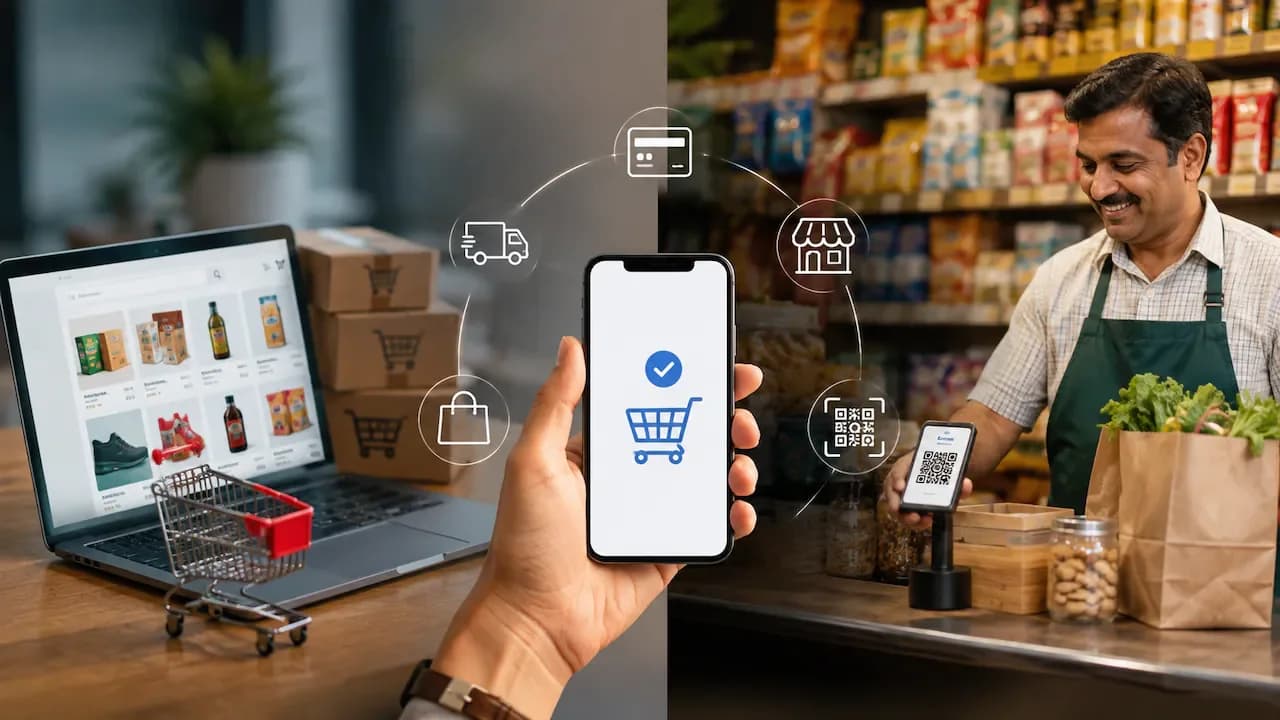
As reported by NDTV Profit, consumers move seamlessly between online and offline retail channels, with a smartphone ordered on a marketplace during Diwali sale, vegetables bought from the neighborhood kirana on monthly credit, and milk delivered at six in the morning. Analysis of listed retail companies shows that brands with strong omnichannel presence consistently deliver higher total shareholder returns than those relying on single channels. The Tier 2 to Tier 4 cities are projected to contribute over 30% of incremental retail growth over the next decade, with their share of e-commerce spending increasing from 25% to 34% between 2021 and 2025. This omnichannel behavior challenges traditional market definitions and regulatory approaches that treat online and offline retail as separate entities. The website and the storefront are no longer separate businesses - they are different doors into the same integrated retail ecosystem, supported by the same inventory, warehouses, pricing systems, customer database, loyalty programme and logistics network. The experience economy requires developers to think beyond just creating retail space, focusing instead on why would someone visit, how long would they want to stay, and most importantly, what would make them return.
According to NDTV Profit analysis, the Competition Commission of India (CCI) and the proposed Digital Competition Bill (DCB) both begin with market definitions that significantly impact regulatory interventions. The Digital Competition Bill proposes ex-ante obligations for Systematically Significant Digital Enterprises, which was sent back for review by the Parliamentary Standing Committee on Finance in August 2025. The evidence presented suggests that defining relevant markets solely as online retail may exclude competitive constraints from offline alternatives and underestimate the integrated nature of India's retail ecosystem. The Digital Competition Bill proposes ex-ante obligations for Systematically Significant Digital Enterprises, creating an opportunity to revisit assumptions underlying the proposal. A narrow online retail market definition would treat a 6-7% segment of retail spending as a standalone market and potentially infer market power without fully accounting for competitive constraints from offline alternatives. The more relevant question is not whether these are different markets, but whether the distinction between them remains meaningful at all, as businesses increasingly operate across both channels and consumers shop everywhere using each format for what it does best.