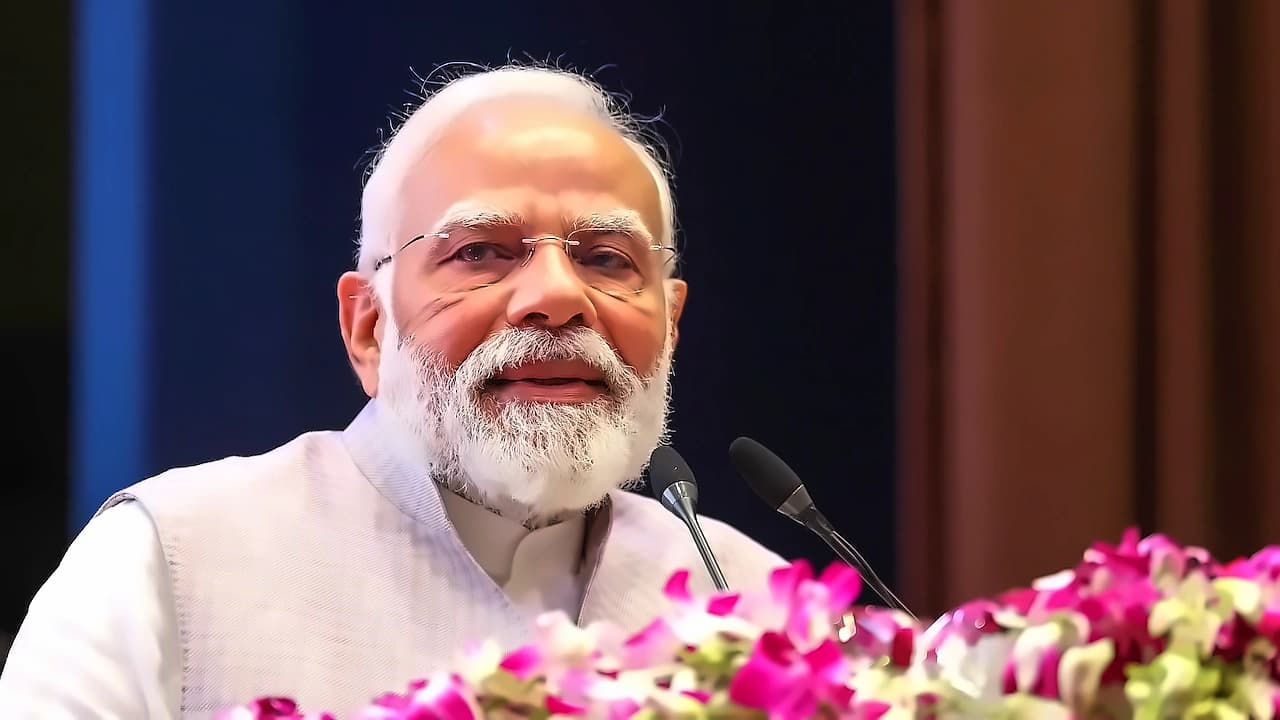
South Korean President Lee Jae Myung's three-day state visit to India (April 19-21) resulted in the Joint Strategic Vision, a comprehensive framework for bilateral cooperation over the next five years. According to The East Asia Foundation, this vision includes annual leader-level meetings to realize the full potential of the India-South Korea Special Strategic Partnership, which began in 2015. The framework encompasses reinforcing political foundations through high-level exchanges, building greater strategic trust, creating win-win industrial dynamism, and focusing on trade finance and development. As reported by The Times of India, both Modi and Lee agreed to establish an India-ROK Industrial Cooperation Committee with its first meeting scheduled for later in 2026, along with the launch of the India-Korea Financial Forum to strengthen business cooperation.
Indian stock markets ended lower on Thursday as investors reacted to escalating geopolitical tensions in West Asia, rising crude oil prices, and weak global cues. The BSE Sensex settled 150.63 points, or 0.20 per cent lower, at 73,832.55, while the NSE Nifty declined 53.35 points, or 0.23 per cent, to close at 23,161.60. Markets witnessed heightened volatility during the day, opening sharply lower before staging a partial recovery and then slipping back into negative territory. According to Religare Broking's Ajit Mishra, markets remained volatile on the weekly expiry day and ended lower amid weak global cues, with investor sentiment hit by renewed concerns surrounding the US-Iran conflict and concerns over elevated global interest rates following stronger-than-expected US inflation data.
The most significant outcome of Lee's visit was the agreement to upgrade the existing Comprehensive Economic Partnership Agreement (CEPA) from 2010, with both sides pledging to double bilateral trade to $50 billion by 2030. As reported by The East Asia Foundation, India imported $21.06 billion worth of goods from South Korea and exported just $5.82 billion in 2024-2025, creating a $15.24 billion deficit that has been a concern for Modi. Commerce Minister Piyush Goyal observed that all options are open, including drafting a completely new FTA, noting that India today has more negotiating strength than previously. The countries also agreed to establish a Korean Industrial Township to facilitate Korean SME entry into India and a Korean industrial enclave similar to Japanese townships with plug-and-play infrastructure.
The partnership encompasses significant technology collaboration, with both leaders launching an India-Korea digital bridge to deepen partnership in AI, semiconductors and information technology. According to The Times of India, Lee highlighted the perfect fit between Korea's world-class AI infrastructure and India's vast pool of AI talent, noting that they can easily identify projects generating meaningful synergy. Defense cooperation was expanded with broadening of defense cooperation in phase 3, emphasizing greater technology transfer, co-development and joint design of advanced military systems. The second phase of the K9 Vajra project provides for more than 60 per cent of the manufacturing process to be carried out in India, with plans to extend the same manufacturing model to future technologies including anti-aircraft weapons and missile systems.
In its report titled Indian States: Strong Growth Softens The Blow Of Fiscal Imbalances, S&P Global Ratings highlighted India's robust economic expansion as a key factor supporting state finances. The agency expects India's real GDP growth to average 6.9 per cent between fiscal 2027 and fiscal 2029, making it one of the fastest-growing major economies in the world. According to S&P, robust economic expansion is helping prevent the finances of Indian states from deteriorating despite persistent fiscal deficits and rising debt levels. The agency noted that state governments continue to face significant spending pressures as welfare programmes and infrastructure investments remain elevated, with revenue-expenditure mismatches and fiscal deficits expected to persist over the next few years.