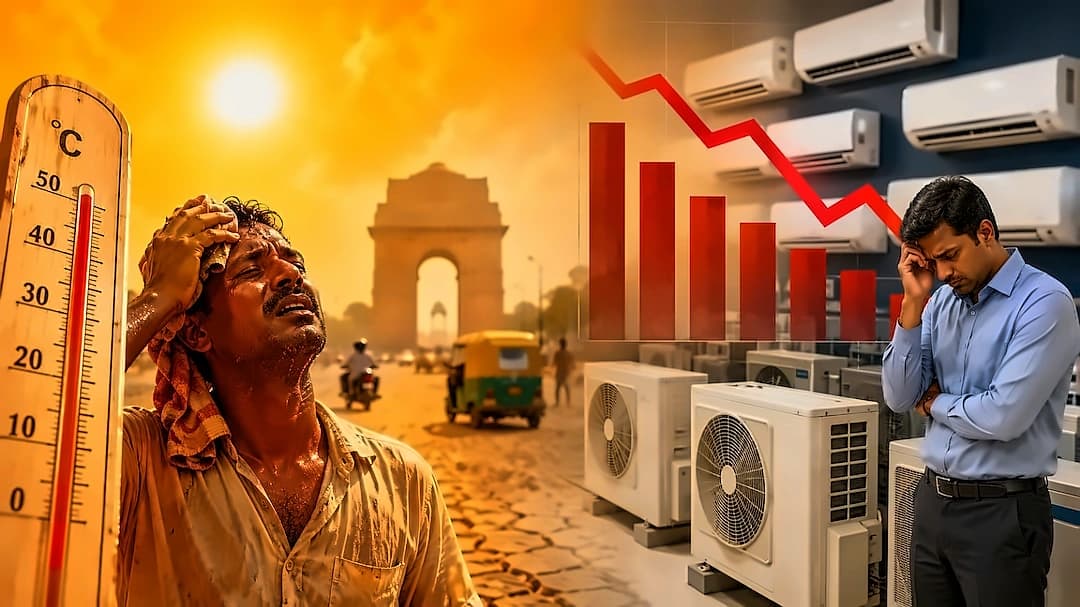
Extreme heat is reshaping household finances across India, with families facing nearly double electricity bills during peak summer months. As per Business Standard, when Sanjay Arora from Delhi's Kalkaji received his June electricity bill, it was nearly double what he paid during cooler months, with his family's air conditioner running longer periods and ceiling fans operating throughout the day. The financial impact extends beyond electricity, with workers like Mohd Arif, a delivery rider, facing increased expenses for water and hydration drinks while avoiding afternoon work hours due to heat stress. According to E Somanathan from the Indian Statistical Institute, heatwaves are increasingly becoming an economic issue for households, particularly those dependent on daily earnings, with one-degree increase in mean temperature associated with a 16% decline in net earnings and one-degree increase in wet-bulb temperature with a 19% decline.
Workers in agriculture and construction sectors across India are losing 20 working days or more annually due to heat stress, with projections showing losses could reach 25 working days by 2030. According to the latest adelphi global report, India loses 4.31% of working hours across all sectors every year due to heat, with this figure projected to rise to 5.80% by 2030. The stress is particularly acute in outdoor physical labor sectors, where working-hour losses are already estimated at 5.87% and are projected to reach 9.04% by 2030. This translates into significant income losses for workers who lack paid sick leave or health insurance, creating a compound effect that threatens household stability. As per the report, 90% of women and 86% of men are informally employed in India, limiting access to paid sick leave, health insurance and formal income protection. Recent reports from La Via Campesina indicate that landless farm labourers are being hospitalised for sunburn, cardiovascular strain, kidney injury, and respiratory illnesses, with daily wages reduced due to fewer working hours.
Food expenses are increasingly reflecting the impact of rising temperatures, with vegetable prices doubling over the last two months according to Sakshi Devi, a Delhi homemaker. According to an HSBC report titled India Economics: Why RBI May Need a Thermometer, temperature now has greater influence on food output and inflation than even rainfall and reservoir levels. Research by the Reserve Bank of India shows that vegetables, which account for 6.04% of the Consumer Price Index basket, are particularly sensitive to temperature shocks, with a one-unit increase in temperature deviation adding 2.60 points to vegetable price momentum compared to 0.07 points for rainfall deviations. The food inflation rate rose to 4.78% in May from 4.2% in April, with rising temperatures contributing to food inflation particularly when extreme weather affects agricultural output and supply chains.
Heat-related illness drives up out-of-pocket medical spending, creating additional financial strain on households. The report cites anecdotal evidence that 40% of urban households and 60% of rural households experiencing heatstroke among a family member had to take loans or sell assets to pay medical bills. Out-of-pocket medical expenditure accounted for 44% of India's total health expenditure in 2023, while annual per capita out-of-pocket spending reached $151 in PPP terms, up 194% since 2000. With 23.9% of India's population earning less than $4.20 per day, heat-linked income losses could increase the risk of households falling below the World Bank poverty line of $4.30 per day for lower-middle-income economies. The report warns that as global temperatures continue to rise, these losses to both household income and GDP are projected to worsen significantly.
Extreme heat is becoming more frequent and intense due to climate change, primarily driven by the burning of fossil fuels like oil, coal, and gas. This year has already seen some of the worst heatwaves ever recorded, some virtually impossible without the influence of climate change. The India Meteorological Department's forecast of above-normal heatwave conditions and warmer-than-usual nights largely played out across large parts of the country during the April-June period. According to the IMD's monthly report, heatwave conditions prevailed in Delhi on May 18, 19, 20, 21, 24 and 27, with the city recording a minimum temperature of 32.4 degrees Celsius on May 25, making it the warmest night in 14 years. Below-normal rainfall, driven by prevailing El Niño conditions, has kept temperatures elevated across large parts of the country, with Delhi's mercury climbing to 38.6 degrees Celsius on July 14 - 3.1 degrees above normal - while the heat index touched 45.8 degrees Celsius in the evening. The IMD has forecast below-normal rainfall across much of the country in July, with both maximum and minimum temperatures expected to remain above normal in most regions, raising the likelihood of continued heat stress.

The report calls for urgent policy action to address the cascading impacts of heat stress on Indian households. As per adelphi global, governments need to "close the gap between adaptation planning and concrete action" for workers and households most exposed to heat. The report recommends linking adaptation plans to social protection, including compensation for lost working time, state-supported insurance, formal labour protections for heat-related losses and stronger public health systems. The World Health Organisation & World Meteorological Organisation have urged governments and businesses to act now by implementing heat-health policies to high-risk sectors, deploying early warning systems to anticipate heatwaves, and training workers and managers on safe practices. Practical interventions such as shaded rest areas, hydration stations, and flexible work schedules have been shown to dramatically reduce heat-related health risks while being cost-effective. According to E Somanathan, protection from heat at night will definitely help, as minimum temperatures play an equally important role in reducing workers' earnings as maximum temperatures.