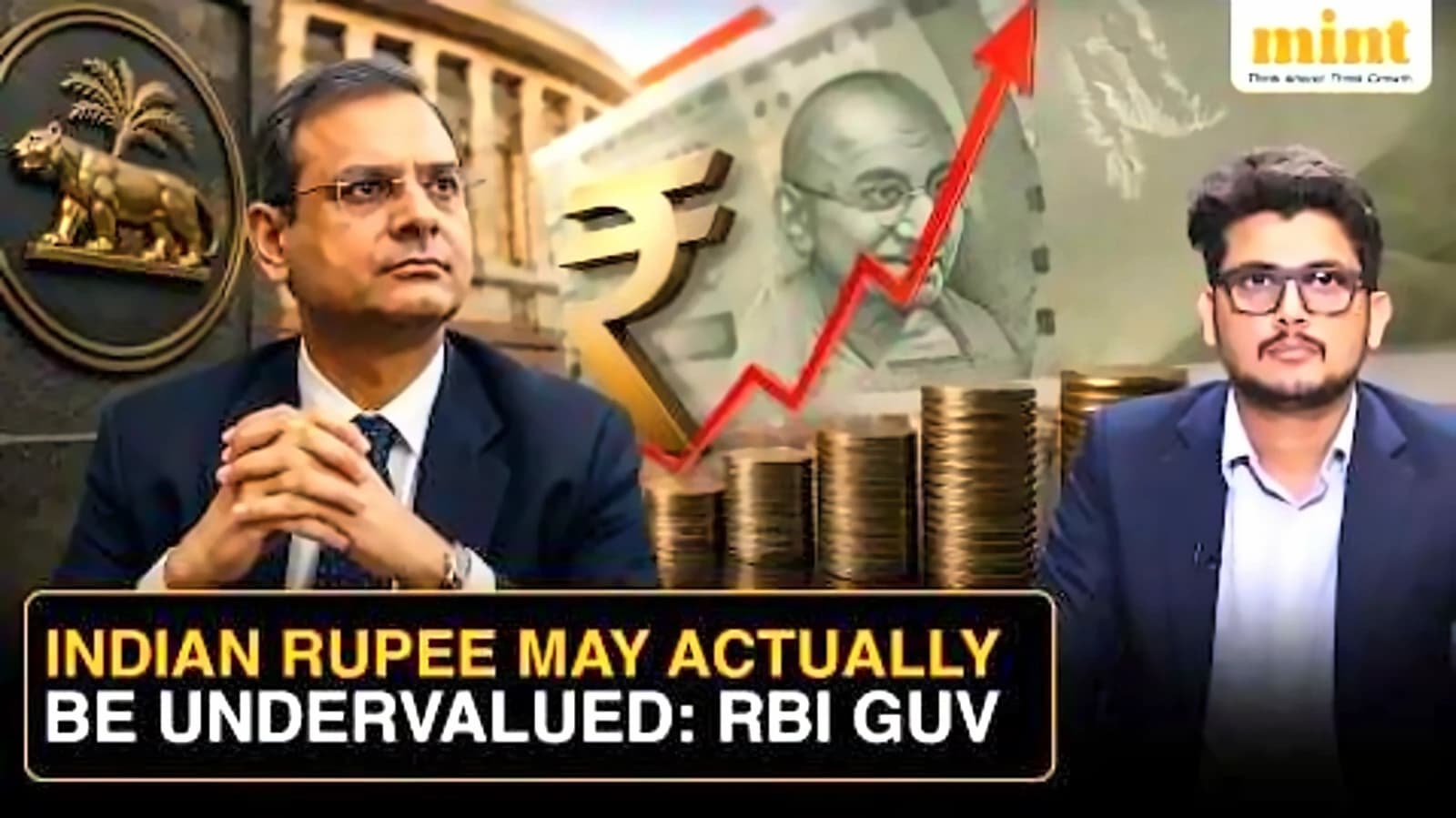
RBI Governor Sanjay Malhotra believes the rupee may be undervalued following its recent depreciation, marking a significant shift in the central bank's assessment of the currency's value. Speaking to Mint against the backdrop of the rupee nearing the psychologically significant 100-per-dollar mark, Malhotra stated that "With the recent depreciation, it would be reasonable to think that rupee is not overvalued. If anything, one could argue that rupee has become undervalued, both in nominal as well as in REER terms." REER, or real effective exchange rate, measures a currency's value against a basket of trading partner currencies after adjusting for inflation, providing a more comprehensive assessment of the rupee's competitiveness. The RBI governor reiterated that the central bank does not target any specific exchange-rate level and intervenes only to curb excessive volatility or speculative movements. Malhotra noted that the rupee has depreciated by around 6% since the West Asia war erupted on February 28, emphasizing that the central bank stands ready to intervene if speculative pressures build up.
RBI Governor Sanjay Malhotra confirmed that the central bank will do "whatever is required" to ensure orderly movements in the foreign exchange market, as reported by Business Standard. The RBI governor emphasized that the central bank has nearly $700 billion in reserves to quell any undue speculative movement and maintain orderly price discovery in the forex market. Malhotra stated that the RBI has enough tools in its kit to manage any forex market volatility, providing reassurance to market participants about the central bank's commitment to maintaining currency stability. The governor's comments come as the rupee has shown signs of recovery after recent depreciation pressures, with traders expecting the currency to hover between 95 and 96 this week. A gauge of the rupee's competitiveness against other currencies stood at 90.96 in April, showing the currency is likely undervalued against peers, according to The Hindu BusinessLine. This was the lowest reading since at least 2014, with a reading above 100 signaling the currency is overvalued.
According to a Bloomberg report, the RBI is considering several measures to stabilize the currency, including a possible interest rate hike, additional currency swap auctions, mobilization of non-resident Indian dollar deposits and even issuance of sovereign dollar bonds. However, Arvind Panagariya, chairman of the 16th Finance Commission, cautioned against using "costly instruments" such as dollar bonds and high-interest NRI deposits, saying they would amount to "largely a transfer to rich NRIs." Panagariya argued that the current macroeconomic situation was very different from the 2013 "taper tantrum" episode, when India faced double-digit inflation and severe external vulnerabilities. "This is not 2013," he said, adding that prudent monetary management had left the economy "well-positioned to absorb some inflationary pressure" arising from currency depreciation. The RBI's monetary policy committee is scheduled to meet during June 3-5, with the central bank having kept the benchmark repo rate unchanged at 5.25% so far this year.
Large currency speculators in the US dollar futures market turned new short, according to the latest Commitment of Traders (COT) data released by the Commodity Futures Trading Commission (CFTC), as reported by Business Standard. The non-commercial futures contracts of US dollar index futures, traded by large speculators and hedge funds, totaled a net short position of 479 contracts in the data reported through May 19, 2026, marking a fall of 3,666 net positions compared to the previous week. This development provides additional support to the rupee's recovery as global investors reduce their exposure to the US dollar amid geopolitical uncertainties. US President Donald Trump said the Iran deal is "largely negotiated" on Saturday, sparking fresh optimism that a breakthrough might be imminent in the three-month-old U.S.-Iran war. Trump said an agreement between Washington and Tehran would reopen the Strait of Hormuz, the vital shipping passage whose closure has sparked a global energy crisis and lifted crude oil prices by roughly 45%.
India's foreign exchange reserves fell by $8.09 billion to $688.89 billion in the week ended May 15, according to RBI data released on Friday, as reported by Upstox. Foreign currency assets, the largest component of reserves, declined by $6.48 billion to $545.90 billion. The decline comes ahead of the RBI's monetary policy committee meeting scheduled for June 3-5, where the central bank is expected to review its current stance. Malhotra noted that the rupee touched a record low of nearly 97 against the US dollar last week amid rising global crude prices and persistent foreign portfolio outflows. Despite the recent challenges, Malhotra underlined that India's macroeconomic fundamentals remained strong, citing higher growth and relatively low inflation compared with most major economies. The RBI governor's most recent projections for inflation and growth were 4.6% and 6.9% respectively, though he acknowledged these would be revised given evolving conditions.