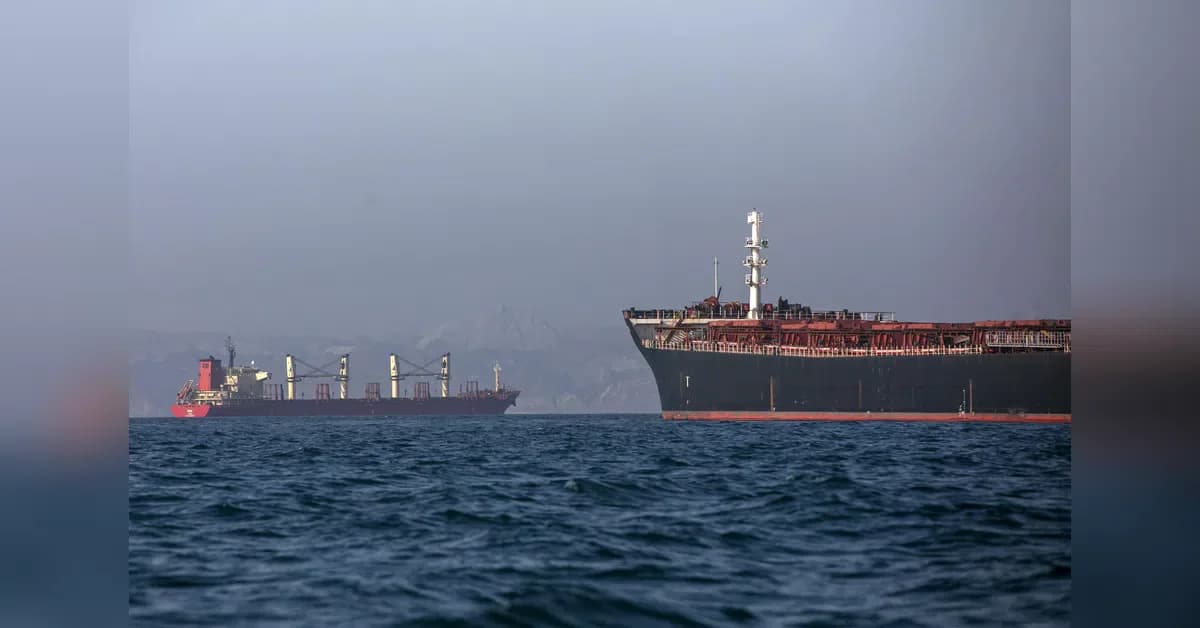
International Energy Agency Executive Director Fatih Birol has issued a stark warning that global energy security is at risk if oil shipments through the Strait of Hormuz do not resume soon. Speaking at a Council on Foreign Relations event on Thursday, Birol stated "Oil security is still a critical issue. We should be worried, and I am worried, if the situation does not improve in the next few weeks." The warning comes as the Strait of Hormuz, a narrow waterway between Iran and Oman that normally carries about one-fifth of the world's energy shipments, has been mostly blocked since the conflict began on February 28 with U.S. and Israeli strikes on Iran. Despite sharp energy price increases, Birol noted that several factors have moderated the rise, including China's stockpile of more than 1 billion barrels of oil before the war, oil conservation through increased use of electric vehicles and public transport, and an IEA-coordinated release of up to 400 million barrels of oil. However, Birol emphasized that these fixes "can't last forever," warning that the Iran war represents the worst energy disruption in history.
President Trump informed Congress that 'limited' military action against Iran has resumed, driving crude oil prices to surge above $86 per barrel during Wednesday's market session. The latest escalation comes after the United States reimposed a naval blockade on all Iranian ports and launched fresh strikes targeting Iranian energy infrastructure. Trump told Fox News in an interview aired Tuesday night that "I'll save the energy targets for last, but ultimately we'll hit energy targets," as per The Hindu BusinessLine. The US military announced it began a fresh round of strikes "to continue degrading Iranian capabilities used to attack commercial shipping in the Strait of Hormuz," according to recent reports. US Central Command confirmed that US forces resumed the naval blockade against vessels transiting to and from Iranian ports and coastal areas at 4 pm ET on Wednesday, with more than 20 US Navy warships and hundreds of military aircraft operating across the Middle East. President Donald Trump was quoted as saying by Fox News that military strikes on Iran would continue and warned that the US could target power plants and bridges next week unless Tehran returns to the negotiating table. "We're hitting them very hard. And it'll continue, and we'll see what happens," Trump stated, as per CNBC TV18. "We're knocking out all of their offensive capability and we're controlling the straits. We're putting the blockade back," Trump stated. Reports suggest that Iran launched drone attacks on US army at Jordan's Azraq base, while citing Iran's Islamic Revolutionary Guard Corps, a Reuters report indicated Iran targeted weapons and storage facilities in Bahrain and Kuwait.
The oil and gas supply crisis has hurt economies around the world, but in an asymmetric way, with Asia facing the biggest impact. As Birol explained, "It is mainly Asia, because Asia was getting 80 to 90% of this energy from the Strait of Hormuz." Japan and South Korea have suffered, but developing countries including Pakistan, Bangladesh and India have been hit hardest. Birol highlighted potential health risks for people in developing countries, especially women, who have turned to alternative cooking fuels including dung and wood with more hazardous emissions as petroleum products have become unaffordable. The closure in Hormuz cut off approximately 20 million barrels per day of crude oil and refined products, representing one-fifth of global consumption, while producers like Saudi Arabia and the United Arab Emirates redirected what they could through alternative pipelines and ports, but these workarounds offset only a fraction of the lost volumes.
Birol acknowledged that a boost in production by the United States, the world's top oil and gas producer, has helped address the supply shortage. "The U.S. increase in production is very good ... The U.S. increased 1 million, 2 million but it cannot increase 10 million" barrels per day of crude oil output, he said. However, the US Strategic Petroleum Reserve (SPR) remains under pressure as Washington has drawn down the reserve throughout the conflict, tapping it each time fighting flared to soften the blow. A sharp price jump could follow if Washington and Tehran keep escalating instead of easing tensions, following an earlier G7 discussion where governments weighed releasing up to 400 million barrels during a previous spike. The warning echoes a recent alert from an ExxonMobil executive, who warned weeks ago that global inventories were tightening fast.
The oil and gas supply crisis has hurt economies around the world, but in an asymmetric way, with Asia facing the biggest impact. As Birol explained, "It is mainly Asia, because Asia was getting 80 to 90% of this energy from the Strait of Hormuz." Japan and South Korea have suffered, but developing countries including Pakistan, Bangladesh and India have been hit hardest. The closure in Hormuz cut off approximately 20 million barrels per day of crude oil and refined products, representing one-fifth of global consumption, while producers like Saudi Arabia and the United Arab Emirates redirected what they could through alternative pipelines and ports, but these workarounds offset only a fraction of the lost volumes.
Prediction market traders on Kalshi now price a 92% chance that US gas prices will top $4 by the end of July, with gasoline prices already reaching $3.89 per gallon from early July lows of around $3.79. The national average currently stands at $3.89 per gallon, up from May's high of $4.52 per gallon, which represented a 51.6% increase from the pre-war level of $2.98 over 72 days. Kalshi traders assign a 92% probability that the gas price will exceed $4 per gallon by the end of July, with the market also pricing a 60% chance of gasoline topping $4.10 and a 36% chance of reaching $4.20. Polymarket traders remain more cautious, offering only 57% odds at $4 by end-of-July, though the lower price tiers trade thinly and send mixed signals. Whether gas climbs further may hinge on the war's path, with a recent poll finding that 79% of Americans expect the war to continue, while six in 10 believe gasoline prices will increase over the next year. The divergence in prediction markets reflects the uncertainty surrounding the conflict's duration and its impact on energy infrastructure.