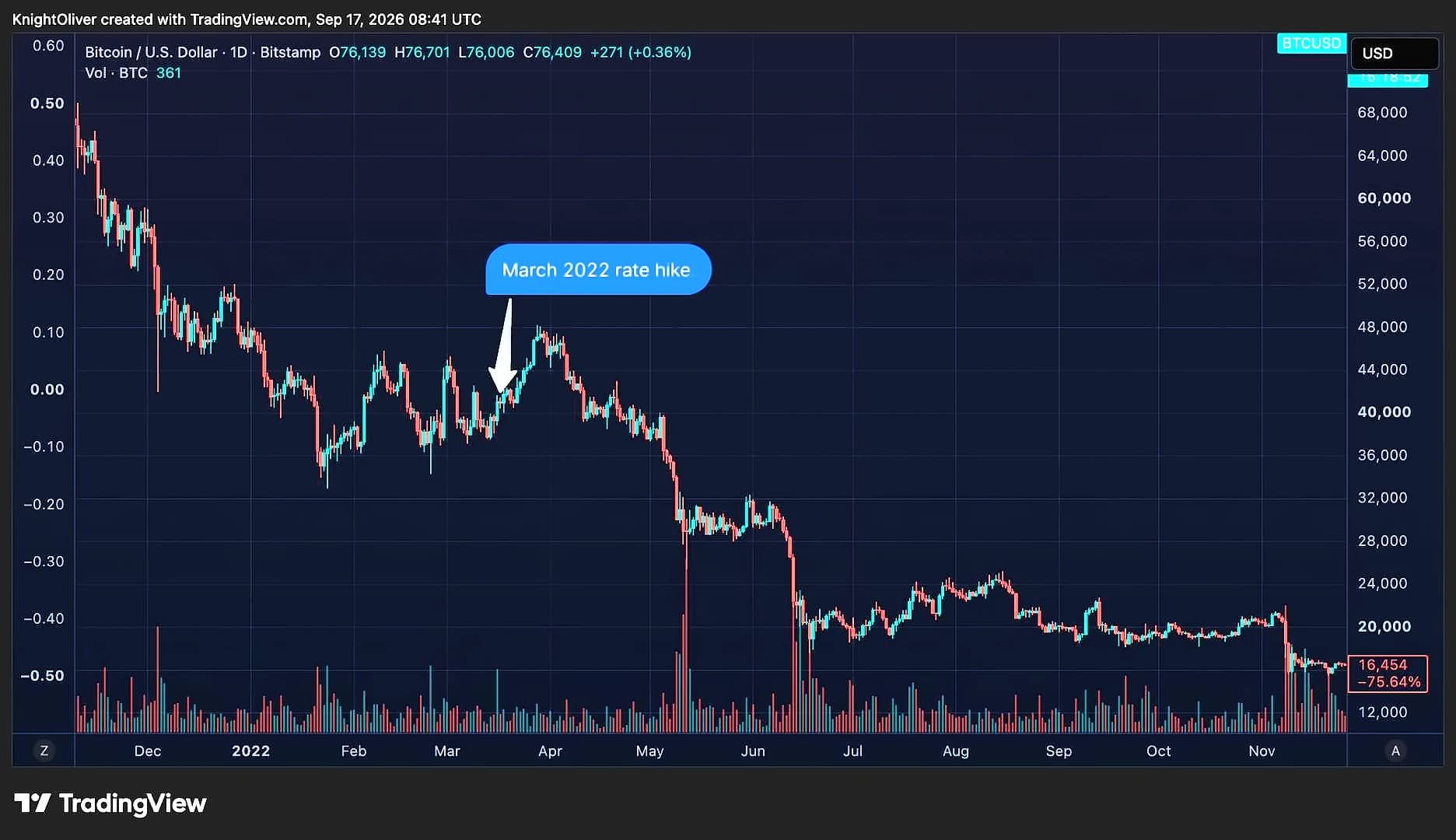
The Federal Reserve raised interest rates by 25 basis points to 3.75%-4.00% for the first time since 2023, creating a backdrop that has historically proved unfavorable for non-yielding Bitcoin and other tokens. According to The Economic Times, Bitcoin traded near $76,431 after the Fed delivered the hike, with Bitcoin and Ethereum ETFs seeing combined outflows of nearly $592 million in a single day. Prateek Gupta, Head of Business at Mudrex, noted that BTC initially rallied but gave up those gains as Fed Chair Kevin Warsh struck a hawkish tone, suggesting more tightening may follow. The rate hike, combined with inflation fears and soaring US bond yields, is expected to push Fed Chairman Kevin Warsh to raise rates, which could further damp demand for risk assets like Bitcoin. Over $540 million in bullish bets on cryptocurrencies were unwound in the last 24 hours, according to Coinglass data, while positioning in Bitcoin showed some resilience with roughly $1.7 billion in calls held at the $80,000 level across all maturities.
Bitcoin faced conflicting institutional signals following the CLARITY Act's failure in the U.S. Senate, with three major entities accumulating approximately $238 million in Bitcoin while Spot Bitcoin ETFs recorded $450 million in outflows. According to AMBCrypto, Morgan Stanley's MSBT acquired 123.21 Bitcoin worth $9.33 million through Coinbase Prime, with the fund recording net daily inflows without a single weekly outflow since September 4, 2026. BlackRock accumulated and withdrew 1,698.44 BTC worth $130.2 million, while MARA Holdings purchased another 1,292 BTC worth $98.64 million through FalconX. However, these concentrated purchases reflected concentrated conviction rather than a market-wide institutional return, as broader U.S. demand remained weak. As per The Economic Times, the global crypto market capitalisation was up 1.45% to $2.62 trillion, with Bitcoin up 0.74% and Ethereum up 1.44% in the past 24 hours, suggesting the market had largely priced in the Fed decision and was looking beyond the hike towards monetary policy trajectory.
The US Senate failed to advance the CLARITY Act on Tuesday, with the legislation failing its Senate cloture vote 50-49, effectively ending its chances of becoming law this year. According to Reuters, the legislation would address legal ambiguity around whether tokens qualify as securities or commodities. Industry executives expressed frustration over the failed vote, as it was meant to lend legitimacy to crypto as it further integrated into Wall Street. Ripple Labs CEO Brad Garlinghouse called for a post-mortem looking at why the bill failed, while Coinbase CEO Brian Armstrong said the industry could no longer wait on Congress. Both executives pointed to the Securities and Exchange Commission and the Commodity Futures Trading Commission as being able to offer a clear regulatory framework in the absence of legislation, though agency rules could prove easier for a future administration to change. As per The Economic Times, crypto policy saw a positive development, with a bill to codify Trump's Strategic Bitcoin Reserve advancing through a House committee as the CLARITY Act failed, offering some legislative progress despite regulatory setbacks.
US initial jobless claims fell to 196,000 in the week ending September 12, down from 206,000 the previous week, according to the U.S. Department of Labor. Economists had expected 207,000 claims, making the reading stronger than forecast and providing additional evidence for the Federal Reserve to maintain elevated interest rates. The four-week moving average declined to 203,250 from 206,000, indicating that employers are retaining workers despite elevated borrowing costs. Fed officials have less pressure to lower rates when job losses are limited, particularly while inflation remains above the central bank's 2% goal. The Fed's updated projections placed the median federal funds rate at 4.1% by the end of 2026, indicating that policymakers expect another quarter-point increase before the year closes. Goldman Sachs has revised its forecast to include another 25-basis-point increase this year, changing its call after Fed officials delivered mixed messages about whether more tightening would be required to return inflation to target.
Bitcoin initially rose about 1.25% to $76,800 following the jobless claims release before retreating toward $76,051, down roughly 1% from its earlier level, according to market data. Analyst Michaël van de Poppe identified $77,500 as the first important resistance area after Bitcoin bounced from approximately $75,584, with another resistance range between $80,500 and $81,200. Ted Pillows separately said Bitcoin was "just one god candle away from hitting a higher high," with the relevant higher-high area close to $82,000. A move through $77,500 would place Bitcoin closer to its 20-day moving average at $78,104 before the asset could test the heavier supply zone above $80,500. Failure to recover the first resistance level would keep attention on the recent support area around $75,584 and the liquidation concentration near $74,600. As per The Economic Times, crypto markets have moved into a recovery phase after a highly volatile Federal Reserve session, with Riya Sehgal, Research Analyst at Delta Exchange, noting that crypto has absorbed the initial hawkish Fed shock relatively well, but the market is still in a post-event stabilisation phase rather than a clear bullish breakout. The next directional signal will depend on whether Bitcoin and Ether can reclaim these nearby resistance zones while the dollar, bond yields and broader macro conditions remain firm.