US President Donald Trump announced Tuesday that the ceasefire with Iran would be extended at Pakistan's request, marking a significant shift from his earlier hardline stance. According to Reuters, a Pakistani source involved in the discussions said there was momentum for talks to recommence on Wednesday, with Trump potentially attending in person or virtually if a deal were to be signed. The source stated 'Things are moving forward and the talks are on track for tomorrow.' A US official speaking on condition of anonymity cautioned that Trump could change his mind on negotiating with Iran at any time, while declining to predict what would happen if the ceasefire expires without another meeting. Trump announced the extension on Truth Social, stating 'Based on the fact that the Government of Iran is seriously fractured, not unexpectedly so and, upon the request of Field Marshal Asim Munir, and Prime Minister Shehbaz Sharif, of Pakistan, we have been asked to hold our Attack on the Country of Iran until such time as their leaders and representatives can come up with a unified proposal.' However, Trump has not said how long the ceasefire will last, only that the United States would await a proposal before talks resume, leaving the original 10-day ceasefire set to expire Wednesday in uncertainty.
Iranian officials delivered a more conciliatory message Tuesday as the 10-day US-Iran ceasefire was set to expire Wednesday, but have now firmly rejected the proposed talks in Pakistan. According to Reuters, a senior Iranian official said Tehran was 'positively reviewing' its participation in talks, despite earlier ruling them out, but stressed no decision had been made. This represents a significant shift from earlier Iranian positions, with parliament speaker Mohammad Bagher Ghalibaf stating publicly that Tehran will not accept negotiations under conditions it considers coercive. The Iranian position has now hardened, with Iranian officials saying they would not attend talks in Pakistan, calling them a 'waste of time' because the United States was blocking a 'suitable agreement'. An Iranian official source told The New Arab that no decision had yet been taken to send a delegation, adding that Tehran's position on not participating in the Islamabad talks 'has not changed'. The rejection comes as the original ceasefire was set to expire Wednesday, creating a critical deadline for diplomatic progress.
The core Iranian complaint centers on the US naval blockade of Iranian ports, which was imposed on the same day the ceasefire was announced. According to Reuters, Iran's foreign ministry on Tuesday condemned the United States for what it called an attack on the Iranian commercial vessel Touska at the weekend, demanding the immediate release of the vessel, its crew and their families. The ministry stated 'Iran would use all its capabilities to defend its national interests and security and protect the rights and dignity of its citizens... the United States would bear full responsibility for any further escalation in the region.' Iranian Foreign Minister Abbas Araqchi had on Monday said truce violations by Washington were a major obstacle to the diplomatic process, while top negotiator Mohammad Baqer Qalibaf accused Trump on X of increasing pressure through a blockade of Iran's ports. He said Trump was deluded in seeking to 'turn the negotiating table into a table of submission,' adding Iran rejects negotiations under threat. Iran's mission to the UN said Tuesday it had sent a letter to the UN Security Council and the UN Secretary-General demanding 'a firm and unequivocal condemnation' of the US seizure, stating 'the seizure constitutes a grave breach of international law, a clear violation of the ceasefire, and an act of aggression marked by the hallmarks of piracy.'
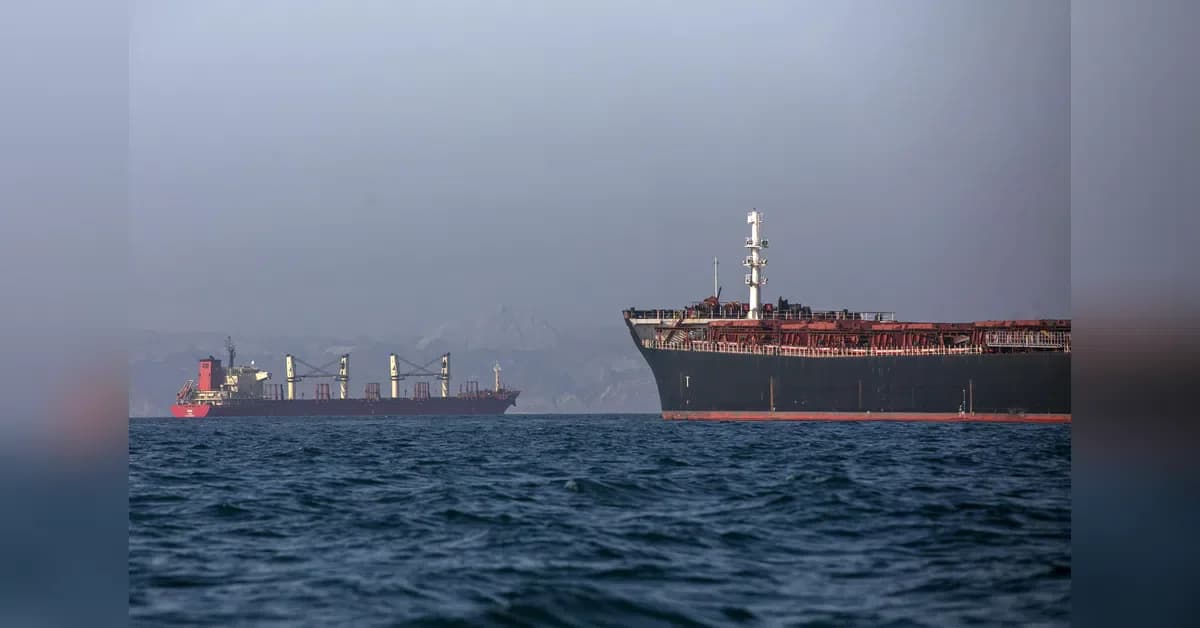
The Strait of Hormuz, which Iran briefly reopened before closing again after the Touska cargo ship seizure, remains effectively closed to normal traffic. As reported by crypto.news, Iran sent drones toward US military ships after the Touska was boarded by US forces, signaling that its military posture remains active. The USS Gerald R. Ford carrier operates in the Mediterranean while the USS Abraham Lincoln is in the north Arabian Sea, with a third carrier group expected in the region by month's end. Security in the Pakistani capital has been significantly tightened in anticipation of the high-level meetings, with nearly 20,000 security personnel deployed across Islamabad, officials said. A US official said Trump has options short of restarting airstrikes if negotiations fail. U.S. Central Command said Tuesday that since the start of the US blockade against ships entering or exiting Iranian ports, U.S. forces have directed 28 vessels to turn around or return to port. Iran's semi-official Tasnim news agency said Tuesday the Strait of Hormuz was again completely 'closed until further notice,' tightening restrictions it had previously eased on account of a 'recent attack by the US-Israeli enemy.'
The ceasefire hopes that lifted Bitcoin to $72,700 and pushed oil down 13% on April 8 are now at direct risk. According to Reuters, oil prices fell and stocks bounced back in early trading in Asia on Tuesday on expectation that U.S.-Iran peace talks will resume this week, after earlier meetings in Islamabad broke down without an agreement. Brent crude futures declined 54 cents, or 0.6%, to $94.94 a barrel and U.S. West Texas Intermediate for May fell $1.11, or 1.2%, to $88.50. However, oil prices had jumped around 6% in Monday trading on doubts over the talks, demonstrating the volatile nature of market expectations. The oil price channel into inflation expectations, Fed rate policy, and risk asset positioning means that the outcome of Wednesday's deadline is the single largest near-term variable for Bitcoin and the broader crypto market. Trump has taken a hard line ahead of the deadline, saying it was 'highly unlikely' the ceasefire would be extended in the absence of a deal, while adding that Washington would maintain its blockade of Iranian ports in the Strait of Hormuz. China, the main buyer of Iranian crude, has expressed concern over the 'forced interception' of the Touska vessel, highlighting the global economic implications of the ongoing tensions.