Royal Enfield's FY27 performance tells a compelling story of strategic product expansion and market dominance. The company achieved its highest-ever monthly sales in September 2026, dispatching 1,33,958 motorcycles—an 8% year-on-year increase. This milestone capped a remarkable first half, with year-to-date sales reaching 7,09,096 units, up 20% from the same period in FY26. The growth wasn't just about volume; it reflected a sophisticated multi-tier strategy spanning premium ICE motorcycles and electric mobility, all designed to capture value across the premiumization spectrum while hedging against the electric transition.
Product Interventions Driving Domestic Growth
The 7% YoY domestic growth to 1,21,326 units in September 2026 stemmed from precise product interventions. The below-350cc segment, including EVs, surged 13% to 1,21,495 units, contributing approximately 90.70% of total monthly sales. This growth was powered by the J-Series platform—Classic, Bullet, Hunter, and Meteor—which grew at 34% year-over-year in Q1 FY27, outperforming the industry. The company implemented a 1.75% price increase on majority of 350cc motorcycles in April 2026, recovering approximately 50% of commodity inflation while maintaining demand elasticity. Premium variant launches like the Guerrilla 450 APEX and Hunter 350 Base Premium drove value perception, while accessories penetration increased from 35-40% initially to nearly 87%, creating transaction-level premiumization beyond ex-showroom prices. Transcript
Himalayan 440: Strategic Market Positioning
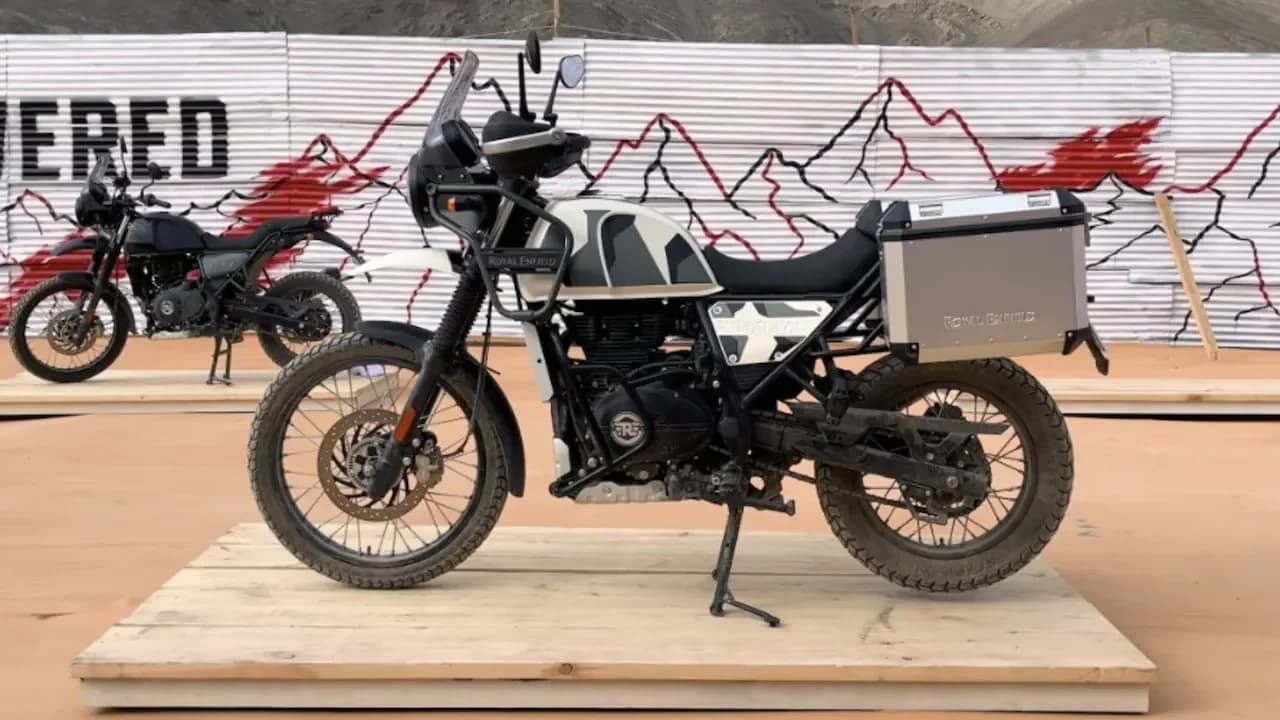
The Himalayan 440 launch at Rs 2.29 lakh represented a masterstroke in competitive positioning. Celebrating the 10-year anniversary of the Himalayan nameplate, the motorcycle filled a crucial gap between the Scram 440 (Rs 2.32 lakh) and Himalayan 450 (Rs 3.06-3.08 lakh), offering a substantial price advantage of approximately Rs 77,000-79,000 over the more powerful variant. The 443cc engine producing 25.4 bhp and 34 Nm torque, combined with a 21-inch front wheel and 200mm front suspension travel, created a compelling value proposition for adventure enthusiasts. The response was overwhelming—the model is fully booked for six months. Against the Suzuki V-Strom SX (priced at Rs 2.01-2.04 lakh), the Himalayan 440 offers 78% larger engine displacement and 53% more torque, justifying its premium through superior off-road capability and heritage appeal.
Festive Season Momentum and Anniversary Appeal
September 2026's record performance coincided with strategic festive season preparation. Management had been building inventory ahead of the festive period, with a new capacity module coming online in late July 2026. The company was running three shifts across Oragadam and Vallam facilities since April 2026, achieving a daily production rate of 5,000+ units. The 10-year anniversary edition of the Himalayan nameplate, featuring commemorative badging, generated emotional connection and nostalgic appeal. This heritage-driven marketing, combined with positive customer sentiment and a strong booking pipeline across networks, created perfect storm conditions. Historical patterns supported this momentum—FY26 witnessed the strongest festive season in company's history with 26% growth, and retail volumes grew nearly 26% during the festival season, much higher than market growth. Transcript
Export Performance: Divergence and Recovery
This divergence reflected regional market-specific challenges in earlier months, particularly in Europe (market adjustment phase with preregistered OBD2B vehicles delaying fresh billing) and Thailand (tourism dip and economic issues), offset by strong recovery momentum in September. Brazil emerged as the largest and fastest-growing international market, with 71% growth in FY26 and every fourth motorcycle exported now shipped to Brazil. The US market showed "some green shoots of growth" in Q1 FY27 with a new trade deal cutting tariffs on motorcycles. The sequential improvement pattern—April 2026 exports down 14.42% YoY to 9,035 units, culminating in September's 17% growth—indicated progressive recovery through H1 FY27. Transcript
Flying Flea C6: Transforming Export Mix
The Flying Flea C6's entry into five European cities (Paris, Barcelona, Rome, Berlin, London) represents a transformative opportunity for Royal Enfield's export mix. Priced at €5,990 in Europe and £5,300 in the UK, compared to the India launch price of ₹2.79 lakh, the European pricing represents approximately 100% premium. This high-margin positioning introduces electric motorcycles to the export portfolio while establishing brand equity in premium European markets. The motorcycle features a 3.91 kWh lithium-ion battery with 104 km WMTC range, 15.4 kW peak power, and 60 Nm maximum torque. The city-by-city rollout strategy allows controlled expansion and infrastructure buildup. While near-term volume contributions will likely remain modest, establishing an early premium electric footprint in key European capitals helps hedge against rapid global shifts toward electric mobility. The premium pricing suggests significant per-unit margin expansion potential as volumes scale.
Premiumization Through Classic 350 Signature White
The Classic 350 Signature White at Rs 2,24,275 exemplifies Royal Enfield's premiumization playbook. Positioned at the top of the Classic 350 range alongside the Emerald Green Edition, it features premium brown touring seats, Tripper Pod navigation system, Assist and Slipper Clutch, adjustable clutch and brake levers, and USB Type-C fast charging. This represents approximately Rs 37,000 premium over the Redditch variant (Rs 1.87 lakh) and Rs 10,000 premium over mid-range Heritage variants. The price premium enables margin expansion through multiple levers: value engineering on the established J-Series platform (4 years of scale delivering 0.4% benefit in Q1 FY27), operating leverage from volume growth, and feature costs more than offset by the price premium commanded. The variant contributes to mix improvement and drives accessories attachment rates, which have reached 87% penetration. Transcript
Dual-Track Strategy: ICE and EV Expansion
Royal Enfield's simultaneous expansion into premium ICE segments and electric vehicles reflects a sophisticated hedging strategy.
The Flying Flea represents a long-term strategic bet on electric mobility with a phased, measured rollout allowing learning without disrupting core business. This dual-track strategy mitigates technology transition risk, market segment risk, and competitive threat risk while maintaining disciplined capital allocation.
The approach balances immediate profitability from ICE dominance with transition readiness through EV presence. Transcript
Competitive Positioning and Market Share
Royal Enfield's multi-tier product strategy creates formidable competitive advantages.
In the domestic market, Royal Enfield's share of >125cc motorcycles grew from 15.5% in FY15 to 31% in FY26, with domestic motorcycle share reaching 13% in the same period. The middleweight segment in India grew from 70,000 units/month in 2022-23 to approximately 1.1-1.2 lakh units/month currently, with Royal Enfield's monthly volume growing from 61,000 units to about 1.01 lakh units—outgrowing the category growth rate. Against Suzuki and other manufacturers, Royal Enfield's platform breadth across three core platforms (J-Series 350cc, Sherpa 450cc, 650cc), brand heritage, and market development philosophy (growing the middleweight segment from sub-50,000 units to nearly 1 million units over 15 years) create significant entry barriers. Transcript
H1 FY27 Performance and Growth Drivers
The 20% YoY growth in YTD sales to 7,09,096 units in April-September 2026 was driven by exceptional domestic momentum. Domestic sales grew 23.11% to 6,42,021 units, which more than offset the 4.75% decline in exports to 67,075 units. The below-350cc segment surged 24.47% to 6,34,312 units, while models above 350cc declined 9.12% to 74,784 units. Key growth drivers included structural premiumization trends, GST-related price benefits (Royal Enfield demonstrated maximum demand elasticity among 2-wheeler brands), strong demand funnel indicators (walk-ins, telephone inquiries, and bookings growing at rates higher than volume growth), and allied business growth (service job cards growing 20% to 9 lakh per month, accessories and apparel growing 30%). The company's focus shifted from demand stimulation to demand fulfillment through capacity ramp-up. Transcript
Festive Season Outlook and Capacity Expansion
Following record September 2026 dispatches, Royal Enfield enters the festive season with comprehensive preparations. The company is operating with lean inventory levels of 10-12 days at dealers, described as "challenging but manageable". Capacity expansion is well underway: the first module of 500 units/day expansion kicked in late July 2026, taking production to 5,000-5,100 units per day, with the next module scheduled for early October 2026. The brownfield expansion at Cheyyar will increase capacity from current 1.5 million to 2 million by FY27-28, while a greenfield expansion in Andhra Pradesh (approved at INR 1,225 crores) will take total capacity to 2.45 million by 2029-30. Supply chain readiness includes vendor planning for 24/7 operations on a 3-shift basis and logistics optimization through direct billing to dealers (increased from 1-1.5% to 4.5-4.7% of overall volume, expected to save another 4-5 days). Management anticipates the classic "two halves" storyline in the automotive industry due to festive and non-festive periods, but remains confident of continued growth due to exceptionally healthy inquiries, bookings, and overall funnel metrics. Transcript
Royal Enfield's FY27 story is one of strategic precision—balancing near-term profitability from ICE dominance with long-term transition readiness through EV presence, leveraging premiumization to drive margins while maintaining volume growth, and executing operational excellence to meet robust demand. The company's multi-tier product strategy, combined with its overwhelming brand advantages and comprehensive festive season preparations, positions it well to sustain market leadership and navigate the evolving competitive landscape.