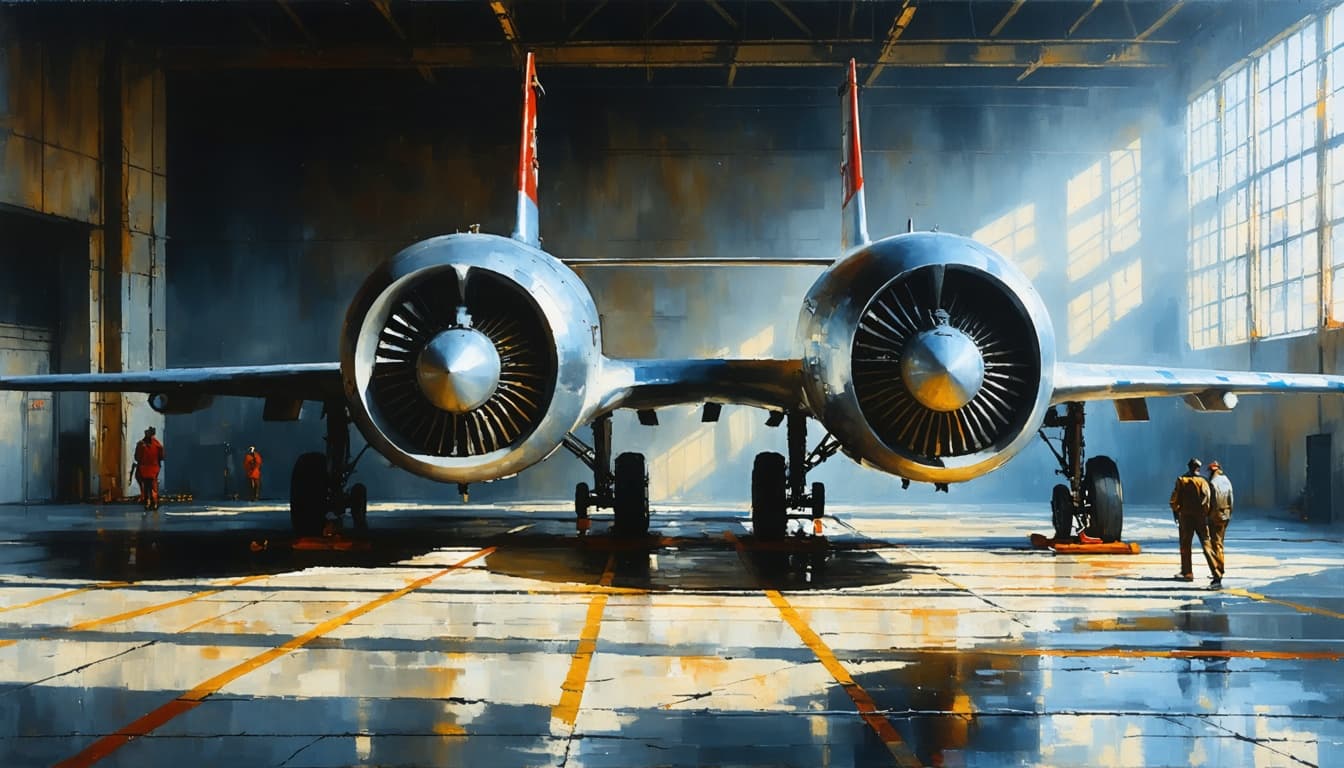
On August 14, 2026, Reliance Industries Limited and Rolls-Royce announced their strategic intent to partner on developing an indigenous combat engine for India's Advanced Medium Combat Aircraft (AMCA) programme. This move marks Reliance's calculated entry into high-tech defense manufacturing, driven by India's Atmanirbhar Bharat vision and a defense budget allocation of ₹7.84 lakh crore for 2026-27, with capital expenditure rising 21.84% to over ₹2.19 lakh crore. For Reliance, this diversification reduces dependence on cyclical energy and consumer sectors while aligning with national priorities. The company's strong financial position—cash flow from operations of ₹1,92,113 crore and a net cash balance of ₹1,45,977 crore—provides the capacity to absorb this strategic pivot. However, it introduces new risks: high R&D intensity, long payback periods, and regulatory complexities typical of defense programs. AnnualReports
For Rolls-Royce, this partnership addresses a critical gap. India's Aircraft and Aero Engines allocation alone reached Rs 63,733.94 crore for 2026-27, representing a massive procurement opportunity. By partnering with Reliance, Rolls-Royce gains a powerful local industrial ally, enhancing its competitive positioning against rivals like Safran, who is also vying for the AMCA engine contract. The collaboration offers Rolls-Royce a pathway to secure a foothold in one of the world's fastest-growing defense markets while leveraging Reliance's execution capabilities and manufacturing scale.
Competitive Advantages Over Foreign Suppliers
The Reliance-Rolls-Royce collaboration presents several compelling advantages over traditional foreign supplier models. Unlike simple licensing arrangements, this partnership proposes 100% technology and intellectual property transfer that stays with India, along with design authority—the ability to independently certify, improve, and develop derivative engines without foreign approval. This addresses India's core strategic requirement: eliminating every "golden screw" or single foreign-controlled component that could hold the program hostage.
Furthermore, the partnership aims to build sovereign, end-to-end Indian capabilities across design, development, manufacturing, testing, production, and through-life support. This comprehensive ecosystem approach contrasts sharply with competitors who might offer assembly or component manufacturing without full technology sovereignty. Rolls-Royce's proposal includes developing the engine in India with complete IP ownership, a significant differentiator in a market where technology transfer restrictions have historically been a major hurdle. Others
Financial Commitment and Returns
Establishing the proposed Aerospace Gas Turbine Complex will require substantial capital investment, estimated between ₹8,000-10,000 crore over 7-10 years. This represents 2-3% of Reliance's annual capex during peak investment years, a manageable increase given the company's strong cash generation. The investment will be phased, with ₹3,500-5,000 crore in the initial 3-year foundation phase, followed by ₹4,000-6,000 crore in development and testing. AnnualReports +1
This allocation will temporarily reduce free cash flow by ₹2,000-3,000 crore annually during peak investment years but is expected to recover as revenue generation begins. The return on capital employed (ROCE) may see dilution of 1-3 percentage points in the first five years but could enhance long-term returns as high-margin MRO and support contracts come online. Defense aerospace typically generates 15-25% ROCE for established players, and with Reliance's operational excellence, 18-22% ROCE is achievable over time.
The partnership structure will likely follow a hybrid model where Rolls-Royce leads technology development (60-70% contribution) while Reliance leads manufacturing and infrastructure (70-80% contribution), with overall investment roughly balanced at 50-50. This structure distributes risks appropriately: technology risk primarily with Rolls-Royce, execution risk with Reliance, and market risk shared based on equity stakes.
Revenue projections are substantial.
Long-term MRO contracts could add another ₹1,500-2,500 crore annually with 20-25% margins, creating recurring revenue streams that extend over 20-30 years per engine fleet.
Technology Transfer and Capability Building
The technology transfer from Rolls-Royce to Reliance represents a transformative opportunity to accelerate India's learning curve by 15-20 years compared to independent development. Rolls-Royce has proposed comprehensive transfer covering critical technologies including special coatings, single-crystal turbine blade casting, nozzle guide vane manufacturing, blisk machining, and advanced materials like ceramic matrix composites.
To achieve end-to-end domestic capability, Reliance must develop expertise across several technical domains. In design, this includes 3D computational fluid dynamics modeling, finite element analysis, and multi-disciplinary design optimization. Testing capabilities must include high-altitude test facilities, sea-level test beds, and specialized component test rigs. Manufacturing requires advanced multi-axis CNC machining, additive manufacturing for 75% of jet engine parts, single-crystal casting, and sophisticated quality control systems.
The proposed Aerospace Gas Turbine Complex will serve as a centre of excellence, providing immediate access to world-class infrastructure and enabling parallel capability development across multiple tracks. This facility-based approach allows Reliance to skip development stages, avoid historical mistakes, and implement latest design and manufacturing methodologies immediately. The learning curve acceleration is significant: while independent development might take 15-20 years with 30-40% success probability, the partnership approach targets 7-10 years with 75-85% success probability.
Policy Alignment and Regulatory Pathway
The partnership demonstrates exceptional alignment with India's Atmanirbhar Bharat initiative and defense procurement policies. It directly supports the government's target of achieving 70% self-reliance in weaponry by 2027 and aligns with the Defence Acquisition Procedure 2020's highest priority category—Buy (Indian-IDDM)—which favors indigenously designed, developed, and manufactured products. AnnualReports
However, the partnership faces a multi-layered regulatory approval process. The Defence Acquisition Council must grant Acceptance of Necessity, followed by Cabinet Committee on Security approval for the final contract. DRDO's Gas Turbine Research Establishment will provide technical oversight, while the Centre for Military Airworthiness & Certification must certify the engine for airworthiness. This process typically takes 18-36 months for major defense programs, adding significant timeline uncertainty.
India's strategic autonomy requirements and FDI policies will significantly influence the ownership structure. Current regulations permit up to 74% FDI through the automatic route and 100% through the government route for defense manufacturing, but with complex security clearance requirements. The draft DAP 2025/26 emphasizes technological ownership over mere manufacturing location, requiring Indian control of intellectual property, design authority, and upgrade pathways. This suggests an optimal structure with 51-74% Indian ownership, ensuring Reliance maintains control while Rolls-Royce contributes as a strategic technology partner.
Execution Risks and Historical Context
The partnership faces substantial execution risks rooted in India's historical challenges with fighter aircraft engine programs. The Kaveri engine program, initiated in 1989 with an initial budget of ₹382 crore and expected completion in eight years, encountered severe technical failures, cost overruns exceeding ₹20 billion, and timeline extensions beyond 35 years without achieving operational status. The engine produced only 70-72 kN of thrust against the required 83-85 kN, remained 150 kg overweight, and faced persistent challenges with turbine blade durability and high-altitude operation.
The absence of a finalized joint venture or engine contract creates additional timeline uncertainties. Currently existing as "strategic intent" rather than a binding agreement, the partnership could face 6-12 months in partnership structure negotiations, 12-18 months in technology transfer terms agreement, and 12-24 months in regulatory approvals. This could delay the Aerospace Gas Turbine Complex establishment by 30-33 months compared to a finalized contract scenario.
Technical challenges are equally formidable. Fifth-generation fighter engines require mastery of high-temperature metallurgy, single-crystal turbine blades, advanced compressor design, and supercruise capability—technologies where even established nations have taken decades to achieve proficiency. The partnership must also navigate India's limited testing infrastructure, particularly the lack of dedicated high-altitude engine testing facilities that forced the Kaveri program to conduct testing in Russia.
Expansion Beyond AMCA: Ecosystem Opportunities
Despite these challenges, the Aerospace Gas Turbine Complex represents a platform with substantial expansion potential beyond the AMCA program. India's civil aviation market is expected to grow from USD 16.53 billion in 2026 to USD 28.96 billion by 2031 at 11.86% CAGR, with turbofan engines representing 70.65% of the market. This creates significant opportunities in commercial engine MRO, component manufacturing, and sustainable aviation fuel integration.
The partnership can also expand into broader defense propulsion applications including naval gas turbines, unmanned systems propulsion, helicopter engines, and missile propulsion systems. The global aerospace and defense propulsion system market, where air-breathing gas turbine engines hold dominant revenue share, presents substantial export opportunities.
Perhaps most significantly, the partnership will create ancillary opportunities across India's defense and aerospace supply chain. With approximately 14,000 defense production-associated MSMEs and 329 defense startups already operating in India, the partnership can catalyze ecosystem development through the Defense Industrial Corridors in Uttar Pradesh and Tamil Nadu, which have attracted combined investment commitments of over ₹74,000 crore. DRDO's technology transfer programs, which have developed a pool of 2,000 industries and offer zero ToT fee for qualified partners, provide additional mechanisms for supply chain development.
The long-term vision is ambitious: establishing India as a global hub for aerospace propulsion systems, generating ₹15,000-25,000 crore annually by 2035, creating 25,000-35,000 direct high-skill jobs, and achieving strategic autonomy in critical defense technologies. Success will depend on effective execution, sustained investment, and the ability to navigate the complex intersection of technology transfer, regulatory compliance, and geopolitical considerations that defines the modern defense aerospace industry.