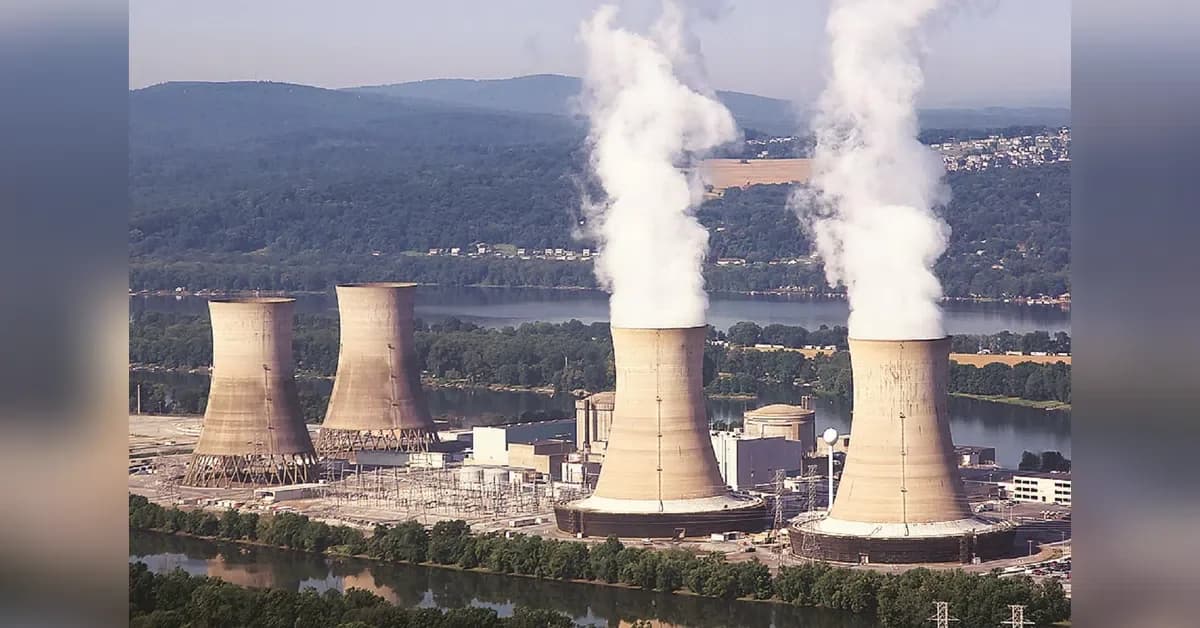
A 20-member US nuclear delegation held discussions with NTPC Limited, India's largest power generation company, on Tuesday to explore opportunities in the civil nuclear sector. According to reports from Business Standard, the meeting was conducted as part of the ongoing United States Nuclear Executive Mission to India, with the US-India Strategic Partnership Forum (USISPF) and the Nuclear Energy Institute (NEI) leading the discussions. The visiting delegation met with K Shanmugha Sundaram, director (Projects), NTPC, along with senior leadership from *NTPC-Parmanu Urja Nigam Limited (NPUNL)**. As reported by US-India Strategic Partnership Forum (USISPF), "The goal is to understand how American and Indian companies can further collaborate to support project development, strengthen supply chains, and build long-term commercial partnerships."
NEI CEO Maria Korsnick highlighted the US's advanced reactor technologies during the discussions, stating that "the innovation in commercial nuclear power in the United States is absolutely amazing." She noted that "for many years, we have had lightwater technology. Now, we also have advanced reactors, high-temperature gas reactors and molten salt reactors." Korsnick emphasized that "it is really up to India -- what it wants and what it is interested in so that we can form partnerships," adding that the industry wants to work with the Indian commercial nuclear sector and government to build nuclear reactors in the country. She noted that "before, it was just about large reactors, and now, here are large, medium and small reactors with many different opportunities to work together." The delegation is also exploring small modular reactors (SMRs) which are billed as the future of nuclear power due to ease of deployment, particularly by repurposing sites of coal-based power plants. As per Devdiscourse, this marks the first visit by NEI representatives to India since 2006, with Korsnick noting that "Twenty years ago, we came to India for a trade mission. However, it did not take off due to nuclear liability concerns, which were different in India compared to other countries."
The SHANTI Act of 2025 has significantly boosted opportunities for US commercial nuclear companies to collaborate with India, according to Korsnick's statements to PTI. She explained that "the SHANTI Act has given us an opening to create a relationship between the US industry and the Indian industry." The SHANTI Act replaced the Atomic Energy Act of 1964 and the Civil Liability for Nuclear Damage (CNLD) Act of 2010, with the CNLD Act having tougher liability provisions on nuclear suppliers which global companies found to be an impediment to exploring the Indian market. Shaswat Kumar, Fellow at Centre for Strategic and International Studies, noted that "India's ambition to scale nuclear capacity to 100 GW by 2047, combined with the opening of the sector to private players, presents a major commercial opportunity for US firms." Recent 10 CFR Part 810 authorisations to Holtec, Clean Core Thorium and Flowserve signal renewed momentum in bilateral nuclear cooperation. As per Devdiscourse, Korsnick added that "It is really a new day for the nuclear sector."
The 20-member US nuclear delegation is visiting New Delhi and Mumbai from May 18 to 21, according to Business Standard reports. On Day 1 of the visit, Power Minister Manohar Lal and Minister of State (Independent Charge) for Science and Technology and Minister of State in the DAE Jitendra Singh met representatives of USISPF and NEI. The delegation will meet Maharashtra Chief Minister Devendra Fadnavis, officials from the Department of Nuclear Energy (DAE), Nuclear Power Corporation of India Limited, and leaders from private sector companies during their visit. The team will also understand how state governments can support nuclear projects and build manufacturing partnerships at the local level. On Monday, the delegation met Union Ministers Manohar Lal Khattar and Jitendra Singh and discussed expanding the scope of India-US cooperation in clean energy and critical technologies. As per Devdiscourse, the delegation also includes companies' representatives from across the nuclear energy value chain.
India has set a target of producing 100 GW nuclear power by 2047, a significant rise from the present installed capacity of nearly 9 GW, aimed at reducing dependency on fossil fuels and achieving India's long-term target of net zero carbon emissions by 2070. After the India-US civil nuclear agreement was signed in 2008, two sites -- Chhayamithi Virdi in Gujarat and Kovvada in Andhra Pradesh -- were allotted to US companies to establish 1,000 MW nuclear power plants. Private sector players such as Tata Consulting Engineers, Adani Group, Larsen & Toubro among others have evinced interest in the civil nuclear sector. NTPC has established a joint venture with Nuclear Power Corporation of India Limited (NPCIL) to build at least six power plants at Mahi Banswara in Rajasthan and Chutka in Madhya Pradesh. India and the US are also exploring cooperation in nuclear fusion technologies in addition to the International Thermonuclear Experimental Reactor that is being developed at Cadarache in France.