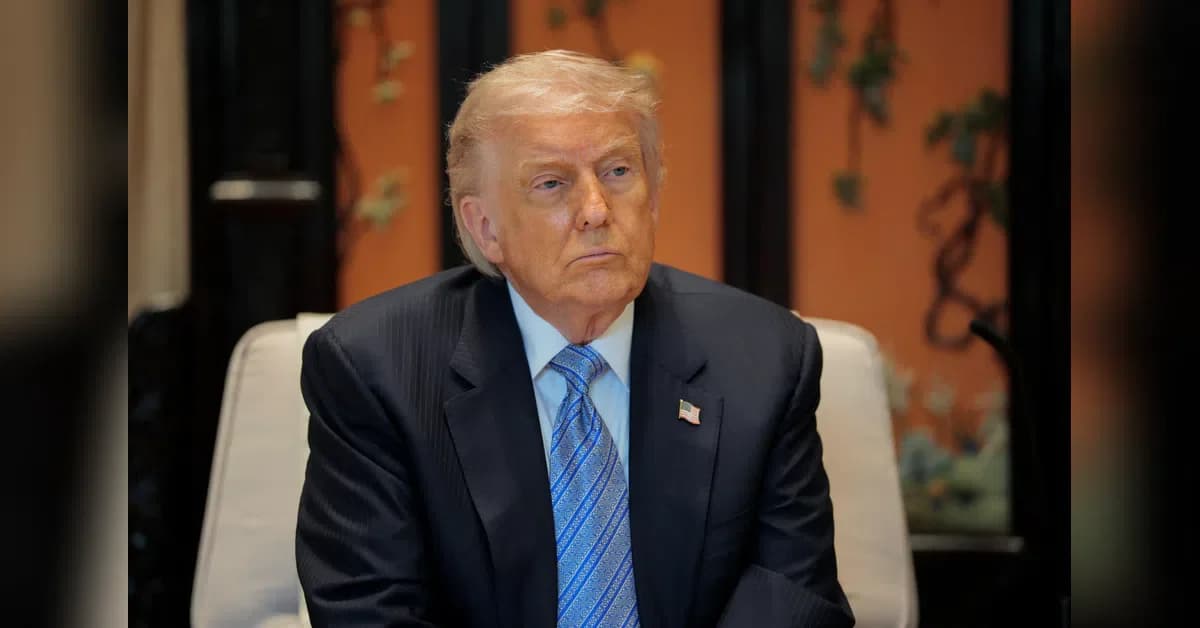
Oil prices have risen more than 2% on Tuesday as President Donald Trump escalated his demands regarding the Strait of Hormuz, threatening to declare the strategic waterway 'a territory of the United States' after defeating Iran. Speaking at an event in New York on Friday, Trump said 'After we finish defeating Iran, which is being very badly defeated, pretty soon I'll be declaring the Hormuz Strait a territory of the United States.' The President had earlier claimed that the US exercised 'total control' over the Strait of Hormuz and that he 'will keep it' amid stalled negotiations with Iran regarding the reopening of the strategic route. Trump asserted that 'The USA has total control over the Strait of Hormuz. I THINK WE WILL KEEP IT! Our Naval Blockade is being called, by everyone, 'A WALL OF STEEL,' and there is nothing Iran can do about it.' The remarks come as control of the Strait of Hormuz has emerged as one of the biggest sticking points in negotiations between Washington and Tehran.
The United Kingdom Maritime Trade Operations (UKMTO) reported an incident involving a tanker and military forces in the Gulf of Oman at 0715 UTC on August 11. According to UKMTO's advisory, the incident was reported by the vessel's master but did not provide further details on the nature of the incident or identify the tanker or military forces involved. Authorities were aware of the incident and relevant investigations were ongoing, with UKMTO advising vessels to consider the latest maritime security information and maintain awareness of the evolving operational environment. The incident comes amid heightened maritime security concerns in the Gulf region, with vessels operating in the area being advised to closely monitor developments.
Iran has firmly rejected Trump's claims about the Strait of Hormuz, with the Persian Gulf Strait Authority stating that Trump's claims and repeated statements by US officials that the Strait of Hormuz was no longer blocked do not change the reality. The PGSA emphasized that 'the Strait of Hormuz remains blocked and will not be reopened until Iran's conditions are accepted.' This rejection comes as both countries continue to stake claims of control over the strategic waterway amid ongoing tensions. The current escalation has already prompted expanded naval patrols, adjustments to shipping routes by commercial carriers, and renewed international calls for diplomatic restraint.
The Hormuz Strait continues to face significant disruptions despite ongoing oil flows, with only five vessels transiting through the passage – significantly lower than its daily average of 14 that it had recovered after the signing of the MoU in June, according to Amrita Sen, Founder and Director of Market Intelligence at Energy Aspects. However, Iraq's state oil marketing company's oil shipments are around 2 million barrels a day in August, as reported by ING Think's Warren Patterson and Ewa Manthey. This represents a substantial reduction from Iraq's pre-war exports of around 3.4 million barrels of oil a day through the Strait of Hormuz. The UAE's ADNOC said on Friday that 15 of its vessels had come under attack while transiting the Strait of Hormuz since the conflict began. The risks around both the Strait of Hormuz and the Bab el-Mandeb remain significant, with even temporary restrictions or the threat of further attacks keeping insurance costs high and forcing ships to take longer routes, which is likely to keep energy flows constrained in the near term.
'Donald Trump and Iran are both making demands that they know full well the other side will and cannot agree to,' said Ole Hansen, head of commodity strategy at Saxo Bank, as reported by Bloomberg. 'That basically points to a prolonged shutdown during which it makes little sense to trade the oil market with a short bias.' Current rhetoric suggests any potential deal between the US and Iran remains 'some way off,' meaning risks remain skewed to the upside for oil prices. Oil continues to move through the Strait of Hormuz even as disruptions persist, underscoring the market's ability to keep flows moving despite periodic turbulence. The latest uptick in fuel costs raises the stakes for the US July consumer price index report due Wednesday, where expectations are for a monthly rise of 0.1% in the headline reading and 0.2% for the core measure. Further insights into global market conditions will come later Tuesday from the US Energy Information Administration, which is scheduled to issue its monthly Short-Term Energy Outlook, with commercial crude inventories in the country hitting the lowest level since 2018 last month.