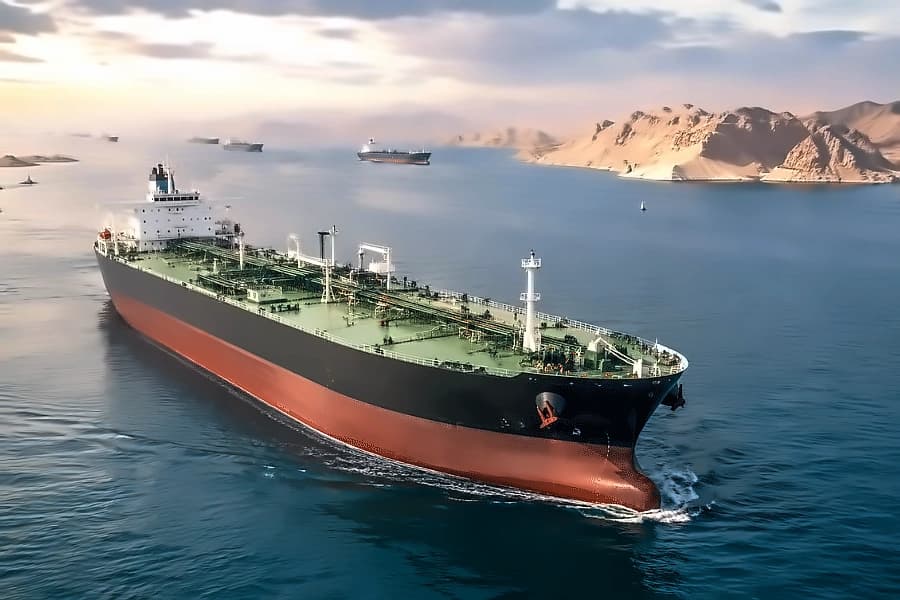
Iran has claimed responsibility for targeting 10 vessels near the Strait of Hormuz after the United States destroyed five Iranian oil tankers, marking the biggest attacks on shipping by both nations since their six-month-old conflict began. The Islamic Revolutionary Guard Corps warned that it would intensify its response if further attacks take place, as reported by The Economic Times. Traffic through the Strait of Hormuz remains far below pre-war levels, with the key waterway carrying roughly a fifth of the world's oil and gas supplies before the conflict began. The U.S. Energy Information Administration raised its oil price forecasts for this year and next on Wednesday, citing falling global stockpiles as Middle Eastern supply remains disrupted.
US President Donald Trump warned the U.S. may hit Iran's Pickaxe Mountain, located near its heavily damaged Natanz uranium enrichment facility, and said the war would end after the November midterm elections. Brent crude futures rose $1.05, or 1%, to $108.68 a barrel by 0045 GMT, while U.S. West Texas Intermediate crude rose 95 cents, also 1%, to $103.45 a barrel, as reported by The Economic Times. Both benchmarks rose over 6% on Thursday and are on track to end the week at over $100 a barrel for the first time since mid-May. On a weekly basis, the benchmarks were trading nearly 13% higher - the steepest gain since the week ended July 17. "With events spiralling and Iran showing it is willing to stretch this conflict as wide and as long as it can, it is becoming increasingly likely that WTI crude will retest the $119.48 high from early March," IG analyst Tony Sycamore said. The U.S. national average price of diesel surpassed $6 a gallon for the first time ever on Thursday, according to price tracker GasBuddy, as the U.S.-Iran war and Ukrainian attacks on Russia's refineries have squeezed supply.
Crude oil prices surged above $100 per barrel on Thursday as traders evaluated the risks associated with supply disruptions stemming from recent shipping attacks. Brent crude moved above $100 a barrel, as traders assessed the risk of a deeper supply disruption following the biggest attacks on shipping by Iran and the United States since their six-month-old conflict began. Brent prices have climbed more than 20% since early August as hopes for a permanent resolution to the six-month-old conflict faded and fighting intensified across the region. Both benchmarks remained in technically overbought territory, with Brent's previous close being its highest since July 23 for a second consecutive session, while WTI settled at its highest level since June 4. Goldman Sachs warns that oil could climb as high as $120 a barrel if shipping attacks broaden and intensify, with Daan Struyven, Goldman's co-head of global commodities research, saying the $120 level is possible.
The latest price surge came after Iran-backed Houthi forces in Yemen attacked four cities in southern Saudi Arabia on Tuesday, leaving 73 people injured and setting oil installations on fire. Reports suggest Saudi warplanes carried out airstrikes in Yemen's Jubah district, east of the capital Sanaa, and in Taiz province in the southwest. Iran's Revolutionary Guards said they had attacked two US destroyers and a US base in Jordan's Al Azraq with ballistic missiles in retaliation for US attacks on Iranian oil tankers. Jordan's air-defence systems intercepted 18 of 20 ballistic missiles launched from Iran, while two landed in unpopulated areas, with no casualties reported, according to state media citing the military. US Secretary of State Marco Rubio warned Iran that Washington would continue striking Iranian oil tankers in retaliation for attacks on US warships, telling reporters during a visit to Colombia that "Iran continues to attempt attacks on US naval ships and for every time they do that or try to do that they're going to lose tankers."
Analysts said the rally's durability will hinge on China, the world's largest crude importer. If China continues to buy, it could amplify the impact of supply disruptions and drive prices higher, according to The Economic Times. OPEC lowered its forecast for world oil demand growth in 2026 to 380,000 barrels per day, marking the fifth straight downward revision. OPEC oil output fell by 640,000 bpd in August, a Reuters survey found. The Houthi grip on Yemen's Mocha port poses risks to Red Sea transport, while tankers in the Strait of Hormuz face threats that limit vessels in the Gulf. Attacks from Yemen on Saudi energy facilities marked an escalation beyond Iran and the Strait of Hormuz, and raised fears of prolonged disruptions in the broader region, analysts say.
The US announced 36 Iran-related sanctions on Tuesday, targeting the country's aviation sector and related companies as part of President Trump's "Operation Economic Outcast." The White House has described the campaign as an effort to cut off Iran's remaining economic lifelines. The US Treasury Department said the latest measures targeted Iran's aviation industry, including Mahan Air, which is already subject to US and EU sanctions. The Treasury's Office of Foreign Assets Control also suspended three Iran-related aviation authorisations that had allowed non-US airlines to operate US-origin or US-controlled commercial aircraft into Iran. US officials said the measures were intended to further restrict the financial channels available to Tehran, adding another layer of economic pressure beyond the ongoing military escalation.