Iran has escalated its threats against the US and its allies, with Supreme National Security Council Secretary Mohsen Rezaei warning that "not a single drop of oil will be exported" if economic warfare continues. As per Reuters, Rezaei stated that "If the economic war continues, not a single drop of oil will be exported, neither through the Strait of Hormuz nor from anywhere in the Persian Gulf." He further warned that "Iran will regard any country's participation in or support for America's economic war against the Iranian people as an act of war." These threats came hours before US Treasury Secretary Scott Bessent unveiled what Washington has called an 'economic D-Day' against Tehran. Bessent posted on X that "President Trump has dismantled Iran's military capabilities, destroyed nearly 100% of its military factories, and buried its nuclear program."
US Treasury Secretary Scott Bessent announced on Sunday that the Trump administration is entering the "endgame" in its campaign against Iran, unveiling what he called an "economic D-Day" aimed at severing Iran's economic lifelines. As per Business Standard, Bessent stated that "We are now entering the endgame. At dawn begins an economic D-Day -- the single greatest financial offensive ever marshaled against an adversary." He accused Iran of using security guarantees as a form of "extortion" and said Tehran had relied on the expectation that Iranian retaliation was certain while US enforcement could be negotiated. "The Islamic Republic has subsisted by dressing extortion as security guarantees. It has drawn strength from a calculus that regards Iranian retaliation as certain and American enforcement as negotiable," Bessent said. "Under President Trump, that era is over. And those who fear the danger of defying Tehran ought not to discount the cost of testing Washington," he added. Bessent said Trump had created the conditions for the US government to deploy its full range of authorities against Iran, stating "The President has created the conditions to leverage every agency, every authority and action many assumed we would never summon." In an op-ed published in the Financial Times, Bessent warned that "the world should understand that our objective is to sever every economic lifeline that sustains the tyrannical regime until Tehran stands alone." He is scheduled to hold a news conference Monday at 1 pm EDT when he is expected to provide details of the new measures.
Oil prices climbed to their highest levels in more than three weeks on Thursday, as concerns mounted that the deadlock in the Iran war would continue disrupting supplies from the key Middle Eastern producing region. Brent crude futures for October delivery gained $2.19, or 2.39%, to $93.81 a barrel at 1257 GMT, while US West Texas Intermediate crude futures for September rose $2.33 to $88.16 a barrel, with the more-active October WTI contract advancing $2.44, or 2.89%, to $86.83. Both benchmarks were at their highest levels since July 24 and headed for a fifth consecutive session of gains, according to Reuters. Speaking to reporters on Tuesday, President Donald Trump said no negotiations were taking place with Iran and that the Strait of Hormuz was open, while Iran maintained that the waterway remained closed. US President Donald Trump warned on Wednesday of economic consequences for any country providing "any type of lifeline to Iran", adding to market uncertainty. President Trump issued a similar warning last week, calling for what he described as the "MOST CRUSHING ECONOMIC OPERATION EVER TAKEN AGAINST ANY COUNTRY." He specifically called for an end to Iranian oil smuggling, financial swap arrangements, cash transfers, exchange houses, ship registries and the use of front companies, stating "This will be an ECONOMIC D-DAY."
Iranian Parliament Speaker Mohammad Bagher Ghalibaf ridiculed the United States following the fresh economic sanctions threat by President Donald Trump, using satirical commentary to argue that heavy-handed economic restrictions ultimately backfire. In a post on X, Ghalibaf commented on the limitations of trying to manage deep-seated financial strain through short-term state interventions and shared a sarcastic take on how economic pressures play out. "Importing frozen meat to fix meat prices. Okay, that might work. What's the plan for bonds, import frozen yields? Frozen homebuyers for housing? Frozen paychecks for wages? A frozen foreign policy delivers a frozen economy. The only thing still moving? The Iran boomerang," he said. Accompanying the post, Ghalibaf shared a satirical four-panel comic strip illustrating the concept of the "Iran boomerang," depicting a character throwing a giant boomerang labelled "the most crushing economic operation ever," only for the weapon to loop back and strike the thrower directly in the face, mocking the perceived backfiring effects of US pressure sanctions.
Islamic Revolutionary Guard Corps (IRGC) Spokesperson Sardar Mohebi asserted that Washington's heavy reliance on economic warfare is a tacit confession of the US's "humiliating defeat" on the military front. Addressing recent statements from Trump regarding aggressive economic pressure, Mohebi, according to IRIB, said that such measures are nothing new, noting that Tehran has faced restrictions targeting its core sectors for decades. "The US President says that he has ordered economic warfare and has launched the most severe economic war against Iran. This is a tacit admission of the enemy's humiliating defeat in the military arena," he said. Mohebi further assured that economic interference can be successfully managed to neutralise adverse effects, allowing the nation to establish economic relations smoothly without domestic concern. Meanwhile, Iranian Foreign Ministry spokesperson Esmaeil Baghaei also slammed US sanctions threat and said that war and sanctions are "not unfamiliar" to Iran, noting that the Islamic Republic has been under sanctions for 20 years. Bessent warned that "Iran's enablers purchase and transport its petroleum" and accused them of allowing seaborne fuel transfers and illicit use of financial institutions, stating "These countries calculate appeasement of the regime to be the safer course. But they would do well to consider the consequences of sustaining it."
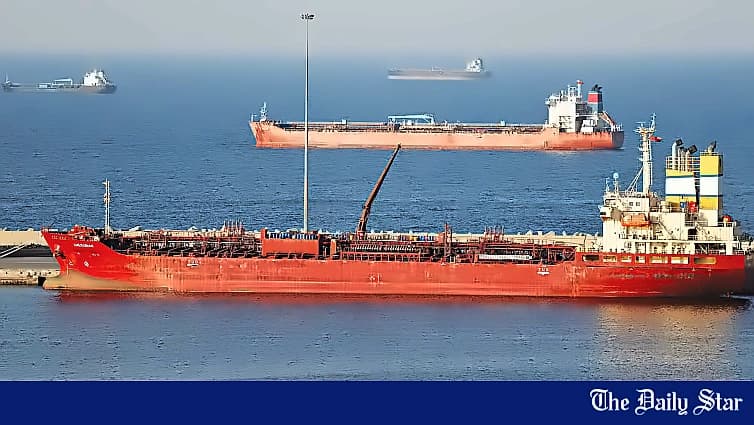
The biggest uncertainty is the scale of supply disruptions through the world's most important oil chokepoint. Flows of crude and refined products through Hormuz, which averaged about 18 million bpd before the war, fell to 4.8 million bpd in July and have averaged around 2 million bpd so far in August amid Iranian attacks and a US blockade, according to Kpler. Some of that lost volume has been offset by higher exports from the Fujairah terminal in the United Arab Emirates and from Saudi Arabia's Red Sea coast. However, even those alternative routes are under pressure after Yemen's Iran-backed Houthis imposed a blockade on Saudi exports through the Bab el-Mandeb Strait. Taken together, Middle East exports averaged 9.5 million bpd this month, less than half the 21 million bpd in 2025, according to Kpler. The UAE appears to have built a network of "dark tankers" that shuttle crude through Hormuz before transferring cargoes in the Gulf of Oman, with UAE crude exports averaging 3.38 million bpd so far in August, compared with 3.2 million bpd in 2025. However, those volumes could come under pressure after Iran reportedly struck several tankers linked to Abu Dhabi National Oil Tanker movements through Hormuz, making movements harder to track as Gulf producers increasingly turn to 'dark' vessels amid the conflict.
US data offered some support to oil prices with refinery runs climbing to the highest level since 2019, according to the Energy Information Administration. Nationwide distillate inventories fell to the lowest level in more than a month, a key area of concern given tightness in the diesel market, which helped offset a 4.4 million-barrel increase in crude stockpiles last week. The US military has now established a corridor in the waterway, as reported by Axios, which has helped facilitate some crude shipments despite the ongoing conflict. Following attacks on shipping and the laying of sea mines, visible traffic remains far below normal levels, but Persian Gulf producers have become more adept at shipping out volumes covertly through alternative routes. US inventories of distillate fuels, including diesel and heating oil, declined last week for a third consecutive week, the Energy Information Administration said on Wednesday, with less crude available for refiners due to the conflict disruptions.
The longer the Hormuz impasse drags on, the less this looks like a temporary supply shock and the more it resembles a structural reshaping of global oil trade. Benchmark rates for very large crude carriers transporting oil from the Middle East to China have surged from around $300,000 per day in early July to $490,000, equivalent to $5 a barrel and nearly 10 times higher than at the start of the year, according to LSEG data. Those rates reflect shipowners' reluctance to enter conflict zones and growing demand for tankers to move oil and fuel from more distant suppliers such as the US and Brazil. The market may no longer fear an immediate collapse in supplies but neither does it expect a swift return to normal. Crude oil prices have stabilized around $90 a barrel, with crude having surrendered some of its panic premium since the early days of the conflict but remaining roughly 50 percent higher than at the start of the year. The growing realization that this represents a structural shift rather than temporary disruption may keep oil prices elevated well into next year.