Iran's president has made a significant push for ending the conflict with the US, urging an immediate cessation while Tehran maintains its advantage. Iranian President Masoud Pezeshkian called for ending the war today when Iran has power and dignity, with the whole world acknowledging our victory, according to the semi-official Iranian Students' News Agency. Pezeshkian is Iran's top elected leader, but his responsibilities are mostly limited to domestic economic policy, making his comments particularly significant as they represent the highest-level diplomatic voice advocating for peace. His comments come as the conflict shows no sign of a quick resolution and US Treasury Secretary Scott Bessent is expected to unveil plans to economically isolate Iran and its trading partners. The standoff has exacerbated inflation in Iran and sent the country's currency to record lows against the dollar, highlighting the severe economic impact of the ongoing war.
Crude oil futures traded lower on Friday morning despite the US threat to impose the 'toughest sanctions in history' on Iran, with Brent crude trading around $94 a barrel after recovering from earlier session lows. Oil prices dipped from session highs on Friday after Pezeshkian's comments, before quickly recovering gains, according to NDTV Profit. October Brent oil futures at $93.45, down by 0.35 per cent, and October WTI crude oil futures at $86.33, down by 0.58 per cent as of Friday, according to The Hindu BusinessLine. On the Multi Commodity Exchange (MCX), September crude oil futures were trading at ₹8,286, down by ₹18 or 0.22 per cent from the previous close of ₹8,304, with a business turnover of 3,477 lots. The decline comes after oil prices had extended gains for a fifth consecutive session, with crude oil futures reaching near one-month highs as fresh US sanctions aimed at isolating Iran had stoked concerns over possible disruptions to global oil supplies. Analysts said the prices fell after participants offloaded their holdings amid weak demand in the spot market, indicating reduced immediate buying interest in the physical oil market.
President Donald Trump announced a fresh campaign to isolate Iran economically, warning countries and entities supporting Tehran that they could face severe economic consequences. In a post on Truth Social, Trump said, "I am announcing the most crushing economic operation ever taken against any country! This will be Economic Warfare and Isolation on an unprecedented scale." He added that "Any country that allows its financial institutions, businesses, airports, or government entities to provide any type of lifeline to Iran will itself face tremendous economic consequences." However, the announcement came without details on the specific measures or countries that could be targeted, analysts said. US Treasury Secretary Scott Bessent also said on Thursday that Iran would face the 'greatest coordinated economic isolation in the history of the world,' according to LiveMint. In an interview with CNBC, Bessent told reporters that the US would impose the 'toughest sanctions in history' on Iran, stating "If we are doing the maximum economic pressure, then that means that likely there will not be a large-scale kinetic restart." Bessent told CNBC he would "talk about exactly what we're going to do" on Iran at a press conference on Monday, saying "We are going to collapse this regime. It is time for our allies and the rest of the world to make a decision." He described a naval blockade reimposed on Iran in July and the 'toughest sanctions in history' as a 'one-two punch'.
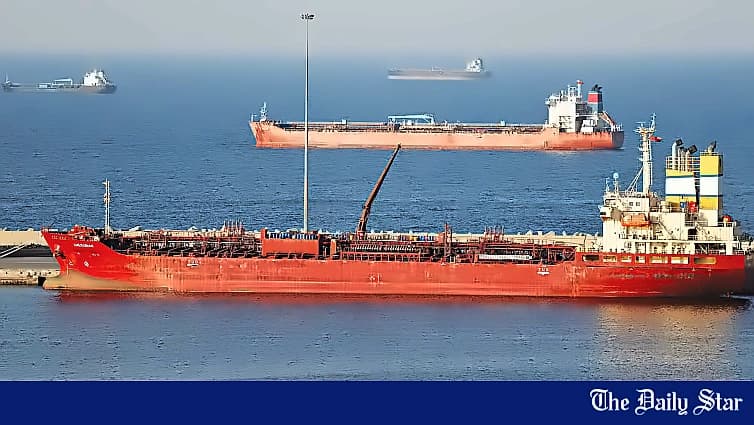
The ongoing war has significantly impacted shipping through the Strait of Hormuz, with just seven commodity ships sailing along the waterway on Thursday, half the previous day's tally, according to data from shiptracker Kpler. This compares with more than 130 ships a day before the war began on February 28, highlighting the severe disruption to global energy flows. Prior to the war, shipments equal to about one-fifth of global consumption moved through the waterway, with current flows far below pre-war levels. The war has also impacted the supply of refined fuels and drawn down inventories with less crude available to refiners. US stockpiles of distillate fuel, including diesel and heating oil, fell last week for a third week, the Energy Information Administration said on Wednesday, as reported by Business Standard. However, crude inventories rose by 4.4 million barrels in the week ended on August 14, compared with estimates for a 600,000-barrel draw, highlighting the complex supply-demand dynamics in the current market environment. Kotak Neo said market participants will monitor potential supply disruptions, retaliatory action around the Strait of Hormuz and whether sanctions force further rerouting of Iranian crude flows. Any disruption to flows through the strategic shipping lane could add another layer of risk to an already sensitive oil outlook, according to the brokerage firm.
The US economic warfare is already impacting China's access to Iranian crude, with offers of Iranian crude to Chinese buyers having already declined since the U.S. reimposed its blockade on Iranian ports in mid-July, according to trade sources cited by Reuters. China buys more than 80% of Iran's shipped oil, according to 2025 data from analytics firm Kpler, making it the largest buyer of Iranian crude globally. When asked if the U.S. could target China for doing business with Iran, Bessent said many conversations were best held in private, telling reporters "Keep in mind that the Chinese get 50% of their energy... from the Gulf. So it would do them a big service to get with the program." China's embassy in Washington said "sanctions and pressure do not help resolve the problem", calling for diplomatic means to address the conflict. The U.S. and Iran have twice announced ceasefire deals, in April and June, aiming to restore the free flow of ships through Hormuz on a path towards ending the nearly six-month-old conflict, but both quickly crumbled. Trump is under pressure to end the war, with high fuel prices dragging down his approval ratings and potentially threatening his Republican Party's control of Congress in midterm elections in November.