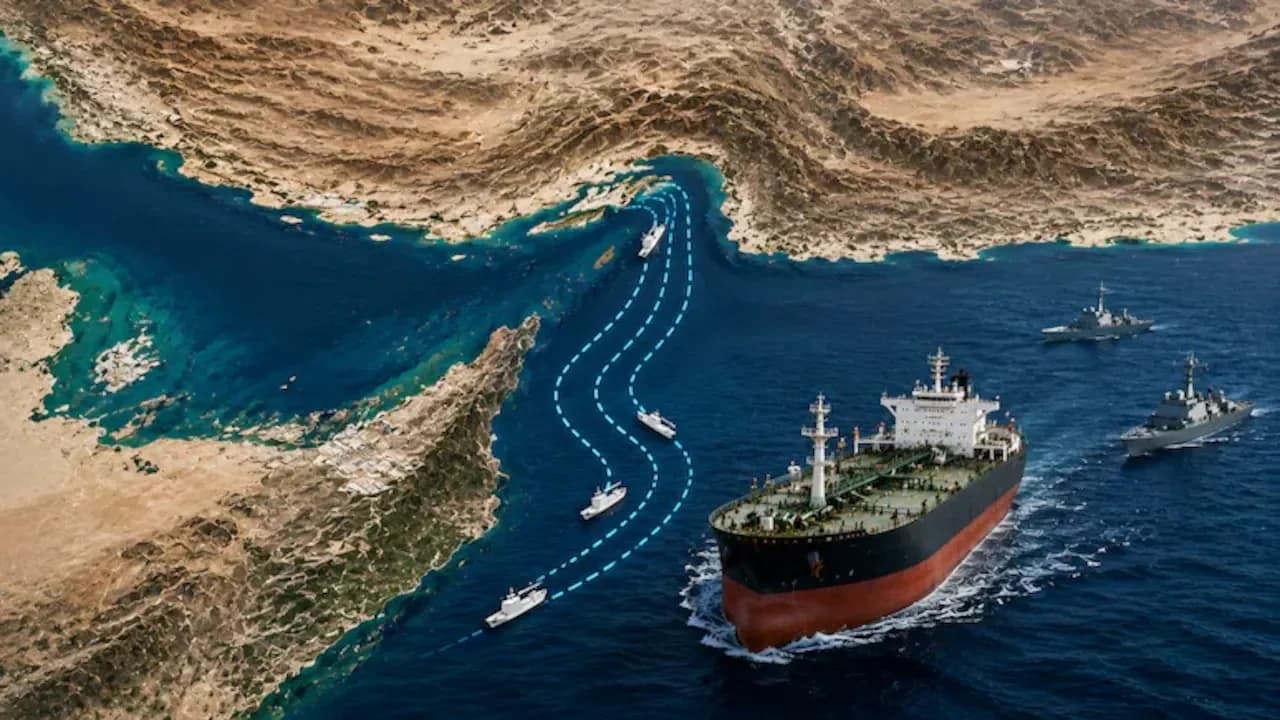
Iran claimed Sunday it struck an unmanned US vessel trying to enter the Strait of Hormuz, a claim that the US military dismissed as a 'total lie'. The purported attack came a day after the US military said forces struck three Iranian oil tankers in response to Navy warships being targeted with ballistic missiles. According to Business Standard, the war began with US and Israeli attacks on Iran on February 28, but since a fragile ceasefire agreement was announced in June, on-and-off fighting has persisted with both sides trying to inflict military and economic pain as negotiations have collapsed. The Trump administration appears to have adopted a dual-prong approach to the conflict, responding militarily to attacks on the strait while going after foreign financial institutions that handle Iran's money.
The Saturday attacks represented a 'major escalation in the maritime conflict' according to maritime intelligence firm Marisks, as reported by The Economic Times. The Iranian navy's Islamic Revolutionary Guard Corps said on Saturday it targeted three oil tankers that were travelling through unauthorized routes in the Strait of Hormuz as well as three additional U.S. vessels in other areas. An average of 10 commodity ships transited the Strait of Hormuz per day over the past 10 days, the lowest since May, according to data from analytics firm Kpler. Mohsen Rezaei, secretary of Iran's Supreme National Security Council, announced on Sunday that a restricted zone will be announced outside the Strait of Hormuz in coming days, adding another layer of supply stress. Marisks highlighted that 'commercial tankers are now being deliberately used as instruments of reciprocal economic pressure, substantially weakening the previous distinction between military confrontation and commercial shipping.'
Despite the ongoing military tensions, US Energy Secretary Chris Wright said that on average, nine million barrels of oil a day are getting through the strait, which should help relieve pressure on energy prices. According to Business Standard, Wright told CNN that with oil also flowing through pipelines in the region, 'we're probably two-thirds or more of pre-conflict flows.' However, those flows depend on the presence of the US Navy to help escort tankers and provide protection against possible Iranian attack. The Strait of Hormuz is crucial to global oil and natural gas shipments and was seen as an international waterway before the war began. Wright said he expected that other countries would eventually support the Navy's efforts. Meanwhile, Iran's Rezaei claimed that 'every day we are selling one million, one and a half million (barrels), as if Iran's oil production and trade are continuing as usual.'
The seven core OPEC+ members, including Saudi Arabia, Russia, Iraq, Kuwait, Algeria, Kazakhstan and Oman, met on Sunday and decided to maintain the group's existing oil output policy for October. As reported by The Economic Times, the producer group said it needs to agree on new production quotas before determining its next steps on output. In August, OPEC+ had agreed to increase production for September, completing a phased rollback of a 1.65 million-barrel-per-day supply cut introduced in 2023. However, despite the planned production increases, actual output from the wider OPEC+ group remains below its targets, with the ongoing conflict creating additional supply disruptions. The group's Sunday statement did not provide details on its policy beyond October, with the next OPEC+ meeting scheduled for October 4.