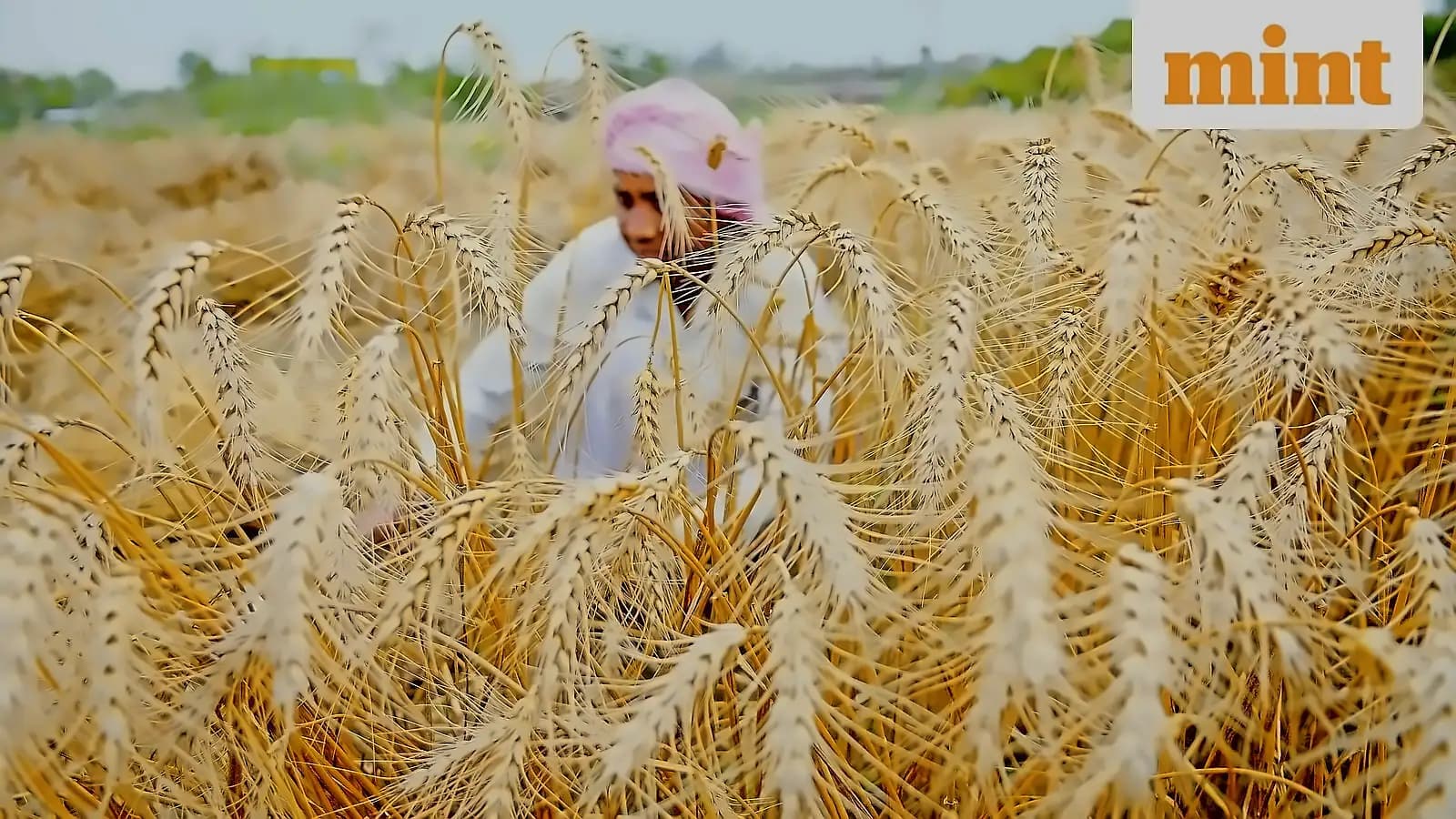
Indian farmers have achieved 96% of the normal Kharif sowing area as the planting window nears its end, demonstrating remarkable resilience in agricultural operations. According to the latest Agriculture Ministry data, the sowing area under all kharif crops reached 1,056.7 lakh hectares as of August 21, compared with 1,072.77 lakh hectares in the same period last year. The deficit from the year-ago level narrowed to just 1.5%, representing a significant improvement from the 2% shortfall recorded until August 7. The pace of sowing has accelerated during August 15-21, with farmers planting over 40 lakh hectares compared to nearly 35 lakh hectares a year ago, helping the country narrow the overall sowing deficit. As per Business Standard, the sowing of kharif crops almost touched the 2025 levels during the week ended August 21, 2026, as the monsoon continued to lash parts of India, though with occasional breaks.
The main cereal for the Kharif season, paddy, is down by 3.2% to 405.10 lakh hectares compared with 418.29 lakh hectares a year ago, though this represents improvement from the 4.4% deficit until August 7. The government has set a production target of 123.15 million tonnes of rice for Kharif 2026. The decline in rice area is mainly attributed to substantial reductions in Karnataka, Telangana, Jharkhand, Madhya Pradesh, Odisha and Maharashtra, with Karnataka reporting the largest decrease of 3.09 lakh hectares, followed by Telangana at 2.45 lakh hectares. However, some regions including Uttar Pradesh and Haryana showed higher area coverage, with Uttar Pradesh contributing 0.36 lakh hectares and Haryana adding 0.21 lakh hectares. According to Business Standard, the maximum drop in area till August 21, compared to the same period last year, has been in paddy, moong and maize, though the gap has narrowed significantly compared to the end of June.
The pulses sector demonstrated positive momentum with area under all pulses reaching 113.63 lakh hectares compared to 112.14 lakh hectares, while oilseeds acreage was 188.37 lakh hectares versus 188.69 lakh hectares. Among pulses, arhar sowing reached 43.86 lakh hectares compared to 43.44 lakh hectares year-ago, and urad rose to 24.38 lakh hectares from 21.72 lakh hectares, though moong declined to 32.68 lakh hectares from 33.93 lakh hectares. In oilseeds, soyabean dropped to 121.35 lakh hectares from 122.76 lakh hectares, while groundnut continued its lead at 48.79 lakh hectares, up from 48.22 lakh hectares. The government has set an oilseeds production target of 28.92 million tonnes for the current season, with soyabean targeted at 14.85 million tonnes and groundnut at 11.35 million tonnes. Other crops showed mixed trends, with sowing of Shree Anna and coarse cereals dropping to 176.36 lakh hectares from 179.81 lakh hectares, and cotton area falling slightly to 108.45 lakh hectares compared to 108.73 lakh hectares.
India's monsoon situation has deteriorated with the cumulative rainfall deficit widening to 13% below normal between June 1 and August 26, according to the latest India Meteorological Department data. The country received 577.8 mm of rainfall against the normal 664.7 mm during this period. The deficit has spread across 14 states and Union Territories, with 310 districts classified as 'deficient' and 38 as 'large deficient' in the IMD's June 1-August 25 distribution. The largest regional deficits were recorded in east and northeast India and the southern peninsula, where east and northeast India received 759.6 mm against a normal 1,037.1 mm, a 27% deficit, while the south peninsula recorded 412.5 mm against a normal 529.4 mm, a 22% deficit. Among the deficient states, Meghalaya had the largest shortfall at 58% below normal, followed by Manipur at 43%, Bihar at 42%, Arunachal Pradesh at 40% and Andhra Pradesh at 39%. The complete list of 14 deficient states includes Arunachal Pradesh, Assam, Meghalaya, Manipur, Mizoram, Bihar, Punjab, Rajasthan, Goa, Andhra Pradesh, Puducherry, Karnataka, Kerala and Lakshadweep. As per The Financial Express, Central India has been the best-performing region with rainfall just 1.8% below the benchmark, while Northwest India recorded a 10.6% deficit, East and northeast India saw a 26.8% deficit, and South peninsular India had a 22.1% deficit.

The government has established ambitious production targets for Kharif 2026, including 176.16 million tonnes of foodgrains comprising 8.4 million tonnes of pulses, 31.04 million tonnes of maize, and 13.56 million tonnes of nut cereals. Despite recent pressure on food prices from sugar and onions, cereal prices are expected to remain relatively stable due to surplus government stocks, according to ICICI Direct reports. The improving monsoon conditions, combined with the near-normal sowing coverage and adequate irrigation reserves, have collectively reduced downside risks to Kharif output. The extended monsoon withdrawal timeline until October provides additional buffer for agricultural activities, while the healthy reservoir storage levels across key agricultural states continue to serve as an important buffer against weather-related challenges. Food-supply and inflation risks have moderated from June levels, providing relief to market participants and supporting broader economic stability. However, ICRA expects total kharif sowing for 2026 to decline by 1-2% year-on-year from 112.1 million hectares in 2025, as the uneven rainfall distribution could weigh on crop yields, particularly in areas that have already received patchy precipitation.