The southwest monsoon covered the entire country on July 9, marking one of its slowest advances in the past five years after entering Kerala on June 4, three days later than normal. According to the India Meteorological Department (IMD), this year's monsoon reached Kerala on June 4, three days later than usual, and completed its advance across India on July 9, taking 35 days compared to the normal timeline. The last time the southwest monsoon took longer to cover the entire country after its onset over Kerala was in 2021, when it reached the state on June 3 and completed its advance on July 13, taking around 40 days. After a slow start, the monsoon gathered momentum in July, reducing the cumulative rainfall deficit from nearly 30 per cent on June 30 to around 15 per cent as of July 8, driven by strong revival of monsoon activity over western and central India.
Total sowing of kharif crops, including paddy, declined to 350.85 lakh hectares, representing a 21 per cent decrease from 442.8 lakh hectares last year, according to agriculture ministry data released on Monday. The decline is attributed to low rainfall amid delayed progress of the southwest monsoon, as reported by Business Standard. Union agriculture and farmers' welfare minister Shivraj Singh Chouhan confirmed that the kharif-sown area this monsoon season has fallen significantly below last year's level, covering 35.08 million hectares, which is 9.2 million hectares less than a year earlier. The improvement in rainfall is expected to support kharif sowing, which was lagging last year's pace by nearly 22 per cent as of July 5. The India Meteorological Department (IMD) confirmed that June rainfall ended 39.8% below the long-period average, making it the fifth-driest June since records began in 1901. Rainfall since June 1 remained about 42% below normal, with deficits touching as high as 92% in some regions.
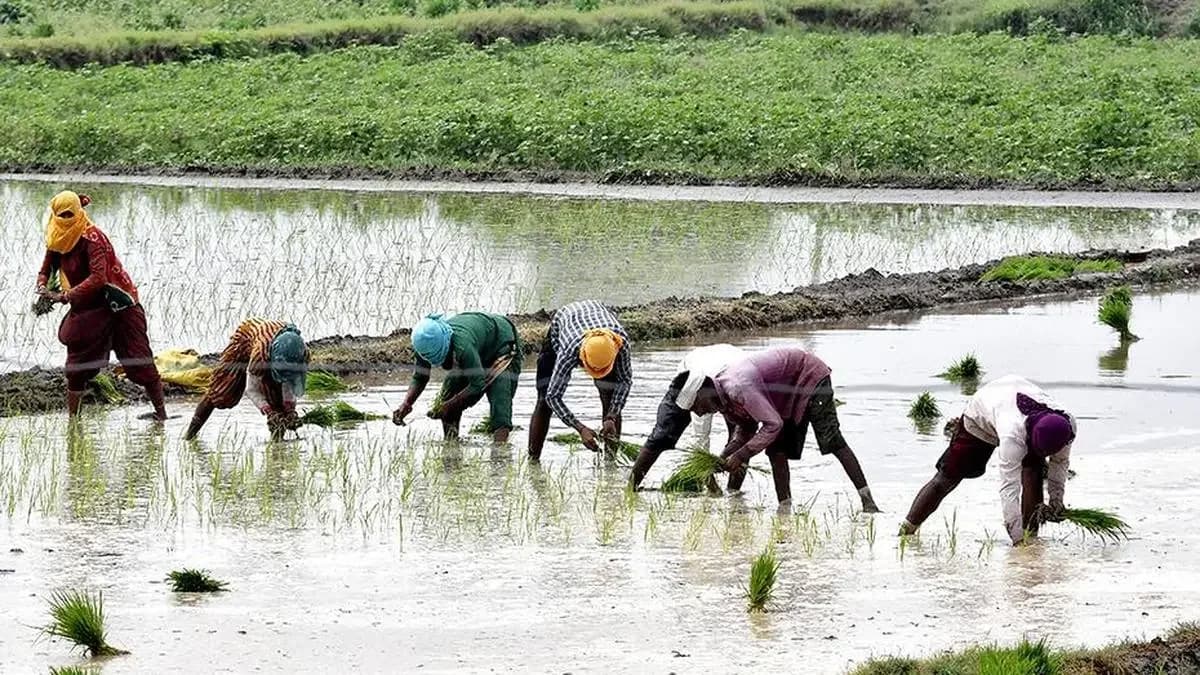
Paddy acreage specifically decreased by 13 per cent to 60.24 lakh hectares till July 6 in the ongoing kharif season, compared with 69.3 lakh hectares last year, according to the agriculture ministry data. The delayed monsoon has affected almost every major kharif crop, with the southwest monsoon reaching Kerala three days later than usual this year before losing momentum across key agricultural regions. For rice farmers, the missing weeks matter far more than a few days' delay in the monsoon's arrival, as paddy follows a different cycle requiring adequate standing water and sustained soil moisture for transplantation. Unlike many crops that can be directly sown after the first showers, paddy requires intermittent or patchy rainfall that is often insufficient for transplantation, making rainfall distribution more important than total rainfall received. Minister Chouhan expressed optimism, noting that the overall rainfall deficit has now narrowed to 24% after a 33% shortfall in June, with the number of rainfall-deficient districts declining from 262 to 178 following recent spells of good rainfall.
Oilseeds sowing experienced the most dramatic reduction, sharply declining to 66.31 lakh hectares from 109.27 lakh hectares last year, representing a 39.31% decline according to the latest agriculture ministry data. This dramatic reduction raises significant concerns about edible oil supplies, as oilseeds were sown on 109.27 lakh hectares last year. The area under coverage for Shri Anna cumulative coarse cereals declined to 60.12 lakh hectares from 71.86 lakh hectares last year, while pulses sowing fell to 37.15 lakh hectares from 47.49 lakh hectares. Cotton sowing also dropped to 63.18 lakh hectares from 82 lakh hectares last year, according to the ministry data. Earlier ministry data cited by Reuters showed soybean planting was down about 65%, cotton by 35% and maize by 16% at the end of June, reflecting the broad-based impact of delayed rains. To mitigate the impact, farmers have been advised to shift to short-duration and low water-intensive crops such as maize, bajra and moong. The improvement in rainfall is expected to support sowing of major kharif crops, including paddy, pulses, oilseeds and cotton, as central India accounts for nearly one-third of the country's area under these major crops.
The Centre is working on a multi-pronged strategy to mitigate the adverse impact of El Niño and below-normal rainfall. A few days ago, the Prime Minister's Office chaired a high-level meeting with major ministries, including agriculture, power, rural development, economic affairs and consumer affairs, to assess the possible impact of El Niño on different sectors of the economy. According to an official statement issued after the meeting, ministries presented detailed assessments of their preparedness and were asked to closely monitor the evolving situation while adopting micro-level and localised strategies to ensure that agricultural production and economic activity are not adversely affected in areas receiving deficient rainfall. The Union agriculture ministry has identified around 375 districts that could be vulnerable to deficient rainfall, of which 111 have been classified as 'extremely vulnerable'. The IMD has forecast below-normal rainfall this year, with the southwest monsoon expected to be 90 per cent of the Long Period Average (LPA) during the June-September season due to developing El Niño conditions over the Pacific Ocean. However, the IMD expects July rainfall to remain below normal, specifically below 94% of the Long Period Average, with conditions remaining favourable for the southwest monsoon to advance into the remaining parts of the north Arabian Sea, Rajasthan, Haryana and Punjab over the next two to three days.
India has comfortable levels of foodgrain stocks as of now, with the central pool foodgrain stocks in Food Corporation of India godowns standing robust at 81.75 million tonnes, much above the buffer norms of 21 million tonnes. This includes 38.95 million tonnes of rice (buffer norm is 13.58 million tonnes) and 42.8 million tonnes of wheat against the buffer norm of 21 million tonnes as of 1 May, according to Mint. However, according to Crisil Intelligence director Pushan Sharma, a prolonged rainfall deficit during critical crop growth stages could impact kharif paddy yields, particularly during flowering. This could tighten supplies from key producing states such as Bihar, West Bengal, Odisha, Chhattisgarh and Maharashtra. To ensure uninterrupted planting, the government has maintained a national seed reserve of about 175,000 quintals. Under a 'Khet Bachao Abhiyan' (Save the Farm campaign) held in June, more than 124,000 programmes were organised nationwide, reaching over 8 million farmers directly, according to the ministry. The government has also stepped up efforts to issue Kisan Credit Cards, with more than 94,000 of the 114,000 applications received by June 30 approved. The Centre has activated district-level contingency plans for affected regions, including promoting alternative crops, encouraging short-duration crop varieties, and crop diversification to help protect farmers against potential crop losses arising from deficient rainfall.