India's vulnerability to oil price shocks has created a crisis-prone history that has repeatedly led to economic crises and political change. According to reports from Business Standard, the 1973 oil shock quadrupled oil prices overnight from $3 to $12 per barrel, causing inflation to soar to 30% and forcing the Opposition to challenge Indira Gandhi's government. The 1979 shock doubled prices to $23.50 per barrel, with spot market prices reaching $40, leading to an unprecedented 5% economic contraction and government collapse. The 2012 oil shock saw prices reach $125 per barrel, creating a surging current account deficit and helping bring Narendra Modi to power. As per Business Standard, every oil price spurt has led to an economic crisis that in turn has provoked political change, with the country's only experience with dictatorial "Emergency" rule following the 1973 shock.
The recent US-Iran war concerns have prompted significant market reactions, with oil prices rising 50% or more and creating worries about assured supply of gas and urea. As reported by Business Standard, India's economy faces potential challenges including higher inflation, lower growth, increased current account deficit, and larger fiscal deficit. However, the averted crisis represents a significant relief for the country, which is hugely dependent on imports of both oil and gas, as well as urea and other Gulf-produced commodities. The announcement of a US-Iran ceasefire should help lower oil, gas and other critical commodity prices, though it will take months for the situation to return to pre-war normal. The world economy has avoided the sharp slowdown that seemed a real prospect last week, providing relief to India's economy.
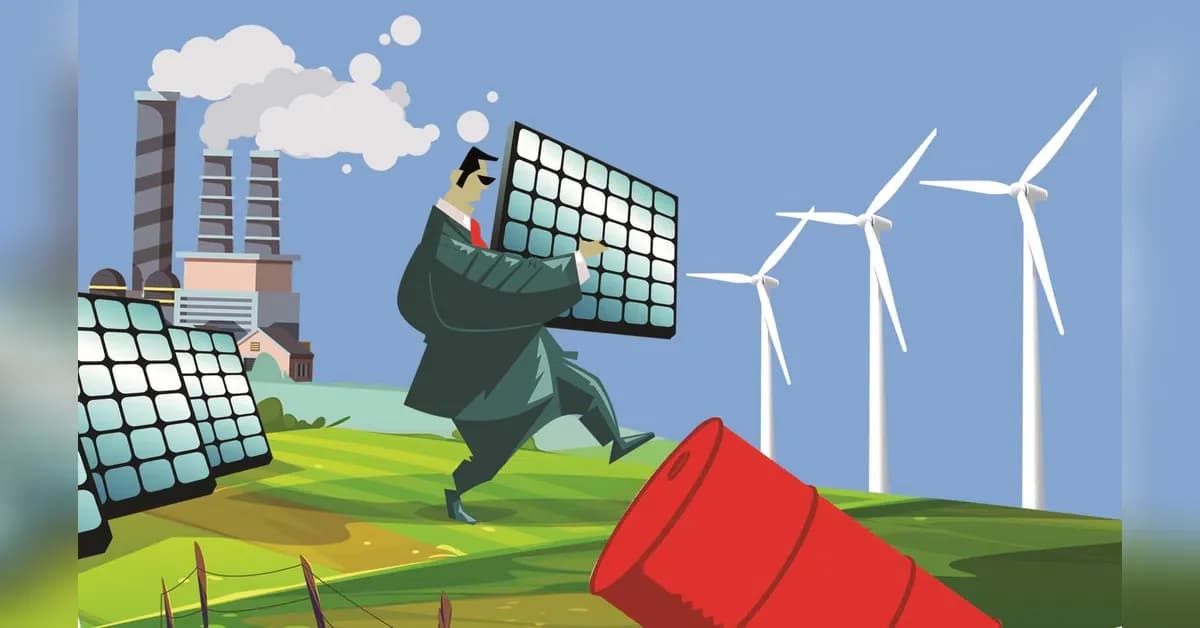
India now has the opportunity to shift toward renewable energy solutions for the first time in its history, with solar and wind energy offering competitive alternatives to fossil fuels. According to Business Standard, renewable energy generation has grown by leaps and bounds and now accounts for about a quarter of electricity generation, with an ambitious target to raise this share to 50% by 2030. The country should aim to become an 'electro-state' by electrifying railways, road transport, domestic cooking, and industrial processes that currently rely on hydrocarbons. Solar energy may be competitive even after considering storage costs, thereby reducing the need for back-up power. Railways have already electrified virtually all their traction, but road transport electrification has made slow progress compared to other countries, with relatively few public charging stations installed.
The renewable energy transition could significantly improve India's external balances, as the country's trade deficit in goods is massive 8% of GDP in 2025-26, with the composite trade deficit of 3% of GDP almost entirely accounted for by oil and gas imports. As reported by Business Standard, reducing hydrocarbon imports would make the economy less dependent on capital inflows, which have been reliable features helping double foreign exchange reserves to $730 billion peak. The country has seen foreign portfolio investors pull out $45 billion in the last 18 months, while net foreign direct investment has shrunk dramatically. The rupee reflects this external weakness, with the Reserve Bank's foreign exchange reserves falling by $40 billion to $688 billion. A more hydrocarbon-proof economy will take the country a big step toward making India a more attractive destination for foreign investors.