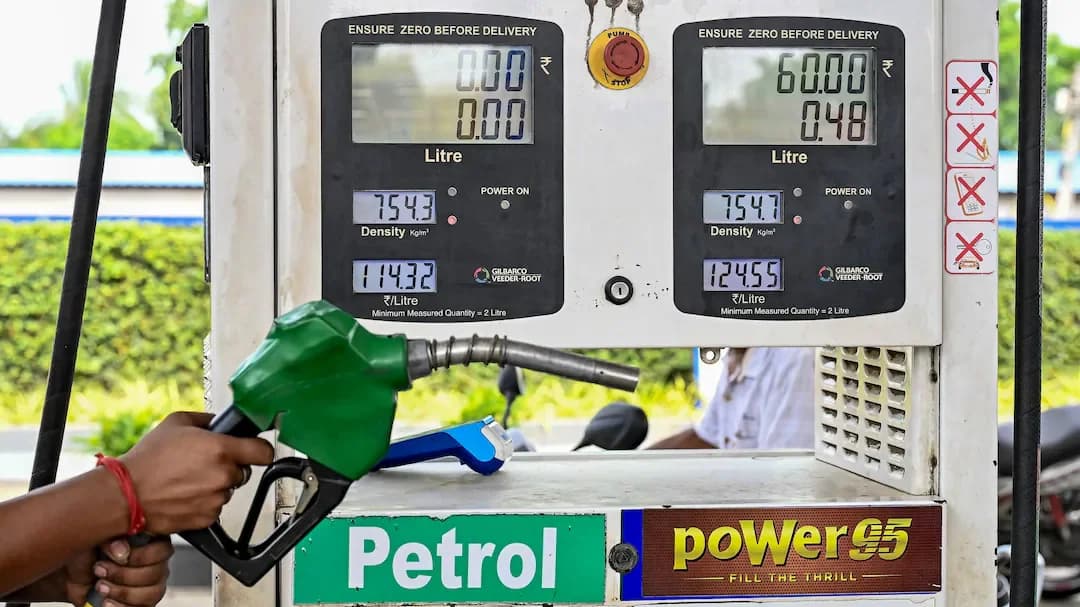
Indian consumers are facing a sharp rise in fuel expenses with petrol prices in several cities racing towards the ₹114-per-litre mark after the latest hike. According to latest fuel price data, Andhra Pradesh's Chittoor has emerged as India's costliest fuel market, with petrol touching ₹114.48 per litre after the latest adjustment. Diesel prices in the district also climbed to ₹102.21 per litre, making it the most expensive diesel market in the country. Vijayawada, which earlier held the record for the country's highest petrol price, now reports petrol at ₹113.40 per litre and diesel at ₹101.12 per litre. Compared with Delhi, where petrol costs ₹98.64 per litre, motorists in Vijayawada are paying nearly ₹15 more per litre.
Across Andhra Pradesh, several cities reported petrol prices above ₹114 per litre, with Nellore recording ₹114.29, Kakinada ₹114.24, Kurnool ₹114.10, Machilipatnam ₹114.09 and Eluru ₹114.06 per litre. Neighbouring Telangana also saw elevated prices, with Nizamabad reporting petrol at ₹113.13 per litre. In Kerala, Thiruvananthapuram recorded petrol at ₹111.51 and diesel at ₹100.28 per litre. Among metro cities, Kolkata remained the most expensive fuel market with petrol priced at ₹109.70 per litre, followed by Mumbai at ₹107.59 and Chennai at ₹104.49. Delhi continued to remain the cheapest among major metros.
India has ended its four-year fuel price freeze with a significant correction after state-owned oil marketing companies recorded ₹7.5 billion in daily losses due to divergence between frozen retail prices and elevated international crude costs. According to reports from The Economic Times, the underrecoveries that oil marketing companies were suffering before Friday's hike was around ₹1,000 crore per day, despite the government's move to cut excise duty on petrol and diesel. The global oil price rally triggered by conflict removed any remaining justification for maintaining the freeze. Two adjustments were implemented within a single week: an initial rise of ₹3 per litre followed by a further increase of approximately ₹0.90 per litre, bringing Delhi petrol to ₹98.64 per litre and diesel to ₹91.58 per litre. The latest revision marks the first hike in almost four years, with the pricing correction implemented after the BJP secured electoral outcomes in key contested states.
Fuel costs underpin India's road freight network, which moves the majority of goods by volume, creating significant inflationary pressures. According to The Economic Times, economists generally expect a cumulative increase of this magnitude to add upward pressure to headline CPI, particularly through food and manufactured goods transport costs. Historical Reserve Bank of India analysis suggests that a ₹1 per litre increase in fuel prices has contributed roughly 10 to 15 basis points to headline consumer price inflation in India, with the full pass-through typically unfolding over several months rather than immediately. The currency dimension compounded this exposure, with the Indian rupee trading at approximately ₹96.35 per US dollar at the time of the adjustment, creating a double pressure on OMC economics that the frozen retail price could not accommodate.
The pricing correction followed a consistent pattern of fuel price freezes preceding Indian election cycles. As reported by The Economic Times, multiple state and national election cycles during this period created strong political incentives to suppress visible consumer price increases. The BJP ultimately secured victories in two of the four key contested states before the pricing correction was implemented in May 2026, consistent with a broader historical pattern where electoral outcomes precede pricing corrections rather than following them. This sequencing reflects the political economy logic that fuel prices are among the most visible and immediate economic variables experienced by Indian voters, with a ₹3 per litre increase in petrol prices translating directly into higher commuting costs for hundreds of millions of households.