The government implemented its third fuel price hike this month on Saturday, raising petrol by less than ₹1 per litre and diesel by less than ₹1 per litre. In Delhi, petrol now costs ₹99.51 per litre (up 87 paise) while diesel is priced at ₹92.49 per litre (up 91 paise). This follows the first hike on May 15 when prices increased by ₹3 per litre and a subsequent 87 paise increase earlier this week. The latest revision brings the cumulative increase to under ₹5 per litre for the month, maintaining India's position as having the smallest material upward movement of any major economy outside directly subsidising Gulf producers. The government absorbed approximately ₹24 per litre on petrol and ₹30 per litre on diesel at peak Brent crude of around $126 per barrel during the Hormuz disruption, while limiting the cumulative increase to under ₹5 per litre during the 76-day period from February 28 to May 15-23.
The Centre has officially attributed the divergence in fuel prices across states to Value Added Tax (VAT) that state governments impose, stating that "the central excise component of the petrol and diesel price is the same in every state of the Union. The pump price diverges because of the value added tax that each state government separately levies." According to the notification, states with the highest VAT impose effective rates of 30% and more, layered with per-litre additions and infrastructure cesses, while states with the lowest impose rates closer to 20%, no per-litre addition, and no further cess. Three states now have petrol above ₹112 per litre after the latest revisions: Andhra Pradesh, Telangana, and Kerala, with Andhra Pradesh charging 31% VAT plus ₹4 per litre plus road development cess, taking the effective rate close to 35%. Telangana takes petrol close to ₹116 per litre, while Kerala adds a social security cess on top of its base VAT. The Centre noted that Andhra Pradesh, Telangana, and Kerala are governed by parties of the INDIA bloc, highlighting the political map of fuel price divergence with a few exceptions.
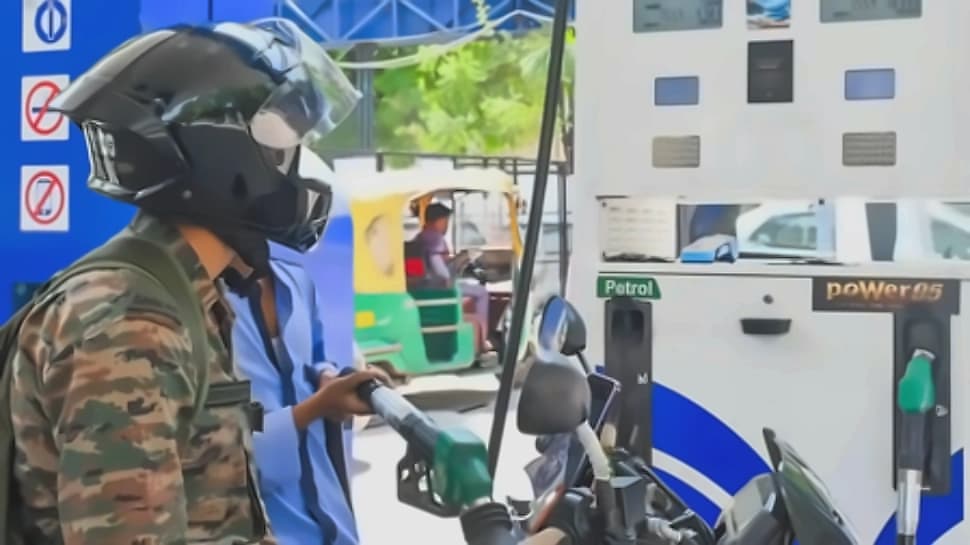
The Centre's latest notification confirms that six BJP-ruled states---Gujarat, Uttar Pradesh, Delhi, Haryana, Goa, and Assam---have priced petrol at or below ₹102 per litre. According to the notification, "the BJP-ruled states passed the full cut through to the pump when the central excise duty was cut by ₹10 per litre on March 27, 2026, while opposition states maintained their higher taxation levels." The Centre emphasized that "the same opposition leaderships that ask the central government to cut excise duty for consumer relief have at no point cut the VAT their own state governments levy on the same litre of fuel." Maharashtra and Madhya Pradesh are BJP-led but carry a higher VAT or recent cess, which explains why they don't feature among the lowest-priced states despite BJP governance. The notification states that "the framing that the central government overtaxes fuel collapses against the state-level data, as the states that tax fuel hardest are not the Centre; they are the political opponents of the Centre."
This pricing structure demonstrates that political control over fuel taxation significantly impacts consumer costs, with opposition-governed states implementing higher taxation levels. The Centre's official statement reinforces that fuel pricing remains a key political tool across different states, with the recent revision maintaining India's measured approach to energy cost adjustments compared to international standards. The data indicates that the states that tax fuel hardest are not the Centre; they are the political opponents of the Centre, according to the Centre's official notification. The framing that the central government overtaxes fuel collapses against the state-level data, as the states that tax fuel hardest are not the Centre; they are the political opponents of the Centre, according to the Centre's official position.