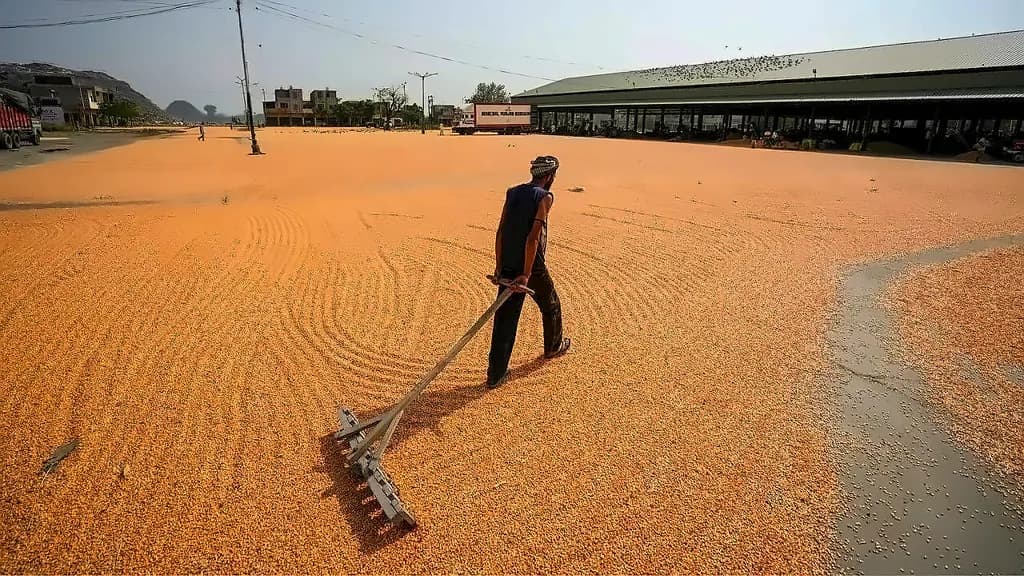
India's foodgrain stocks have reached 92 million tonnes as of July 1, 2026, significantly exceeding buffer and strategic reserve requirements. According to reports from Business Standard, Agriculture Minister Shivraj Singh Chouhan confirmed that these reserves are sufficient to meet domestic demand and support exports despite ongoing climate challenges. S&P Global Ratings has highlighted that India's strong food and grain buffers for affected crops as of July 2026 are key to managing food shock, with authorities coordinating at the district level to minimize crop losses. The minister emphasized that India cannot afford to remain dependent on other countries for its food security needs.
Despite facing climate challenges like El Nino and supply disruptions from the West Asia crisis, India has maintained adequate buffer stocks of wheat and rice. As reported by Business Standard, the southwest monsoon has shown signs of recovery, with the deficit narrowing from over 37% at the end of June to around 11% as of August 9. However, the Reserve Bank of India last week flagged risks to agriculture and rural demand from a deficient and uneven southwest monsoon amid El Nino conditions and projected retail inflation at 5 per cent for the 2026/27 financial year. The central bank noted that El Nino's impact on temporal and spatial rainfall distribution continues to remain a risk, though proactive supply management and adequate foodgrain stocks could provide buffers. According to S&P Global Ratings, the effects of the El Nino period starting in 2026 will reach Asia-Pacific mainly through weaker rainfall and climate disruption, with key transmission channels including reduced agricultural output, higher food inflation, and diminished hydropower generation. The agency warns that a strengthening El Nino could lift food prices across Asia-Pacific, with India exposed through weaker rainfall and crop stress, but notes that India's sizeable grain stocks and policy coordination should help soften the inflation shock.
The minister launched the National Scholarship Portal (NSP) to disburse scholarships and fellowships through Direct Benefit Transfer (DBT) mode. According to Business Standard, Chouhan disbursed ₹21.35 crore directly into the bank accounts of over 6,000 agricultural students across the country. The digital transition involved six institutions including ICAR, Public Financial Management System (PFMS), National Scholarship Portal (NSP), Direct Benefit Transfer Mission (DBTM), National Payments Corporation of India (NPCI), and State Bank of India (SBI).
Minister Chouhan highlighted three primary focus areas for strengthening India's self-reliance amid global uncertainties: food security, nutritional security, and farmers' livelihoods. As reported by Business Standard, he emphasized that examinations, admissions, and payments must occur on time as the real test of an effective system. The new portal replaces traditional bureaucratic workflows with real-time tracking mechanisms, allowing students to monitor payment statuses and communicate directly with authorities.
Current market indicators show resilience despite El Nino concerns, with the Sensex at 78,569.00 and Nifty 50 at 24,604.60 showing calm market sentiment. However, analysts warn that food inflation risks should be treated as a household cash-flow event before becoming an equity-market event. The USD/INR at ₹95.24 adds another layer of complexity, as currency weakness could complicate import-related inflation pressures. Investment experts recommend focusing on companies with pricing power, strong distribution networks, and resilient demand rather than speculative El Nino trades. The key takeaway is that El Nino becomes market-relevant when weather stress interacts with tight food supplies, sticky inflation expectations, and fragile household budgets, making it crucial to track rainfall distribution, foodgrain stock management, RBI commentary, rural consumption signals, and currency movements together.