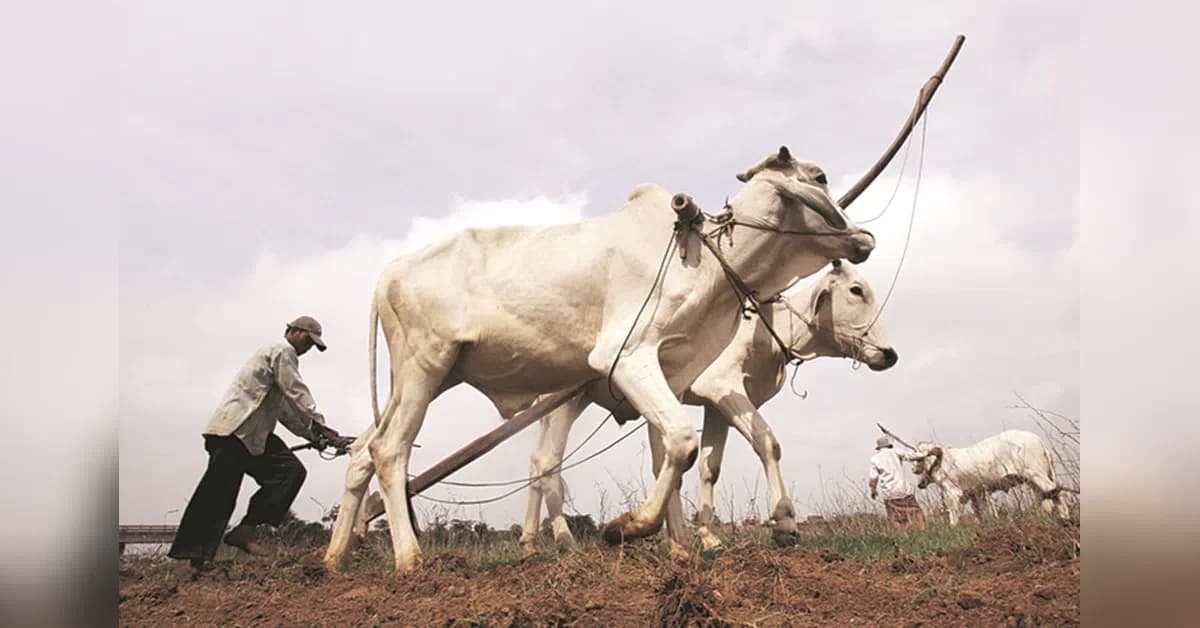
India's foodgrain production has experienced remarkable transformation since independence, rising from 50.82 million tonnes in 1950-51 to an estimated 376.56 million tonnes in 2025-26, according to the latest Economic Survey data. This represents a more than seven-fold increase over the eight decades since India's independence in 1947. The Economic Survey describes this achievement as one of the most significant measures of the country's economic transformation, demonstrating how India has evolved from a nation struggling to feed itself to one producing food surpluses.
The 1970s marked a critical turning point in India's foodgrain economy, with the Green Revolution serving as the catalyst for self-sufficiency. Historical data shows wheat production grew at an annual rate of 4.69% between 1970-71 and 1979-80, compared to 1.91% for rice, 0.74% for coarse cereals, and a decline of 0.54% for pulses. The Economic Survey attributes this productivity surge to changes in seed technology that raised agricultural yields significantly. Wheat's share in foodgrain production increased from approximately 13% in 1950-51 to 32% in the latest estimates, while pulses' share declined from about 17% to 7%.
The most significant transformation occurred in crop yields rather than cultivated area expansion. Between 1950-51 and 1997-98, the area under foodgrains increased by only about 27% while production surged by 279%. Using production and area data, yield rose dramatically from roughly 522 kg per hectare in 1950-51 to 1,552 kg per hectare in 1997-98. The latest data shows India's average foodgrain yield reached 2,646 kg per hectare in 2025-26, up from 2,343 kg per hectare in 2019-20. The Economic Survey emphasizes that agricultural productivity serves as the most vital differentiator in a country with limited capacity to enhance agricultural land.
India's food-security system has evolved from heavy dependence on imports to substantial domestic production and distribution capabilities. According to the Economic Survey, the 1960s recorded low annual growth of 1.72%, necessitating large-scale foodgrain imports. However, current data shows India's net production reached 295.6 million tonnes in 2023, with net imports turning negative at -28.6 million tonnes. The government now procures wheat, rice and coarse cereals through the Food Corporation of India (FCI) and state agencies at Minimum Support Price, with procurement reaching 72.2 million tonnes in 2022-23. The National Food Security Act covers 81.35 crore beneficiaries based on the 2011 Census.
Corporate focus on El Nino risks has reached multi-year highs, with companies increasingly preparing for potential disruptions. According to Reuters analysis, 478 companies mentioned El Nino in 1,443 documents from May 1 to August 4, with 316 mentions in earnings calls - the highest since 2019. In India, agricultural firm UPL Limited's CFO noted planting delays would push some demand into later quarters, while AWL Agri Business Limited's CEO called the El Nino "a serious concern" with rural sales at risk. Reuters Climate Monitor showed parts of India were already 8 to 9 degrees Celsius above their 1961-1990 average on August 10, with the average high across Asia 3.9 degrees above. The US CPC now gives a greater than 90% chance of a very strong El Nino during the northern hemisphere fall and winter, with a 69% chance it will exceed the strength of any previous El Nino events going back to 1950.