State-run oil marketing companies have made a substantial financial commitment to India's ethanol blending programme, with OMCs spending nearly ₹1.72 lakh crore on ethanol procurement across the last three supply years. According to the Ministry of Petroleum and Natural Gas, OMCs have purchased over 2,417 crore litres of ethanol during this period, demonstrating the scale of investment required to support the country's biofuel transition. The latest data shows that OMCs purchased 705.43 crore litres of ethanol worth ₹49,577 crore during the ongoing Ethanol Supply Year (ESY) 2025-26 up to June, highlighting the continued momentum in ethanol adoption.
India has successfully achieved 20 per cent ethanol blending in petrol (E20) during Ethanol Supply Year 2024–25, marking one of the fastest large-scale ethanol adoption programmes in the world. According to reports from Business Standard, this achievement has transformed ethanol from a fuel additive into a cornerstone of India's energy strategy. The programme has also enabled automakers to introduce flex-fuel vehicles compatible with higher ethanol blends, positioning India as a global leader in biofuel adoption. As per the All India Distillers Association (AIDA), this represents a significant milestone achieved years ahead of the original target timeline, with the industry already discussing higher ethanol blends and flex-fuel technologies for future mobility solutions.
The Centre is planning to expand ethanol's use beyond transport, with a policy framework that could introduce ethanol-powered cooking stoves and dedicated dispensing stations. As reported by The Economic Times, the government is reportedly working on a policy framework that would allow ethanol to be used as a mainstream cooking fuel, with consumers able to refill ethanol canisters through dedicated dispensing stations, or 'ethanol ATMs', for use in specially designed cooking stoves. This initiative could help reduce India's dependence on imported LPG and strengthen energy security, creating a new domestic market for ethanol beyond its traditional fuel applications.
Aviation represents one of the fastest-growing opportunities for ethanol expansion, with aircraft requiring conversion of ethanol into Sustainable Aviation Fuel (SAF) through the Alcohol-to-Jet (ATJ) pathway. As reported by Business Standard, unlike cars, aircraft cannot run on ethanol directly, necessitating this conversion process. In April 2026, India amended its Aviation Turbine Fuel regulations to bring SAF-blended aviation turbine fuel under regulatory framework, creating a foundation for aviation decarbonisation. The government has approved a roadmap requiring 1% SAF blending in international flights by 2027, increasing to 2% in 2028 and 5% by 2030. To support this transition, NTPC Green Energy and GPS Renewables are setting up India's first ethanol-to-jet fuel facility near Visakhapatnam, with an estimated annual production capacity of 1,800 tonnes.
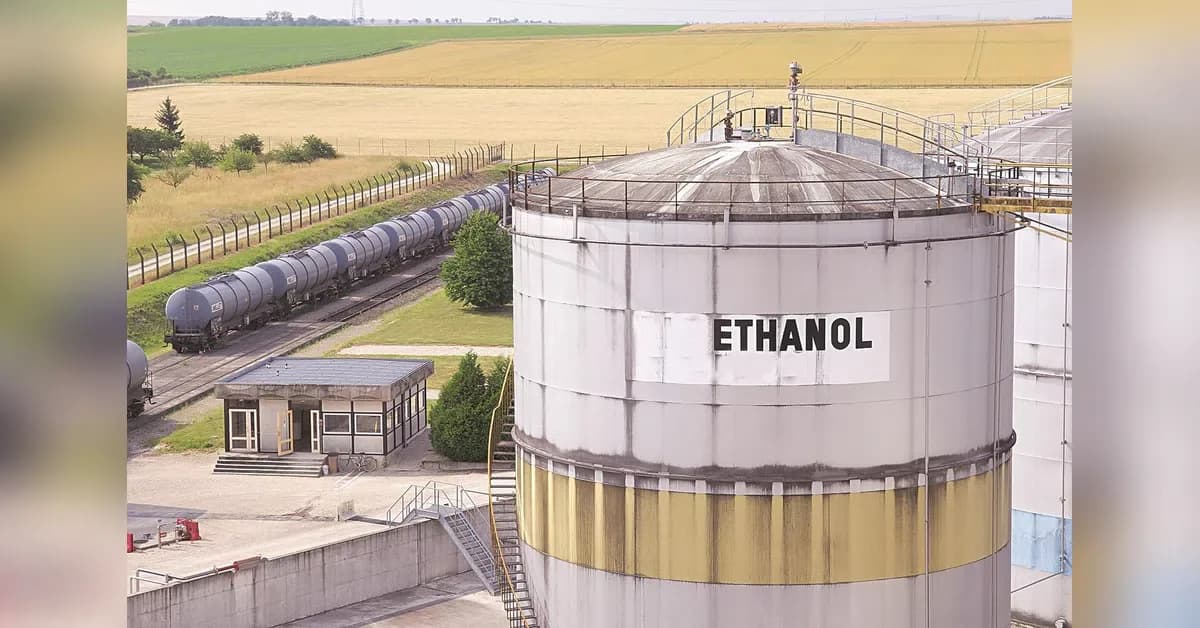
Ethanol is increasingly being used as a cleaner-burning fuel in industrial boilers and furnaces, replacing fossil fuels such as furnace oil and diesel. According to Business Standard, industries including food processing, pharmaceuticals, chemicals and distilleries use ethanol for process heat, helping reduce emissions and improve energy efficiency. Beyond industrial applications, ethanol-based fuels are being used in hospitality sectors for buffet chafing dishes and catering services, with systems typically using denatured ethanol or ethanol-based gel fuels that burn with minimal smoke and odour.
With ethanol production capacity outpacing current demand, policymakers are seeking new markets to absorb surplus capacity and expand India's biofuel ecosystem. According to The Economic Times, India's ethanol production capacity has crossed 20 billion litres annually, with another 4 billion litres expected to be added during the current financial year. While the government's E20 petrol blending programme consumes around 11 billion litres annually, industries such as liquor, pharmaceuticals and chemicals account for another 3-3.5 billion litres. This leaves nearly 7 billion litres of unutilised capacity. Industry executives have begun exploring export opportunities in countries such as Nepal, Bangladesh and Indonesia, which have blending targets but insufficient domestic production capacity. The automotive sector is also being brought into the biofuel ecosystem, with draft Corporate Average Fuel Efficiency (CAFE)-III norms proposing incentives linked to the use of ethanol and other biofuels, encouraging adoption of flex-fuel vehicles capable of running on higher ethanol blends.
India's ethanol programme has undergone a significant shift in raw material sourcing, with grain-based sources—particularly maize—now accounting for a larger share of ethanol production. According to a CareEdge Ratings report cited by The Economic Times, this transition has diversified the supply chain, bringing grain processors into the country's expanding biofuel ecosystem alongside traditional sugar mills. This diversification has created a more resilient and flexible supply chain for India's rapidly expanding ethanol industry, reducing dependence on single feedstock sources and enabling greater production flexibility across different regions and agricultural cycles.