India's energy crisis has reached critical proportions, with Prime Minister's adviser Tarun Kapoor revealing that high oil and gas import dependence is costing the country between ₹6 lakh crore and ₹7 lakh crore extra annually. Speaking at a Confederation of Indian Industry (CII) event on energy security, Kapoor emphasized that the impact is being felt across the economy, including fuel prices, freight rates, and overall inflation. As per Business Standard, Kapoor noted that large dependence on imports has shown that we are so vulnerable that we may be caught in a tight situation and it can be disastrous for the country. The government has absorbed a significant portion of price increases, with oil companies graciously absorbing part of the increase, preventing the disastrous impact that would have occurred if all price increases were passed to consumers.
India's crude oil vulnerability is most visible with domestic production of 28 million tonnes in FY2025-26 and import dependence reaching 88.7%, as reported by the Petroleum Planning and Analysis Cell (PPAC). However, the country maintains significant refining capabilities with installed capacity of 258.1 million tonnes per year and petroleum-product output of 284.9 million tonnes in FY2025-26. According to Business Standard, India imported over 293 million tonnes of crude oil and petroleum products last financial year (2025-26) at a cost of over ₹13 lakh crore, with the first seven months of the current financial year seeing the country spend ₹11.4 lakh crore to import 161 MT of crude oil and products. The government addresses domestic supply through the Hydrocarbon Exploration and Licensing Policy and Open Acreage Licensing Program, while diversification efforts include buying crude from multiple producers and maintaining 5.33 million tonnes of strategic storage across Visakhapatnam, Mangaluru and Padur facilities.
The US-Israel war against Iran and subsequent closure of the Strait of Hormuz has severely affected crude oil and LNG supplies from the world's most critical energy chokepoint, through which one-fifth of global hydrocarbon supply passes. During the initial war period from March to May 2026, substantial geopolitical turmoil disrupted supply chains and drove up prices globally. India's crude oil imports remained resilient, with total imports from 41 exporting countries during the first ten months of 2026. Russia emerged as India's leading crude supplier with 11.039 million tonnes in July 2026, while crude oil imports from Saudi Arabia witnessed significant reduction due to the ongoing conflict. India imported a record 2.8 million tonnes of LNG in October 2026, with the United States replacing Qatar as India's largest LNG supplier during May-August 2026, while Qatar's gas supply plunged to zero in April and May.
According to Kapoor's assessment at the CII event, countries like China have been able to overcome shock by building huge energy storage capacity, but that solution has its limits, as storage capacity cannot be built for two-three years. As reported by Business Standard, Kapoor explained that storage can be built at best for 90 days or a little more, though this helps because if even a part of requirement comes from stored supplies, at least the country knows when to buy or play with the market. He noted that given the huge energy consumption of the country, strategies like diversification of oil supplies, looking for alternative sources, and entering into long-term contracts have limited gains. Kapoor emphasized that it is more important that citizens cut avoidable consumption, reiterating Prime Minister Modi's recent call for citizens to cut fuel, gold, and foreign-linked consumption to conserve foreign exchange reserves and ease import pressures amid the West Asia and Strait of Hormuz crisis.
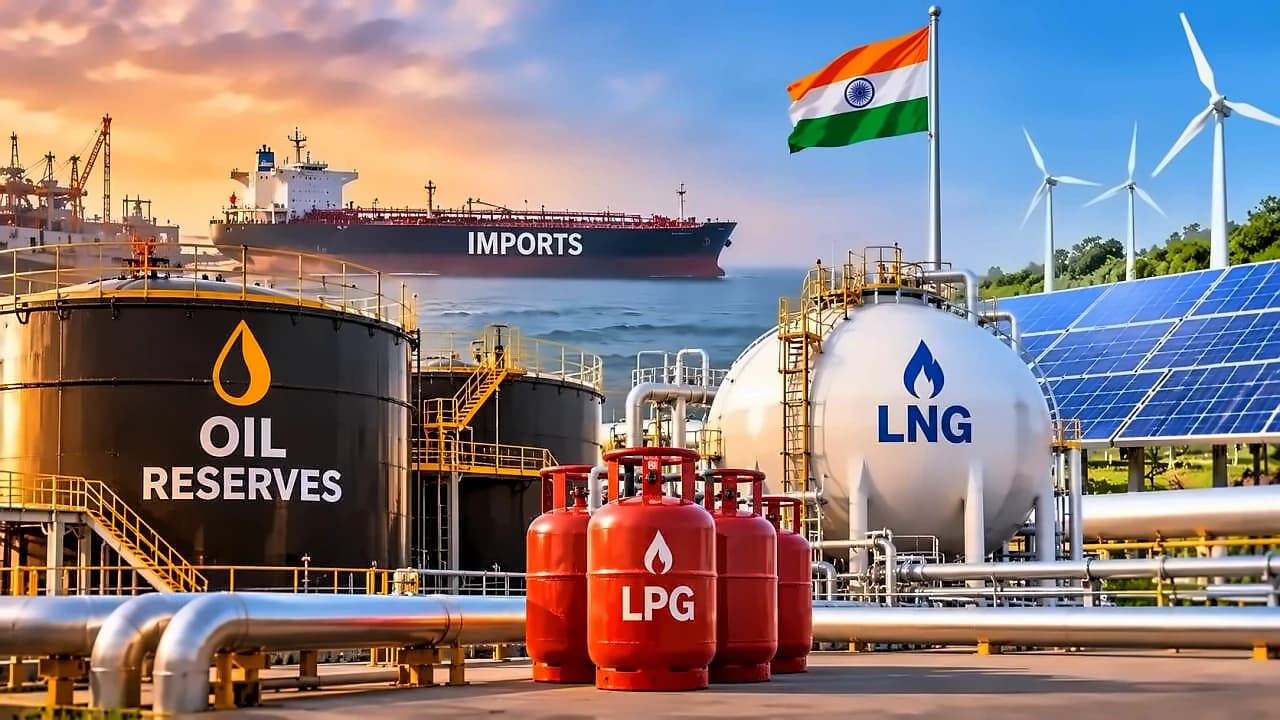
India consumed 68.5 billion cubic metres of natural gas in FY2025-26 with net domestic production of 34.3 bcm and LNG imports of 34.2 bcm, resulting in import dependence of about 50%, according to the Petroleum and Natural Gas Regulatory Board (PNGRB). The country operates eight operational LNG terminals with 53.5 million tonnes per annum of regasification capacity and 27,905 km of operational natural-gas pipelines as of March 2026. However, utilization varies sharply by location due to pipeline connectivity, anchor demand and delivered prices, requiring a balanced procurement approach including long-term contracts, multiple pricing benchmarks and destination flexibility. The cost of India's LNG imports has surged to a six-year high due to the geopolitical disruptions, with new players including the United States, Angola and Oman emerging in India's gas supply chain.
By October 31, 2026, India achieved 303.5 GW of renewable capacity including 174.5 GW of solar, 59.5 GW of wind and 57.5 GW of large and small hydro, with total non-fossil capacity reaching 312.2 GW, according to the Ministry of New and Renewable Energy (MNRE). The Central Electricity Authority estimates the system may require 47.24 GW of battery storage and 26.69 GW of pumped storage by 2031-32. Supporting programs include Green Energy Corridors, interstate transmission planning and the PM Surya Ghar rooftop solar initiative, though meeting these storage requirements will depend on viable revenue models and domestic supply chains for upstream materials. Kapoor emphasized that the country needs dedicated policy intervention to ramp up the pace of the shift towards electric trucks, a cost-effective mode of transport that could help reduce energy consumption.