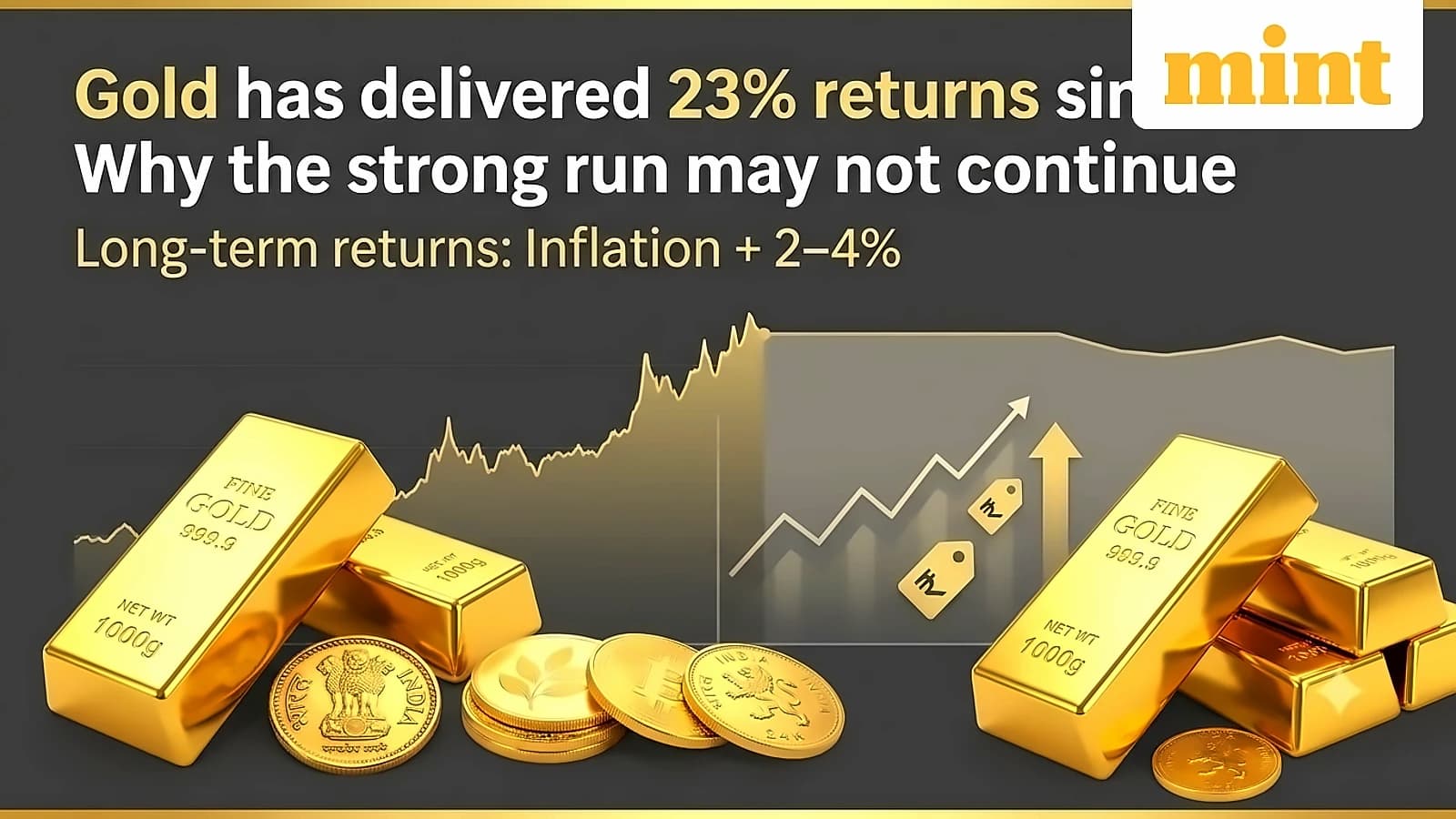
According to reports from Business Standard, Vallum Capital believes the recent gold correction has not destroyed the bullish thesis but rather reset it for investors. The investment firm issued a note on 24 August stating that the correction may be the wrong time to write off the rally, as it has created new accumulation opportunities. The firm's message to investors is blunt: it may be time to start accumulating gold and silver again as a new phase of the "debasement trade" takes shape. The correction has not killed the thesis - it has re-priced who owns it, with sell discipline working both ways. As Vallum notes, the same rule that said trim into $5,600 says re-enter into fiscal dominance signals, not into headlines.
Gold has successfully reclaimed its 20-week moving average and broken a six-month downtrend, with December COMEX futures topping $4,700 for the first time in more than three months. As per latest reports, gold currently trades at $4,643.95, representing a 17% rally from its July lows. The correction, which started at the January record of $5,598 and ran approximately 26 weeks, has now been officially broken with both weekly and daily charts showing the downtrend has been reversed. The move comes after gold slipped under $4,000 during the correction test, but weekly RSI bottomed near 40 and never reached oversold territory below 30, suggesting a correction inside a bull trend rather than a reversal.
As reported by Vallum Capital, central banks demonstrated extraordinary buying behavior in the second quarter of 2026, purchasing 289 tonnes of gold - a massive 411% increase from the previous quarter. This buying occurred despite weakening demand from traditional sources, including 44.8 tonnes of outflows from Western gold ETFs and a 17% decline in jewellery demand. The firm notes that this shift in market dynamics represents a fundamental change in the gold cycle's center of gravity, with the old gold cycle heavily dependent on Western investment demand and the relationship between real yields and gold breaking in 2022 and not returning. The buying came even as some traditional sources of demand weakened, yet gold remained 37% above its year-ago level.
According to Vallum Capital's analysis, gold supply has remained remarkably muted despite the price surge, with mine production rising only 2% while recycled gold actually fell 6%. The firm estimates that all above-ground gold is worth approximately ₹31 trillion, compared to around ₹102 trillion in major central-bank money supply and ₹350 trillion in global debt. This supply-demand imbalance creates what the firm describes as a structural case for holding precious metals as gold cannot be manufactured at the same pace as fiat money. The firm's point is not that gold will automatically rise because global debt is high - rather, it argues that the enormous gap between scarce physical gold and an expanding pool of money and debt creates a long-term case for holding the metal.
As reported by Vallum Capital, Indian retail investors have significantly increased their precious metals exposure, with ₹93,000 crore invested in gold funds and ETFs between January 2025 and January 2026. January 2026 alone saw a record ₹33,837 crore flow into these products, coinciding with gold reaching approximately $5,608 per ounce. Despite the subsequent 25-30% correction that wiped an estimated ₹23,000-28,000 crore from mark-to-market values, investors who maintained positions saw gold recover from around $4,196 to $4,359. The precious-metals boom isn't just a global phenomenon, with Indian investors pouring money into financial gold as the firm notes that the correction did not kill the thesis - it re-priced who owns it.
According to Vallum Capital's analysis, silver has dramatically outperformed gold since 2021, rising 263% compared to gold's 164% gain, representing a 99 percentage-point outperformance. The gold-silver ratio currently stands at approximately 69 times, well above its long-run median of 45-50 times. The firm suggests this ratio indicates that silver's story may still have room to develop, with silver potentially serving as a more aggressive play in the precious metals space. If gold is the defensive bet, silver could be the more aggressive one, with the precious-metals boom not just a global phenomenon but also a domestic Indian trend.