The Centre has categorically stated that diverting surplus broken rice for ethanol production is not impacting food inflation, as ethanol production is allowed only after maintaining adequate buffer stocks and meeting requirements under the National Food Security Act (NFSA) and other welfare schemes. In a reply to a question in the Lok Sabha, Minister of State for Food Nimuben Jayantibhai Bambhaniya explained that after maintaining buffer stocks and providing for requirements under the NFSA, the government sells only excess rice from the Central Pool under the Open Market Sale Scheme, which is then allocated as feedstock for ethanol production. The minister emphasized that this allocation process ensures food security needs are met before any surplus is diverted for industrial use. The government has also defended the programme, stating that only surplus, certified by the Department of Food & Public Distribution after every food security obligation has been met, is approved for ethanol production. As per the Ministry of Petroleum and Natural Gas, what actually goes into the ethanol programme is damaged grain, broken rice and foodgrain unfit for human consumption — stocks that would otherwise rot in warehouses.
The Food Corporation of India (FCI) sold rice to ethanol distilleries at prices nearly 40% below its average acquisition cost between June 2025 and June 2026, according to a government response to Parliament. Minister of State for Consumer Affairs, Food and Public Distribution Nimuben Jayantibhai Bambhaniya revealed that rice was sold under the Open Market Sale Scheme (Domestic) at ₹2,250 per quintal between June and October 2025 and ₹2,320 per quintal from November 2025, while the all-India average acquisition cost stood at ₹3,720 per quintal in FY24-25 and ₹3,889 per quintal in FY25-26 (revised estimates). The government has also fixed the sale price at ₹2,390 per quintal for the period from November 2026 to June 2027 under the OMSS(D) policy, as reported in the parliamentary disclosure. Despite the difference between the acquisition cost and the price charged to ethanol producers, the government maintained that no subsidy was being provided to distilleries, noting that rice was sold at the notified OMSS(D) price. However, the parliamentary reply did not explain why the sale price remains significantly below FCI's acquisition cost. The government has also rejected claims that FCI rice was sold to ethanol producers at an unusually low price, stating that the programme does not depend on rice and uses whichever approved feedstock is available.
The parliamentary reply shows FCI dispatched 6.3 million tonnes of rice to ethanol plants during the 12-month period from June 2025 to June 2026, with the grain valued at ₹14,596 crore. According to the government response, the economic cost is higher as it also factors in expenses such as storage, transportation and carrying costs incurred before the grain is distributed or sold. The figures indicate that rice supplied to ethanol producers was priced around 40% below what it cost FCI to procure and handle the grain. The disclosure came in response to a question from Rajya Sabha member Ashok Singh, who sought details of rice supplied from FCI warehouses to ethanol plants, the prices at which it was sold, whether any subsidy was being provided and whether any cases of diversion had been detected. The government has also taken note of claims that the government sold FCI rice worth ₹37 per kg to distilleries at ₹23 per kg, causing a loss of ₹10,000 crore, which it has described as incorrect.
Haryana received the largest allocation of rice during the period at 844,141 tonnes, followed by Uttar Pradesh at 838,645 tonnes. Punjab and Himachal Pradesh combined received 658,952 tonnes, while West Bengal received 584,672 tonnes and Madhya Pradesh received 432,485 tonnes. The parliamentary disclosure shows that overall, FCI dispatched 6,349,913 metric tonnes (about 6.35 lakh tonnes) of rice valued at ₹14,596.78 crore during the 12-month period. The government informed Parliament that two cases of diversion involving FCI rice allocated for ethanol production had been detected, following which state food departments initiated action and the FCI stopped further allocations to the two distilleries involved. The names of the distilleries were not disclosed in the parliamentary response.
Regarding maize as an alternative feedstock for ethanol production, the minister stated that India's maize production is projected at 55 million tonnes according to third advance estimates for 2025-26, which is sufficient to meet demand for ethanol production, poultry, cattle feed and other purposes. In the ethanol supply year 2024-25, which ended in November, around 13.1 million tonnes of maize was used for ethanol production, while the quantum of surplus FCI rice was around 3.18 million tonnes. The ministry noted that in ESY 2023-24, FCI rice contributed virtually nothing, just 0.02 per cent of ethanol production, while by ESY 2025-26, its share increased to 24.64 per cent only because surplus FCI stocks became available after all food security needs had been met. The ministry added that maize's share declined from 42.6 per cent to 35.96 per cent during the same period, showing that producers simply switch between different feedstocks depending on availability. India produces ethanol from rice, maize and sugarcane, with maize accounting for the largest share in recent years, overtaking sugarcane. The ministry also said the programme is moving further ahead through the Pradhan Mantri JI-VAN Yojana, under which India is rapidly expanding second-generation (2G) ethanol production from agricultural residue, reducing dependence on foodgrains altogether.
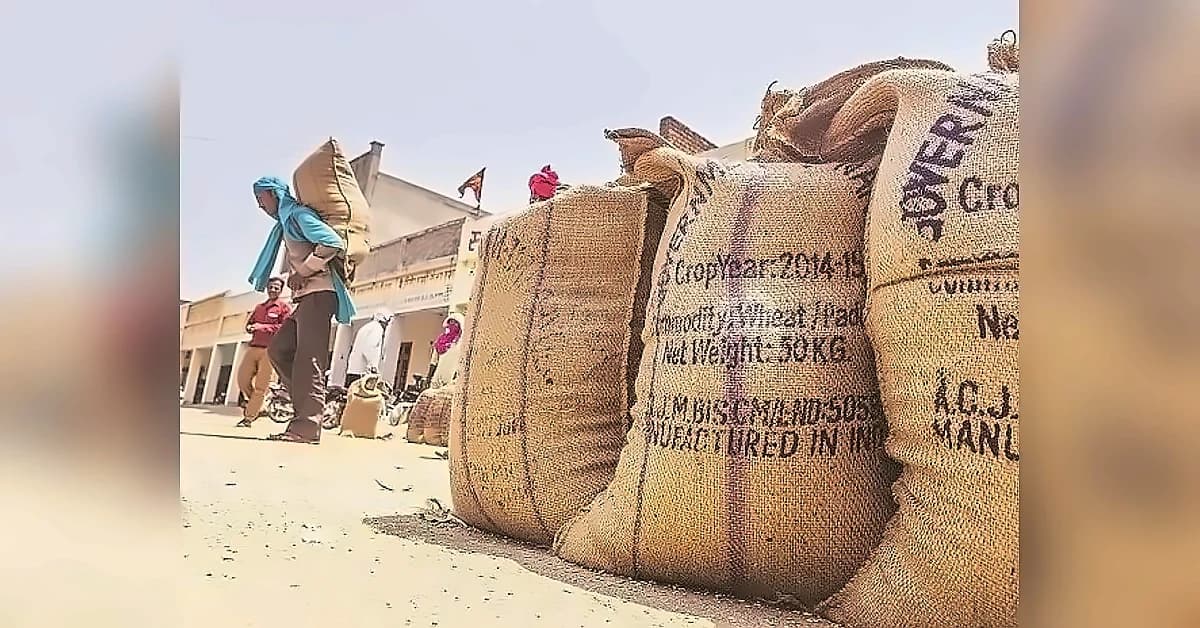
Agriculture expert and independent director G.K. Sood said selling rice below its economic cost effectively amounts to a subsidy. "The government plans to allocate 7.2 million tonnes of FCI rice for ethanol production during the 2026-27 ethanol supply year at around ₹23,900 per tonne, compared with an economic cost of about ₹43,100 per tonne. Unless the difference is provided separately through the Union Budget, it will eventually be reflected in the food subsidy bill," Sood said. Sood said the policy raises broader questions because rice production is already supported through minimum support prices and other subsidies while also being highly water-intensive. "The larger issue is why such large quantities of rice are procured only to be diverted to ethanol production at a substantial cost to the exchequer," he added. Madan Sabnavis, Chief Economist at Bank of Baroda, said the pricing appears to have been designed to fit the economics of ethanol procurement by oil marketing companies under the blending programme. The parliamentary reply comes as the government pushes to expand ethanol blending with petrol by widening the range of feedstocks, including surplus rice held in FCI stocks. The ministry has also defended the programme, stating that ethanol blending is not a taxpayer subsidy but India's energy insurance and has already delivered when global oil price crises hit.