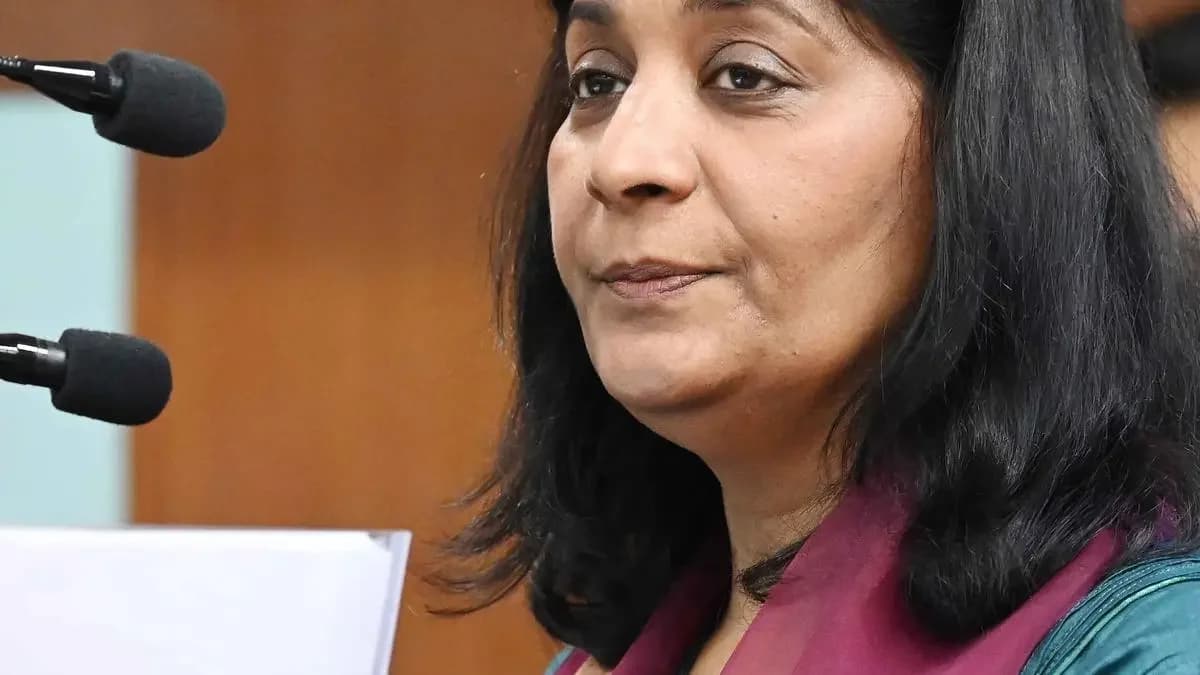
RBI Deputy Governor Poonam Gupta has indicated that India's economic growth could approach 7% in FY27, potentially exceeding the central bank's official 6.7% forecast. Speaking on Thursday, Gupta's assessment is based on expectations of a strong April-June quarter performance, with official GDP data for the period due later this month. Economists' forecasts for the April-June quarter currently range between 6.9% and 8%, according to the latest reports. Gupta emphasized that a stronger first-quarter performance could lift full-year growth closer to 7%, despite several challenges facing the Indian economy including higher oil prices, US tariffs, trade-related uncertainty and the possibility of a weak monsoon. The Reserve Bank of India (RBI) reported in its latest 'State of the Economy' bulletin that India's economy has shown notable resilience to ongoing global headwinds, with buoyant domestic demand, rising manufacturing and services activity, and a recovery in monsoon supporting kharif sowing.
India has witnessed a broad-based sequential increase in food prices, raising particular concerns for monetary policymakers, according to the RBI's latest monthly report. The headline inflation measured by Consumer Price Index remained above the 4% target - 4.5% in July and 4.4% in June - primarily on account of supply-side pressures, with CPI-based inflation rising to 4.45% in July from 4.38% in June, mainly due to food and beverages fuelling inflation. However, core inflation, which excludes volatile food and energy prices, remained unchanged, endorsing the lower pass-through of cost pressures. The Reserve Bank of India's (RBI) reported that monetary policymakers have particularly been wary of any broad-based increase in inflation as this could lead to policy tightening, as evidenced in the minutes of the central bank's monetary policy meeting released last week. The recovery of southwest monsoon in July helped kharif crop sowing reach closer to normal acreage, partly mitigating risks to the agriculture sector, with the government also announcing an Open Market Sales Scheme for the current financial year to augment supply, backed by a high stock of public foodgrains.
Industrial production in June recorded its strongest growth in nearly two years, with the Index of Industrial Production (IIP) growing 7.3% year-on-year, while manufacturing output rose 7.8%. The bulletin showed that capital goods production expanded 14.2%, indicating continued strength in investment-related activity. Services PMI stayed in expansionary territory as railway freight and port cargo traffic recorded healthy growth, and cement production picked up, providing additional evidence of sustained manufacturing and services activity across multiple sectors. The report highlighted that the services sector also exhibited resilience, with broad-based acceleration in manufacturing supporting the overall industrial strength.
Domestic demand remained firm in July, supported particularly by rural consumption, with retail automobile sales growing 25.9%, including tractor sales rising 28.1% and two-wheeler sales 28.3%. Urban demand also remained strong, with passenger vehicle sales increasing 19.1%. Petroleum consumption returned to growth in July after three consecutive months of contraction, with overall petroleum product consumption rising 2.9%, while petrol and diesel consumption increased 9.2% and 10% respectively. The recovery was led by petrol and diesel consumption, indicating improved demand for transportation fuels across both urban and rural markets. The report noted that the total flow of financial resources to the commercial sector increased in 2026-27 so far (up to July 31), driven by a pickup in non-food bank credit and rise in foreign direct investment (FDI) to India.
India's merchandise trade deficit widened in July, both year-on-year and sequential basis, primarily driven by electronic goods. The oil deficit remained unchanged even as the price of the Indian basket crude oil increased to $89.7 per barrel in August, higher than the average price recorded in both June and July. The additional 10% tariff imposed by the US with effect from July 24 clouded the bilateral trade even as India's major export commodities to the US, such as smartphones, petroleum products and pharmaceuticals, remain outside its purview. "India is likely to be less affected than some of the Asian economies in the US market, such as China, Vietnam and Thailand," the RBI report said, noting that China, Vietnam and Thailand face an additional 12.5% tariff. "Despite the risks to the global trade and growth-inflation matrix, India's robust macroeconomic fundamentals continue to provide cushion to the domestic economy," the report concluded. However, both merchandise exports and imports grew strongly in July 2026, with exports growing at a four-month high in 2026-27 so far.
FDI flows improved significantly in June 2026, with net FDI standing at $1.3 billion compared to (-) $0.1 billion in May 2026 and $2.3 billion in June 2025. During the June quarter of 2026-27, net FDI reached $7.8 billion compared to $4.8 billion in the corresponding period last year. Gross inward FDI stood at $30.7 billion during the same period, higher than $26.7 billion a year ago. The report noted that Singapore, the Netherlands, the US, and Canada accounted for around 74% of the total equity inflows, with manufacturing receiving the highest share of equity inflows, followed by electricity generation, computer, and communication services. Outward FDI continued to register a downward trend for the last two months, with about 65% of outward FDI flows directed to Singapore, the UAE, and the US, primarily in financial, insurance and business services, manufacturing, wholesale/retail trade, restaurants, and hotels.