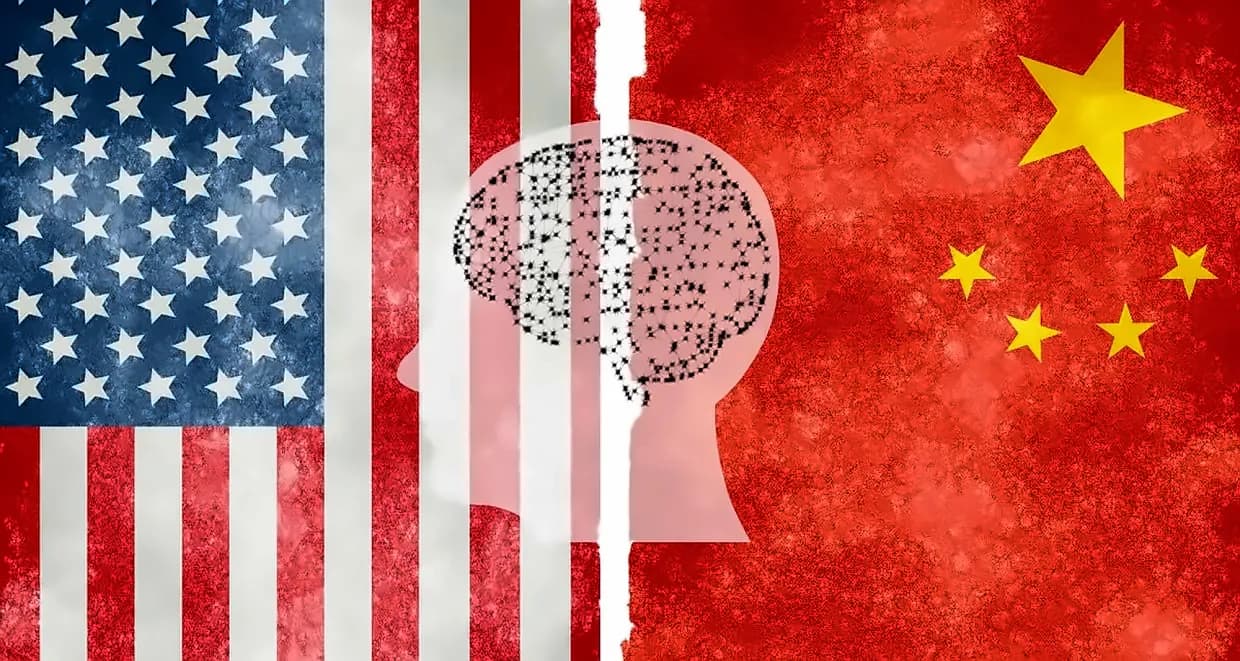
The US-China AI rivalry has reached new heights with US President Donald Trump publicly undermining multilateralism and accusing China of benefiting from AI development restrictions. As reported by Reuters, Trump blasted out on social media that 'There is a sick conspiracy going on against AI and Data Centers, and the only one that is happy about it is China'. Meanwhile, China's state-backed Global Times editorial characterized AI warnings as a 'Cold War playbook' targeted at China. The political tensions come as Trump is scheduled to meet with Chinese President Xi Jinping next week in Washington, with reports indicating the two countries were planning a separate meeting in mid-September to discuss AI risks led by lower-level government officials. This escalation threatens to undermine any potential multilateral agreements on AI protocols, as Trump's administration has replaced multilateralism with bilateral deals where America holds the upper hand.
Researchers from China's leading universities and tech giants are setting their sights on a crucial new front in the AI race with the US: developing systems capable of building better versions of themselves without human intervention. In a joint paper published on Thursday, researchers from ByteDance, Tsinghua University and the Shanghai Artificial Intelligence Laboratory, among others, outlined a five-stage road map for recursive self-improvement (RSI). The study, titled 'The Last AI Built by Humans: Toward Genuine Recursive Self-Improvement', highlights a growing industry focus on automating the labor-intensive life cycle of training, evaluating, and fine-tuning AI models. The paper describes five progressive stages of autonomy, where in the initial phase an AI merely executes improvement procedures designed by human engineers, progressing to later stages where the system determines what new information or experiences it must acquire and adapts to changes post-deployment.
Chinese models are gaining significant cost advantages in agentic workloads, where requests consume 15 times more tokens than human-led requests. As reported by J.P. Morgan, this has made inference cost an increasingly important variable in model selection, with Chinese labs emerging as attractive suppliers. A run of open-weight releases this summer, including Moonshot AI's Kimi K3 and Z.ai's GLM-5.3, landed close to the U.S. capability frontier while remaining free to download and much cheaper to run. While Chinese models remain cheaper, the price advantage often narrows when measured per task due to varying token usage patterns across different models.
Despite political tensions, the AI investment boom shows no signs of slowing, with Goldman Sachs expecting cumulative global AI spending through the end of the decade to reach as much as 5% of global GDP. According to Morgan Stanley, demand for computing power still far exceeds supply, meaning any slowdown in AI buildout may strengthen the position of the 'merchants of compute' – hyperscalers – by increasing the scarcity value of their installed base and enhancing their pricing power. However, Morgan Stanley's strategists estimated that almost $200 billion of AI-related projects were cancelled or delayed last year and through the first quarter of 2026 due to rising domestic political opposition to US data centre building. The bank's analysis shows that capex is set to account for roughly one-third of all US GDP growth this year and next, with that effect likely amplified by the boost to household wealth from sustained investment-driven equity gains.
A series of apocalyptic warnings about AI's threat to human life reached a crescendo over the weekend, with Anthropic's resigning employee warning that the new technology 'could kill us all' by the end of the decade. By Sunday, there appeared to be consensus among Anthropic boss Dario Amodei, OpenAI's Sam Altman, Elon Musk at SpaceX, Apple's Tim Cook and others about the need to slow development down, increase human intervention and checks, and ensure clear limitations on AI agents' autonomy. Microsoft published its own draft code as part of these coordinated efforts. However, the long-awaited OpenAI IPO is now likely delayed to next year following these developments, with the news knocking stakeholder SoftBank shares by about 13% on Monday (14 September). Anthropic still appears to be proceeding with its public listing as soon as next month, though the bigger issue for investors remains whether tech-industry calls for a slowdown are credible given similar AI protocols have been suggested before.