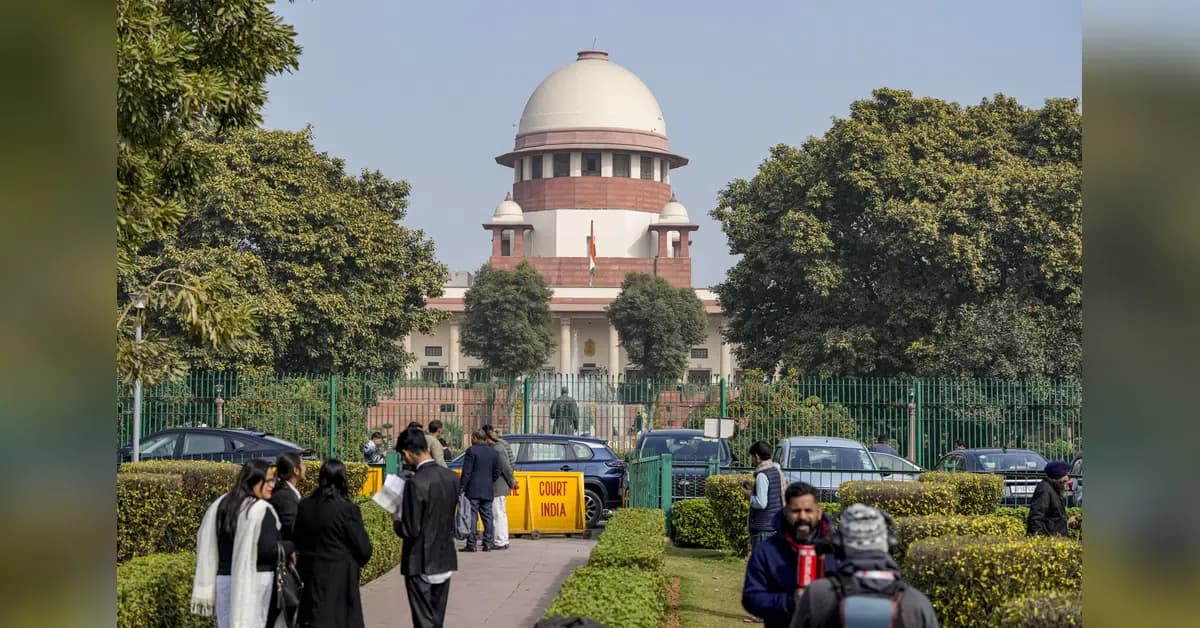
The Supreme Court on Wednesday, September 2, 2026, set aside a customs penalty of over ₹425 crore after finding that the adjudicating officer had relied on judgments and legal articles that were either non-existent, carried fake citations, or attributed legal propositions to real cases that those cases never laid down. According to reports from The Economic Times, Raw Law, and Mint, a bench of Justice Dipankar Dutta and Justice Sheel Nagu made the effort to individually verify whether the appellant's contention about AI-generated material was true, and upon verification found that the second respondent had relied upon case laws that are either non-existent or have fake citations. The court branded this phenomenon as AI hallucinations, emphasizing that these errors appeared to be the product of artificial intelligence systems. The findings were particularly damning, with some case laws relied upon by the department being non-existent or carrying fake citations, while others were real decisions that simply did not lay down the proposition attributed to them - the classic signature of an AI hallucination. The Supreme Court held that it was unnecessary to enter into the underlying merits of the customs dispute once the integrity of the adjudication itself was compromised, as the present case extended this principle beyond conventional court judgments to a quasi-judicial customs adjudication order.
The case involved Vijay Ghanshyam Gadiya, who was served an Order-in-Original by the Additional Commissioner of Customs, Surat, on October 8, 2025. As reported by The Economic Times, Raw Law, and Mint, the officer imposed a penalty of ₹425,27,99,100 under Section 114 of the Customs Act, 1962, for allegedly mis-declaring a consignment of natural diamonds as lab-grown diamonds to pay a lower tariff. Gadiya challenged the penalty before the Gujarat High Court, which dismissed his appeal on January 20, 2026, before he moved the Supreme Court. Before the apex court, Gadiya's counsel contended that several judgments and articles cited in the original order were generated using AI systems. The Additional Solicitor General did not join issue, and the Union did not even try to defend the order on this point, accepting the court's findings about the AI-generated material. The Supreme Court allowed the appeal against both the Gujarat High Court order confirming the penalty and the Customs Order-in-Original imposing the ₹425.27-crore penalty.

The Supreme Court addressed broader concerns about AI in adjudication, noting that the court had recently released draft Regulations for Use of Artificial Intelligence in Courts, 2026. According to the court's order quoted by The Economic Times, Raw Law, and Mint, while acknowledging that AI can assist in speeding up decisions, the court sounded a caution: "assistance can never be substituted for adjudication. AI may well serve as training wheels, but entrusting it with the pilot's seat would be both imprudent and dangerous." The bench held that the reliance on dubious AI-generated material was fatal to the sustainability of the order imposing penalty on the appellant. The court noted that it had recently released draft regulations, but stressed that AI cannot replace human judgment. The court's findings demonstrate that even an iota of such material is enough to vitiate the sanctity of adjudication, and the standard binds the Bench and the Bar alike. The problem in this case was not merely that AI had been used, but that the adjudicating authority relied upon dubious, non-existent or misrepresented legal material without verification, which contamination went to the integrity of the decision-making process itself.
The court referred to its earlier decision in Pooja Ramesh Singh v. Jammu & Kashmir Bank Ltd., a precedent dealing with the use of AI in judgments. As reported by The Economic Times, Raw Law, and Mint, the order quoted an excerpt from this judgment, which established that any adjudication resting on unverified or AI-fabricated legal material is vulnerable to being struck down, regardless of the underlying merits of the case. The court anchored itself in this precedent, which had already declared a policy of zero tolerance for producing, citing or relying on AI-generated precedents without verification. The apex court set aside both the Gujarat High Court order and the original Order-in-Original, and revived the proceedings for fresh adjudication by a different officer of the same rank, while leaving it to the appointing authority to initiate action against the officer who authored the October 2025 order. The ruling serves as a stark reminder that while technology can assist, it must never compromise the integrity of the judicial process. The Supreme Court reiterated that courts must adopt a zero-tolerance approach toward unverified AI-generated precedents, distinguishing between the legitimate use of AI as an aid and illegitimate reliance on fabricated output masquerading as authoritative legal precedent.