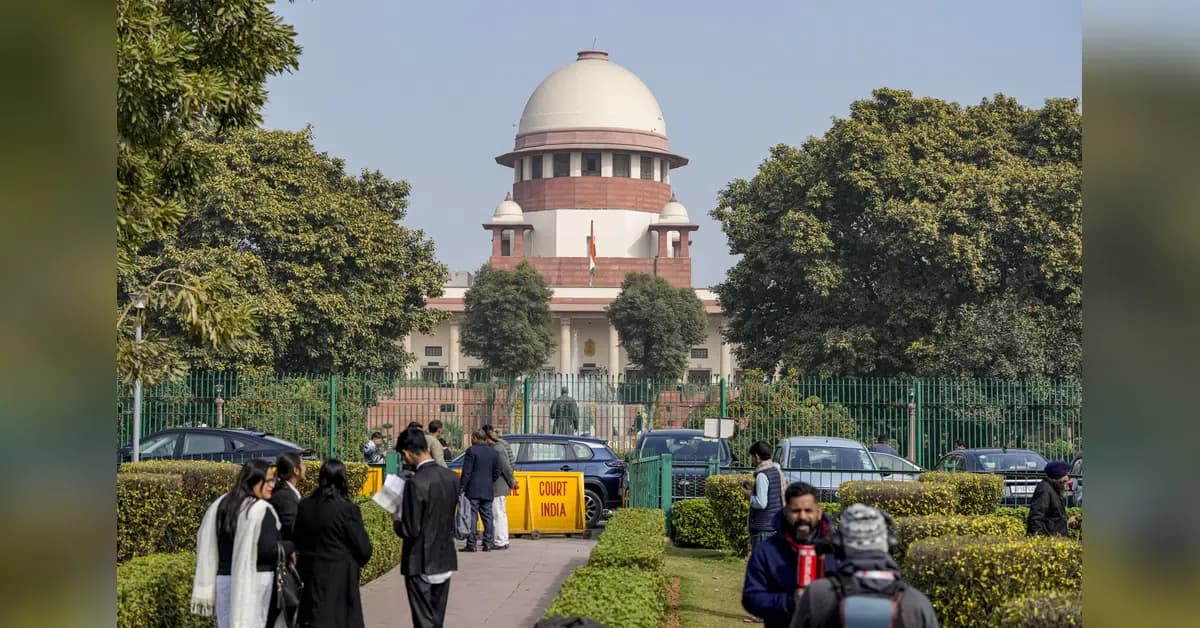
The Supreme Court has established that mineral royalty is payable at the rate prevailing on the date of actual dispatch or removal, regardless of earlier contractual terms. According to reports from Business Standard, a Bench of Justices Sanjay Karol and N Kotiswar Singh held that a statutory enhancement of royalty under the Mines and Minerals (Development and Regulation) Act, 1957, overrides any contrary contractual arrangement. The ruling addresses the fundamental question of when royalty liability crystallises, with the Court emphasising that Section 9 of the MMDR Act links royalty to the event of removal or consumption of minerals. The Court specifically ruled that if the date of movement is after the enhancement in royalty on account of change in law, a contract made before the statutory change cannot be limiting its impact. In the latest ruling, the Court observed that statutory amendments override contractual arrangements where the movement of minerals takes place after the revised rates become effective, with a pre-existing agreement unable to shield a company from financial obligations arising out of a later legislative change.
The dispute originated from iron ore sales through e-auctions conducted by a Monitoring Committee following the Supreme Court's intervention in the Karnataka mining scandal. As reported by Business Standard, BMM Ispat Limited had purchased iron ore stockpiles in 2014 when royalty was fixed at 10 per cent, but before the company could lift the entire quantity, the Centre amended the MMDR Act with effect from September 1, 2014, increasing royalty on iron ore to 15 per cent. The State recovered the differential royalty for ore removed after the amendment by adjusting over ₹2 crore from the company's security deposit. According to the Supreme Court, it was entirely open to BMM Ispat, which operates an approximately 1 MTPA integrated steel facility in Karnataka, to remove the iron ore from the site at one go or at any date prior to the amendment, which the company chose not to do. The judges further remarked that BMM Ispat either transported the ore in phases over time or moved the entire stock after the revised rates had become operational, holding that in either scenario, the company could not avoid the enhanced royalty obligation prescribed by law.
Odisha has ordered an intensified crackdown on illegal mining following audit findings that expose massive irregularities across the state's mining sector. According to Business Standard, with audit findings and field-level investigations flagging possible irregularities exceeding ₹20,000 crore in recent years, the Odisha government has directed surprise inspections and strengthened surveillance. The findings reveal unlawful mining worth ₹5,467 crore due to violations of environmental clearance conditions, an estimated ₹4,162 crore loss linked to alleged undervaluation and grade manipulation in iron ore transportation, and ₹3,966 crore in dues yet to be recovered from illegal mining operations. Additionally, minor minerals with a royalty value of ₹4,624.58 crore were allegedly extracted and utilised in public works between 2015 and 2022 without adequate proof of authorised sourcing. The state government has warned that negligence in enforcement will attract disciplinary action against officials, with the Steel and Mines Department directing monthly progress reports on enforcement activities to ensure effective prevention and detection of illegal mining activities.
According to Business Standard, the Supreme Court reversed the Karnataka High Court's decision to order a refund, holding that royalty liability crystallises upon physical removal of minerals. Law experts note that the judgment largely clarifies and reinforces an already settled position rather than creating new law. Ramanuj Kumar from Cyril Amarchand Mangaldas emphasised that the Court has reiterated that royalty is payable at the rate applicable on the date of dispatch or removal and that contractual provisions cannot restrict the operation of a subsequent statutory amendment. The Court set aside the Karnataka High Court's order that ruled otherwise, validating the Karnataka government's decision to deduct an additional 5% royalty from BMM Ispat's security deposit. The dispute arose after the Centre amended the Second Schedule of the Mines and Minerals (Development and Regulation) Act, 1957, with effect from September 1, 2014, increasing the royalty on iron ore from 10% to 15%. While BMM Ispat's tender agreement with the Karnataka government had been executed on July 20, 2014—before the amendment took effect—the actual movement of minerals occurred after the revised royalty structure came into force.
As reported by Business Standard, the judgment shifts focus of royalty risk to the date of physical dispatch, meaning buyers can no longer assume that rates prevailing at bidding time will govern the entire transaction. Ashutosh K Srivastava from SKV Law Offices explained that bid pricing, lifting schedules and downstream supply arrangements will have to account for the possibility of statutory revisions during the lifting period. The ruling confirms that contractual buffer clauses cannot insulate parties from legislative changes, reinforcing the principle that royalty under the MMDR Act is a statutory levy rather than purely contractual obligation. The Central Government, by amendment to the Second Schedule appended to the Mines and Minerals (Development and Regulation) Act, 1957 dated September 1, 2014, revised the rates of royalty for iron ore to 15% w.e.f. the same date, as opposed to 10% applicable on July 20, 2014, the date of the tender between the Karnataka government and BMM Ispat. Odisha, India's largest producer of iron ore and chromite, derives a significant share of its non-tax revenue from mining, having accumulated over ₹31,000 crore in District Mineral Foundation fund collections since 2015, the highest in the country.