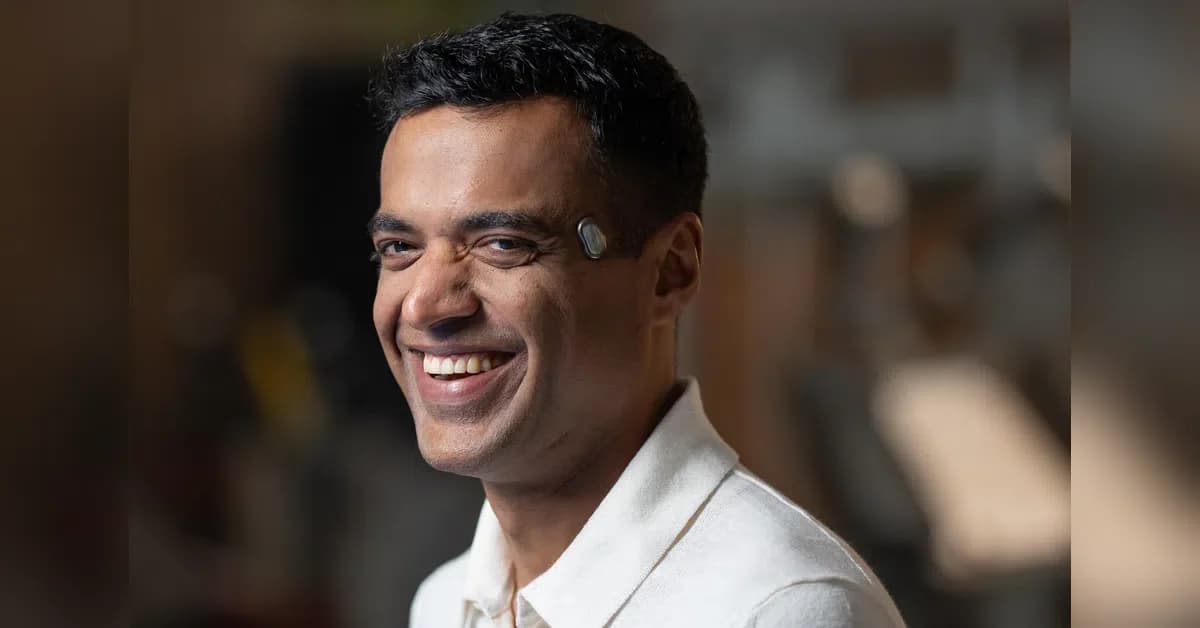
Health-tech startup Temple has acquired Longevous, a London-based longevity medicine practice, as it looks to strengthen its clinical and scientific expertise ahead of the planned launch of its wearable device. According to reports from ANI, Temple founder Deepinder Goyal announced the acquisition on Thursday, with the financial terms of the deal not disclosed. The acquisition brings Dr Robert Mohr and Dr Avi Roy, along with their team, to join Temple full-time. As per Goyal's latest announcement, the founders and their team are joining Temple full-time to bring clinical and scientific expertise at a crucial stage as the company moves closer to commercial launch. Longevous will continue operating under the Temple umbrella, with Mohr and Roy remaining involved in their existing clients' care.
Dr Robert Mohr will join Temple as Chief Medical Officer. As reported by ANI, he is a board-certified physician with nearly two decades of clinical experience who has transitioned from emergency medicine to preventive and precision medicine. According to Goyal's announcement, Mohr will bring clinical oversight to Temple's experiments and health-related claims. Dr Avi Roy will become Temple's Head of Science, bringing his Oxford-trained biomedical scientist background and former research fellow experience at the University of Oxford's Centre for the Advancement of Sustainable Medical Innovation. Roy has also worked as a co-founder of Founders Health and UDA, according to Goyal. Goyal said Mohr and Roy will work alongside Temple's existing science team, bringing clinical experience, research expertise and publication experience to the company's product development and validation efforts.
The deal appears to have emerged from a chance meeting between Goyal and the Longévous founders in London a few months ago. According to Goyal, Mohr and Roy noticed the Temple device he was wearing at a dinner and asked him about it. What started as an informal conversation about the science behind Temple turned into an hour-long discussion. Towards the end of the dinner, the two asked Goyal if they could try Temple themselves. They subsequently used the product for two months as their 'daily driver' for tracking their activities. Their curiosity eventually turned into deeper involvement with Temple's science team. Goyal said the pair pressure-tested the company's work around Entropy and the data Temple could collect, challenged its assumptions and 'poked holes' in its vision. They later became involved in Temple's validation work and reviewed the company's first scientific manuscripts before submission. "At some point, it felt like an obvious next step," Goyal said, adding that he asked the two whether they would consider building Temple with him full-time.
According to ANI, Temple is developing a compact wearable device designed to sit on the temple, the area on the side of the head between the forehead and ear. The device is designed to continuously track cerebral blood flow and oxygenation levels in real time. Unlike conventional smartwatches that primarily monitor signals such as heart rate, Temple aims to use data from the temple area to provide deeper insights into how the body functions. The startup has since raised USD 54 million earlier in 2026 at a valuation of around USD 190 million, with internal valuations seeing further increases as it moves towards launch. Central to the platform is Entropy, a health metric that the company describes as an indicator of the body's energy use at a given point in time. The metric is designed to update continuously using data collected by the wearable, with Temple's scientific team still working to validate the concept. The latest development shows Goyal unveiled the latest design of Temple's wearable, saying it is now less than half the size of the earlier version. He also announced that pre-orders for a limited-edition version will open soon, with shipments expected by the end of 2026. The startup has partnered with contract manufacturers Zetwerk and Ethereal Machines to scale production, while planning to keep primary manufacturing in-house.
The wearable is being developed around Goyal's biological research initiative, Continue Research, and its first hypothesis, dubbed 'Gravity Ageing'. The hypothesis examines whether gravity's lifelong effect on blood circulation to the brain, or cerebral blood flow (CBF), could contribute to age-related decline in certain brain functions. According to the hypothesis, gravity pulls blood away from the brain when people stand or sit, potentially reducing CBF by up to 17% in an upright posture. Temple's wearable is expected to measure cerebral blood flow and could provide users with data linked to brain health. However, Goyal has indicated that the device will function as a standalone consumer product even if the Gravity Ageing hypothesis does not hold up. The startup has shipped its first cohort of 100 devices and reportedly began offering liquidity to employees through an employee stock ownership plan (ESOP) that values Temple at ₹375 million, nearly double its valuation at the time of its seed round.
As reported by ANI, Goyal met Mohr and Roy at a dinner in London a few months ago, where a casual conversation about Temple's wearable eventually turned into detailed discussions about the science behind the device. The acquisition brings clinical and scientific expertise into Temple as the company prepares for launch. Goyal said Mohr will bring clinical-grade expertise to Temple's experiments and the claims it makes, while Roy will work on the company's science alongside its existing in-house team. The move also gives Temple a direct link to an operating longevity medicine practice in London. The pair's involvement eventually led Goyal to ask them to join Temple full-time, with their scientific validation including reviewing the company's first scientific manuscripts before submission. Temple's health claims have drawn questions from medical experts, particularly because the device and its Entropy metric are still awaiting wider independent scientific validation.