India's building materials market has reached ₹3.2 lakh crore in 2026, growing from ₹44.40 lakh crore in 2025 and projected to reach ₹64.51 lakh crore by 2034 at a 4.24% CAGR, according to the latest market analysis. The construction industry faces significant workforce challenges, with over 70 million people employed but nearly 80% of the workforce unskilled, creating an estimated shortage of two million skilled workers. This labor constraint is driving the sector toward more efficient construction methods, with global markets like Singapore, Scandinavia, and Japan having adopted precast and modular construction decades ago to address similar workforce limitations.
Precast and modular building methods deliver up to 50% faster turnaround while requiring up to 60% less on-site labor, as reported by Business Standard. The approach moves approximately 70% of structural work into factory environments, providing three key advantages: predictable quality through factory-cast components using high-grade M40 and M50 concrete, safer job sites with minimal wet work remaining on-site, and parallel execution where 3D modular pods and AAC wall panels are fabricated simultaneously while foundations are being cast on-site. Advanced precast concrete production technology, including precision mold systems, automated reinforcement placement, and high-early-strength concrete formulations, is enabling precast component manufacturers to supply large residential and infrastructure projects with speed and quality that traditional cast-in-situ methods cannot match.
Adoption is accelerating in sectors requiring speed and repetition, including mass housing, hospitals, and hotels, with projects like the Lighthouse Project in Ranchi and Suraksha Smart City in Mumbai demonstrating successful implementation, according to Business Standard. Industrial developers are following suit, with precast components including hollow core slabs spanning up to 13 meters without intermediate supports successfully installed at clients like Borosil, Aarti Industries, and Deepak Chem. AAC wall panels are replacing traditional blockwork across high-rise towers and data centers, while AAC block manufacturing capacity is expanding across India as builders seek lightweight, thermally efficient alternatives to conventional fired clay bricks that weigh approximately one-third of conventional bricks.
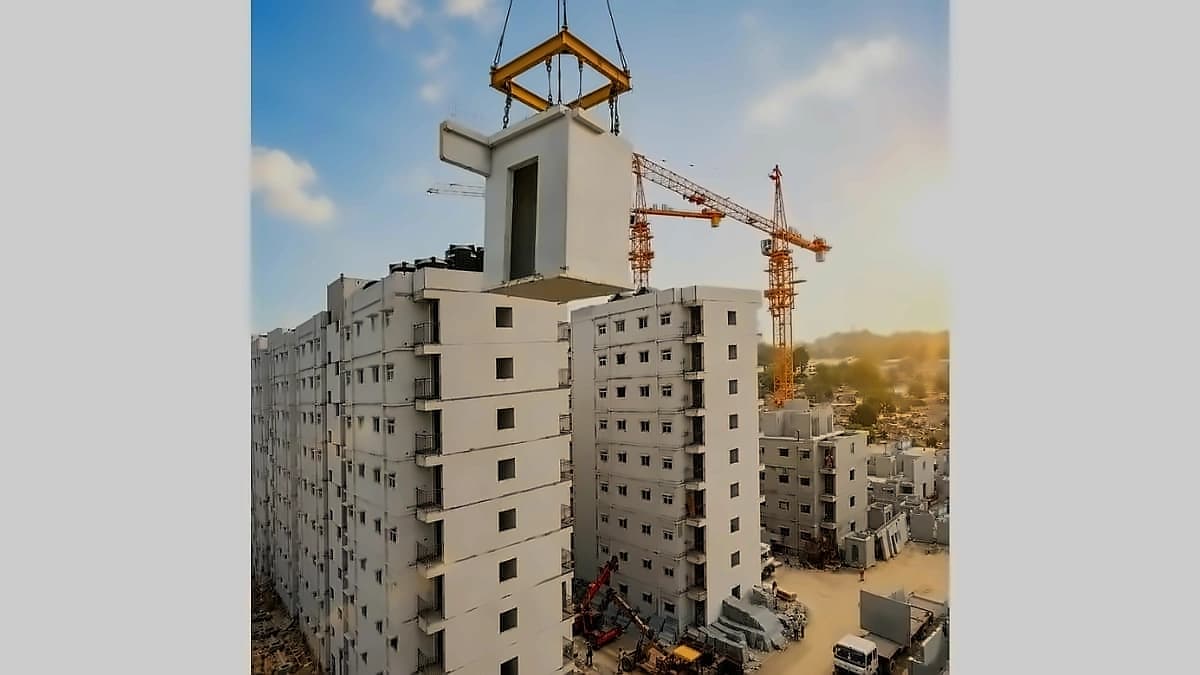
India's precast concrete market is projected to surge from ₹6.7 billion currently to over ₹17 billion within the decade, as reported by Business Standard. The environmental benefits are significant, with India's green-certified footprint already exceeding 15.7 billion square feet, making precast's material efficiency and minimal site waste an indispensable tool for meeting tighter ESG benchmarks. Government-backed affordable housing projects under PMAY are increasingly specifying prefabricated construction technologies, creating consistent project volume for precast component suppliers and driving structural investment in precast manufacturing facilities across North and West India. The market is moderately concentrated at the cement segment level, with the broader building materials market being more fragmented, while North India leads regionally at 31.8% reflecting high construction activity density across Delhi NCR and major infrastructure development corridors.
Residential construction dominates at 52.8% of the market in 2025, sustained by India's structural housing deficit of 18.78 million units in urban areas and government PMAY affordable housing commitments. Infrastructure construction offers the highest volume growth driven by the National Infrastructure Pipeline (NIP) budget allocations, while commercial construction encompasses office, retail, and hospitality development. The market is witnessing increasing adoption of low-carbon and sustainable construction solutions, with initiatives like Godrej Properties' Habitat Matters program promoting innovative materials through live construction projects. Digital building material procurement platforms and e-commerce channels are growing in importance, enabling direct-from-manufacturer procurement that reduces intermediary costs and improves product quality assurance, driving gradual market formalization that favors organized building material brands with verifiable quality standards.