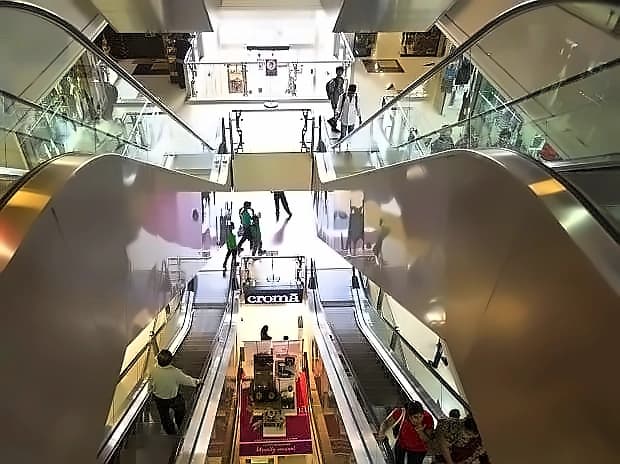
Retail space leasing in shopping malls fell 38% to 0.71 million square feet in the July-September quarter across eight major cities, according to Cushman & Wakefield. Including shopping malls and high-street locations, total retail space leasing declined nearly 5% to 2.22 million square feet in Q3 2026 from 2.33 million sq ft in the year-ago period. High street retail locations dominated leasing activities, accounting for 68% of total gross leasing while shopping malls represented 32% of overall leasing. Of the eight cities - Mumbai, Delhi-NCR, Chennai, Kolkata, Bengaluru, Hyderabad, Pune and Ahmedabad - leasing activities were down only in Mumbai and Pune, with the remaining six cities showing an upward trend.
Delhi NCR emerged as the leading market with 0.55 million square feet of leasing, accounting for 24.9% of total activity, though leasing fell 17.7% from the previous quarter while remaining 7.9% higher than a year earlier. Mint reports that Hyderabad followed with 0.45 million square feet and a 20.3% share, making it the fastest-growing among the three major markets with leasing rising 22% quarter-on-quarter and 18.3% year-on-year. Mumbai ranked third with 0.35 million square feet and a 15.7% share, though leasing declined 29.5% sequentially and 40.8% from a year earlier. The remaining cities showed varied performance with Bengaluru recording 0.24 million square feet, Pune at 0.21 million square feet, Chennai at 0.18 million square feet, Ahmedabad at 0.13 million square feet, and Kolkata at 0.10 million square feet.
Fashion continued to lead retail leasing demand, accounting for 24.9% of total activity in the quarter, followed by Food & Beverage (F&B) with a 19.2% share, while Accessories & Lifestyle contributed 13.1%. Together, these three segments made up 57.2% of overall leasing, as reported by Mint. Department Stores and Entertainment also remained significant, accounting for 7.8% and 7.5% respectively. According to Cushman & Wakefield, Delhi NCR, Hyderabad and Mumbai together accounted for 61% of gross leasing volume across the top eight cities, indicating strong demand concentration in these metropolitan areas.
Despite the Q3 decline, total leasing of retail spaces rose marginally to 6.57 million sq ft in the January-September period, indicating underlying market resilience. According to Cushman & Wakefield, vacancy levels in Grade A malls have tightened to below 5%, with Grade A mall vacancy in NCR specifically at 4.8%. Gautam Saraf, Executive Managing Director at Cushman & Wakefield, noted that India's retail market continues to demonstrate steady underlying occupier interest, even as quality retail space remains constrained. The limited availability of premium retail space is increasingly influencing the pace of leasing, with the 12.7 million sq ft supply pipeline through 2028 coming at an important point in the market cycle. Looking ahead, approximately 12.7 million square feet of Grade A mall supply is expected through 2028, with Delhi NCR leading the pipeline followed by Bengaluru and Chennai.
Large-format malls are expected to account for 56% of India's upcoming shopping mall supply through 2031, with these developments allocating around 30-35% of their space to entertainment, food and beverage (F&B), and services. According to the JLL report, this translates into nearly 9-10 million square feet across the three categories, with large-format malls alone accounting for 28.7 million square feet of the total upcoming supply. These developments are being designed around the experiential and destination needs of shoppers, with technology and design emerging as key differentiators. The report indicates that large-format malls are being designed to combine retail with lifestyle, leisure and services, moving beyond traditional commerce to create lifestyle destinations that blend technology, design, and experience.
Shriram PM Monga, co-founder at property consultancy firm SRED Global, explained that when quality mall space is scarce, retailers naturally turn to high streets, and this quarter's numbers show that clearly. For NCR retailers, high streets are no longer simply a second choice, with well-located high-street stores offering brands strong visibility and direct access to consumers. Monga noted that malls and high streets would work alongside each other rather than competing, advising that brands should have the right mix - high streets for visibility and everyday footfall, and malls for scale and a more complete consumer experience. The next five years are expected to see the emergence of next-generation neighbourhood malls, which will account for 15% of upcoming mall supply, or approximately 7.9 million square feet.