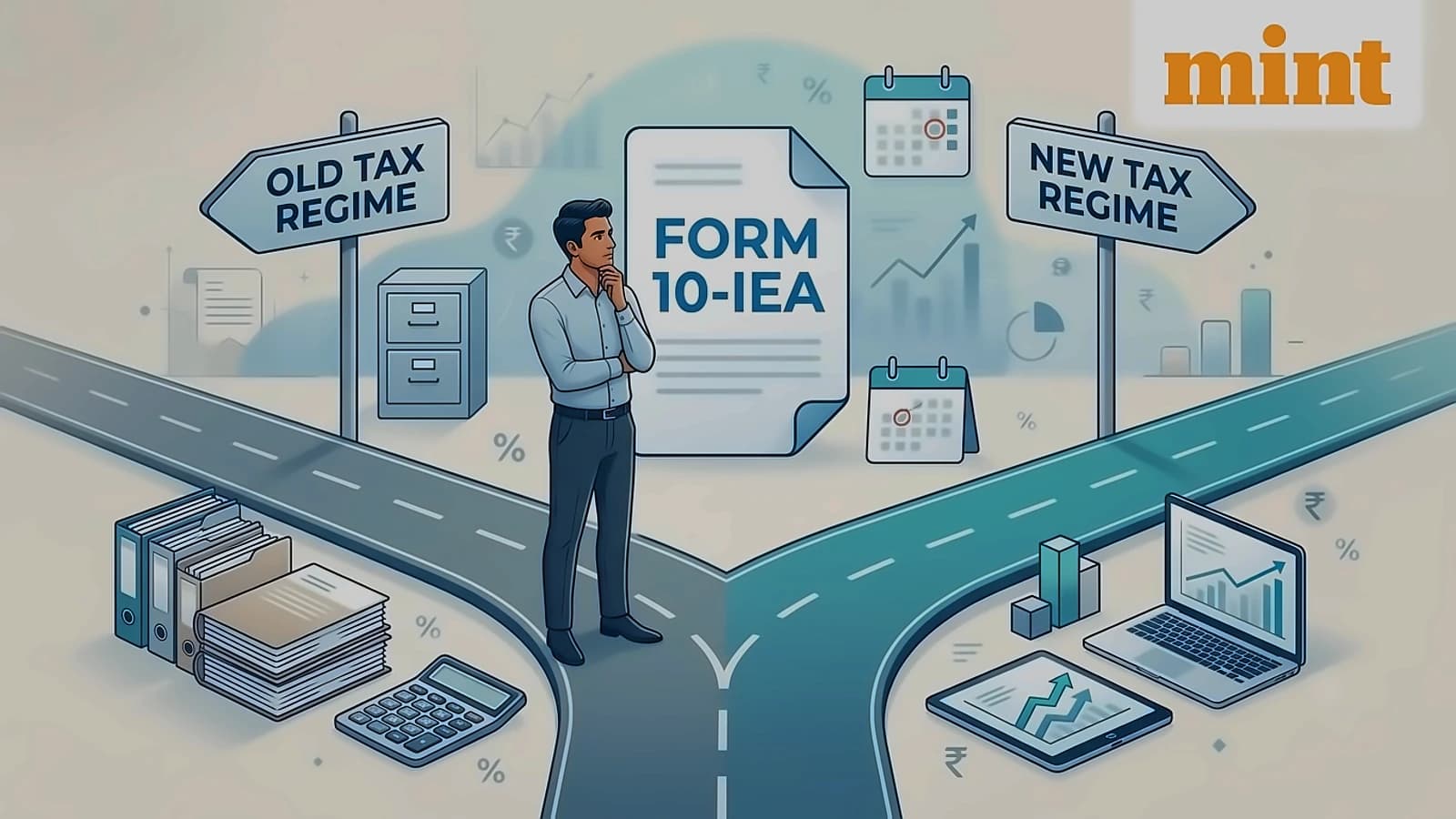
Taxpayers with business or professional income cannot switch between the old and new tax regimes every year. According to reports from Mint, those filing ITR-3 or ITR-4 with business income must use Form 10-IEA to make regime changes, with significant restrictions on re-entry. The new tax regime has been the default regime from assessment year 2024-25, but business taxpayers face different rules compared to those without business income. For taxpayers filing ITR-3 or ITR-4 in non-audit cases for AY 2026-27, Form 10-IEA must be filed by 31 August. As reported by Mint, the form is required for individuals, Hindu Undivided Families (HUFs), and Associations of Persons (AOPs), excluding co-operative societies. If filed after the deadline, the form will be treated as invalid, though it's recommended to submit before filing the ITR to include the acknowledgement number and filing date in the return.
For taxpayers filing ITR-3 or ITR-4 in non-audit cases for AY 2026-27, Form 10-IEA must be filed by 31 August. As reported by Mint, the form is required for individuals, Hindu Undivided Families (HUFs), and Associations of Persons (AOPs), excluding co-operative societies. If filed after the deadline, the form will be treated as invalid, though it's recommended to submit before filing the ITR to include the acknowledgement number and filing date in the return.
Form 10-IEA can only be filed twice during a taxpayer's lifetime - once to opt out of the new regime and once to re-enter it. According to Mint reports, once a taxpayer returns to the new regime, they cannot choose the old regime again while they continue to have business or professional income. This means business taxpayers get only one chance to opt out of the new regime and one chance to return to it during their lifetime. The new regime vs old regime decision often comes down to whether your combined deductions exceed the gap created by the new regime's lower rates. When your total deductions exceed about ₹3.5-4 lakh, the old regime may still be more beneficial, particularly for taxpayers with home loans, Section 80C investments, and HRA claims. The core of this choice lies in the fundamental difference between the regimes: lower rates with fewer deductions versus higher rates with more room to reduce taxable income.
For FY 2026-27, Budget 2026 left the slabs unchanged from the previous year, creating different advantages for each regime. Under the new regime, resident individuals earning taxable income up to ₹12 lakh get a rebate of up to ₹60,000, bringing tax liability to nil. The new regime offers a nil tax slab up to ₹4 lakh and tax-free income of around ₹12.75 lakh, with the 30% rate only kicking in above ₹24 lakh instead of ₹10 lakh. In contrast, the old regime retains provisions such as 80C, 80D, HRA, and home loan interest deductions, which have been discontinued in the new regime. Salaried taxpayers without business income can choose either regime each financial year, based on which one lowers their tax. However, business owners and professionals face stricter switching rules, making the decision more complex for them. The old regime's rebate applies only up to ₹5 lakh of taxable income, with a standard deduction of ₹50,000, while the new regime offers a standard deduction of ₹75,000, making the tax-free window far wider.
The old regime remains relevant for one reason: deductions. If your annual deductions add up, the higher slab rates may still leave you paying less overall. Some popular exemptions include investments made in Section 80C instruments such as PPF, ELSS, life insurance, and 5-year FDs worth up to ₹1.5 lakh; Section 80D health insurance premium; HRA exemption for salaried individuals making payments towards rent; Section 24(b) home loan interest paid worth up to ₹2 lakh for self-occupied property; and LTA. All these do not hold any relevance under the new system except for a few cases. When your total deductions exceed about ₹3.5-4 lakh, the old regime may still be more beneficial, particularly for taxpayers with home loans, Section 80C investments, and HRA claims. Those who earn higher and have fewer allowable deductions tend to benefit more from the new regime's low rates. The decision comes down to whether your combined deductions exceed the gap created by the new regime's lower rates. Taxpayers with an active home loan and 80C investments often find the old regime still wins on paper, while those with fewer deductions typically benefit more from the new regime's tax-free income threshold of ₹12.75 lakh.