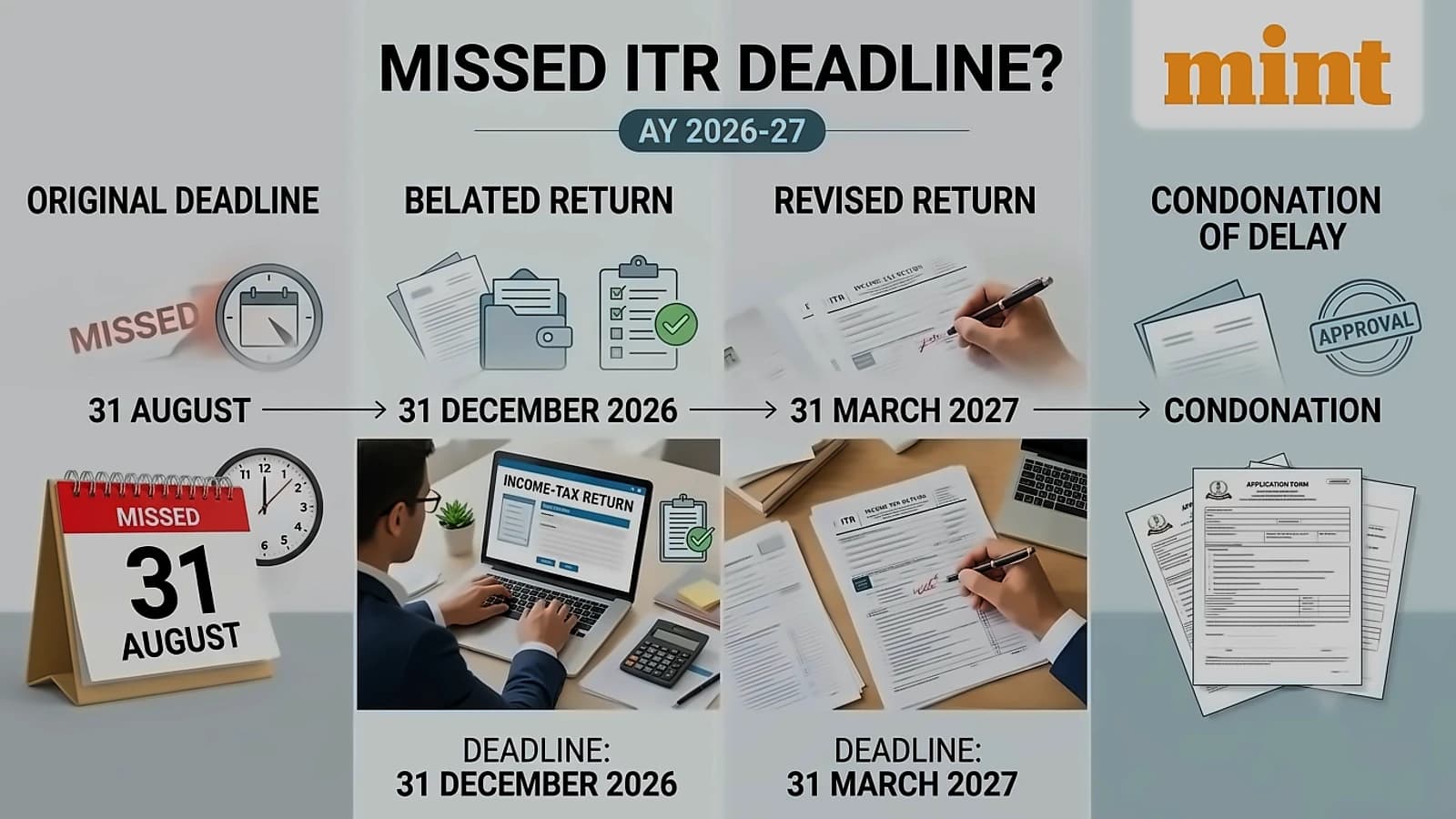
For taxpayers not subject to tax audit, the ITR filing deadline for Assessment Year 2026-27 is August 31, 2026. According to reports from Personal Finance News and Mint, this includes applicable taxpayers whose return falls under the extended due-date category. However, for taxpayers whose accounts are required to be audited, the ITR filing deadline is October 31, 2026. The Income Tax Department has confirmed that the tax audit report for FY 2025-26 (AY 2026-27) is due by September 30, 2026 for taxpayers whose corresponding ITR filing deadline is October 31. Salaried employees and pensioners filing ITR-1 or ITR-2 forms had their deadline on July 31, 2026, while freelancers, professionals, and small business owners filing ITR-3 or ITR-4 forms had their deadline on August 31, 2026. As per Personal Finance News, the August 31 deadline specifically applies to eligible taxpayers filing ITR-3, ITR-4, ITR-5 or ITR-7 whose income is from business or profession and who are not subject to tax audit under the Income-tax Act, 1961.
September 15 marks a critical deadline for taxpayers liable to pay advance tax, requiring them to have paid 45% of their estimated annual advance-tax liability cumulatively. As reported by Personal Finance News and Mint, December 15 is the next major advance-tax deadline, when taxpayers generally need to have paid 75% of their estimated annual advance-tax liability cumulatively. For people with significant income from sources such as business, professional fees, capital gains, interest or other non-salary income, keeping track of advance-tax payments is particularly important. Advance tax applies when your total liability for the year is likely to top ₹10,000, with different payment schedules under normal ITR-3 filing versus the 44ADA presumptive scheme. The instalments are particularly critical for taxpayers with significant income from professional fees, business, interest, capital gains or other non-salary sources, as failing to pay advance tax on time can result in taxation-related penalties, including interest and fines.
Freelancers have two primary options for ITR filing under the new regime for AY 2026-27. ITR-4 (Sugam) is best suited for freelancers using presumptive taxation under Section 44ADA, where they declare 50% of gross receipts as profit and skip detailed bookkeeping. This form suits most solo freelancers whose real costs are modest, such as a laptop, internet and a few subscriptions. ITR-3 is recommended for freelancers claiming actual expenses, or when receipts cross the presumptive limits, requiring proper books of account, profit and loss statements, and balance sheets. The gross receipts limit under 44ADA is up to ₹50 lakh, or ₹75 lakh if 95%+ of receipts are digital, with no upper limit for ITR-3 filers. As per Personal Finance News, the choice between ITR-3 and ITR-4 depends on whether your income is from business or profession and whether you're subject to tax audit under the Income-tax Act, 1961.
October 31 serves multiple purposes for tax compliance. According to the Income Tax Department, October 31 is also an important date for certain TDS and TCS reporting requirements for the July-September quarter. Additionally, the tax audit report for transfer-pricing cases is due by October 31, while the corresponding ITR filing deadline is November 30, 2026. This creates a compressed timeline for taxpayers requiring transfer-pricing audits. For foreign client income, money from overseas clients is fully taxable in India regardless of whether it was taxed elsewhere, and must be reported in rupees using the exchange rate on the receipt date. The ITR filing deadline for certain transfer-pricing cases is October 30, 2026, requiring taxpayers to be prepared for this compressed timeline. For business owners and traders, timely filing can be particularly important as it affects their ability to carry forward certain eligible losses.
No official extension has been announced by CBDT for the current filing season, contrary to some outdated information still circulating online. The new Income Tax Act 2025 came into force from April 1, 2026, but filing for AY 2026-27 remains entirely governed by the old 1961 Act, meaning no procedural changes apply to this year's filing process. Taxpayers who have missed their original deadlines can file belated returns under Section 139(4) by December 31, 2026, along with applicable late fees of up to ₹5,000. Under Section 234F, the late filing fee structure is ₹1,000 if your total income does not exceed ₹5 lakh and ₹5,000 in other cases, with interest also applying where tax remains payable. A revised return can generally be filed until March 31, 2027, subject to applicable conditions and additional Section 234-I fee after December 31. The Income Tax Department has clarified that AY 2026-27 relates to income earned in FY 2025-26 and is governed by the Income-tax Act, 1961, even though the new Income-tax Act, 2025, came into force on April 1, 2026.