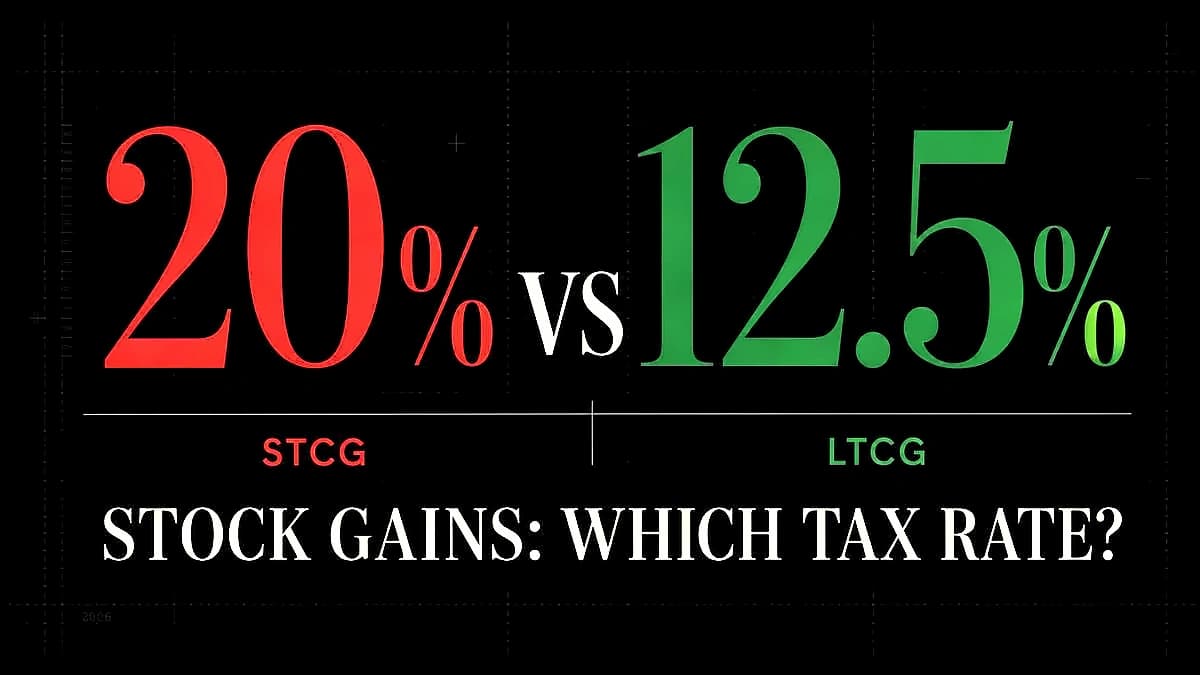
Stock market investors and traders face different tax treatments based on their activity classification. According to Mint reports, the tax treatment depends on whether the activity is for long-term wealth creation or regular business trading. For investors, listed equity shares and equity-oriented mutual funds held for 12 months or less attract 20% short-term capital gains (STCG) tax. Holdings of more than 12 months attract 12.5% long-term capital gains (LTCG) tax on gains exceeding the annual exemption of ₹1.25 lakh, subject to applicable conditions and STT. Trading income is treated as business income and taxed according to the applicable income tax slab rate. The tax treatment of dividend income is separate from the tax treatment associated with selling preferred shares, with a sale transaction creating capital gains or losses depending on the share's adjusted cost base and selling price.
As reported by Mint, no single transaction or holding period will provide a definitive answer for distinguishing between investor and trader classifications. The classification depends on the overall intention and nature of the activity, with key factors including the number, frequency and volume of transactions, average holding period, whether funds are borrowed or provided by third parties, time devoted to stock-market activity, trading strategy, and tax treatment followed in earlier years. Buying shares with clear intention of long-term holding indicates investment activity, while frequent buying and selling with profit objectives may indicate business or trading activity. According to Siddharth Maurya, Founder and Managing Director of Vibhvangal Anukulara, the classification depends on the overall intention and nature of the activity, with factors including the number, frequency and volume of transactions, whether funds are borrowed or provided by a third party, time devoted to stock-market activity, trading strategy, and tax treatment followed in earlier years.

According to Mint reports, an individual earning capital gains from equity shares along with salary or house-property income needs to file ITR-2. Capital gains should be reported separately as STCG or LTCG under Schedule CG, while dividend income from all brokers and demat accounts should be reported under 'Income from Other Sources' and taxed at applicable slab rates. Intraday trading, F&O, and delivery-based equity trading treated as business activities require ITR-3 filing, with trading turnover, business expenses, profit or loss, and other financial details reported in business income schedules. ITR-4 under presumptive taxation may be considered by eligible taxpayers, but is not appropriate where there are STCG, carried-forward losses, or complex trading activities. In Canadian taxation, preferred share dividends issued by taxable Canadian corporations may qualify as eligible dividends or non-eligible dividends depending on the corporation paying the dividend, with eligible dividends generally originating from corporate income that has already been taxed at higher general corporate tax rates.
As explained by Mint, short-term capital losses can be set off against both short-term and long-term capital gains, while long-term capital losses can be set off only against long-term capital gains. Intraday speculative losses can be set off only against speculative profits. ITR-3 needs to be used where there are both trading and investment activities, with taxpayers required to reconcile AIS, Form 26AS, broker tax reports, and contract notes. Intraday trading, F&O, unlisted shares, ESOPs, foreign shares, and overseas broker accounts require careful review. In Canadian taxation, Part IV.1 tax is a 10% tax levied on corporations that receive dividends on taxable preferred shares, to the extent that those dividends were deductible under Section 112 or 113, or subsection 115(1) or 138(6) of the Act, while Part VI.1 tax may apply to the payer corporation to limit tax advantages from preferred share financing structures.
According to Mint reports, a major mistake is reporting all stock-market gains as capital gains, irrespective of whether the activity qualifies as trading. Other common errors include failing to disclose intraday and F&O losses for carrying them forward, omitting dividend income, ignoring transactions across multiple brokers, incorrectly calculating F&O turnover, and applying incorrect loss set-off rules. Taxpayers should ensure comprehensive reconciliation of all stock market activities and transactions across different platforms to avoid these common filing mistakes. In Canadian taxation, not every preferred-share dividend automatically qualifies as an eligible dividend, with classification determined on the corporation paying the dividend and how the payment is designated for tax purposes, while foreign preferred-share dividends may not qualify for the Canadian dividend tax credit even when held in a taxable account.