For long-term wealth creation, investors have three primary options: Systematic Investment Plans (SIPs) in mutual funds, Recurring Deposits (RDs) in post offices, and Public Provident Fund (PPF). According to reports from NDTV Profit, while SIPs involve investing fixed amounts in market-linked mutual funds, RDs allow depositing fixed sums monthly at guaranteed interest rates, and PPF offers risk-free government-backed savings with tax benefits. SIPs have potential for higher long-term returns but are subject to market fluctuations, while RDs provide stable and predictable returns backed by government support. As InvestKraft emphasizes, 2026 is the perfect year to upgrade from saving to investing as inflation continues reducing the real value of savings, with what feels like ₹1,00,000 today worth only around ₹87,000 in real value after a few years if inflation continues.
For a ₹25,000 monthly SIP investment over 5 years at 12% annual returns, the total investment requirement is ₹15 lakh. As reported by NDTV Profit, the estimated gains after 5 years would be ₹5.62 lakh, bringing the total corpus to approximately ₹20.62 lakh. In contrast, a similar post office RD investment at the current 6.7% returns would yield a total corpus value of ₹17.85 lakh. The difference between the two approaches remains relatively modest in the first 5 years, but higher compounding potential begins to show as investment duration increases. According to InvestKraft, 2026 offers more opportunities than ever before, including real estate fractional platforms and strong returns from equities and mutual funds.
For a ₹25,000 monthly SIP investment over 10 years at 12% annual returns, the total investment requirement is ₹30 lakh. According to NDTV Profit calculations, the returns would amount to ₹28.08 lakh, resulting in a total corpus of ₹58.08 lakh. In comparison, a post office RD for 10 years at 6.7% returns would generate approximately ₹12.80 lakh returns on the same ₹30 lakh investment, reaching a total corpus of ₹42.80 lakh. The difference between the two strategies becomes more pronounced due to mutual funds' higher compounding benefits over the extended period. Mint reports that SIPs allow you to set up SIP for any period from 6 months onwards with no upper limit, providing flexibility for investors with varying investment horizons.
Over a 20-year investment period, the performance gap between SIPs and RDs becomes substantial. As reported by NDTV Profit, a post office RD requiring ₹25,000 monthly investments would result in a total corpus of ₹1,26,29,090 at 6.7% returns. In contrast, a SIP investment of the same amount over 20 years at 12% annual returns could potentially grow to ₹2,49,78,697, representing nearly four times the growth compared to RDs. The post office RD would double the invested amount through steady, guaranteed returns, while SIPs in equity mutual funds have the potential to grow investments significantly higher over longer durations. Mint reports that for PPF, the account is for 20 years, including a lock-in period of 15 years with indefinitely renewable extension in five-year blocks each.
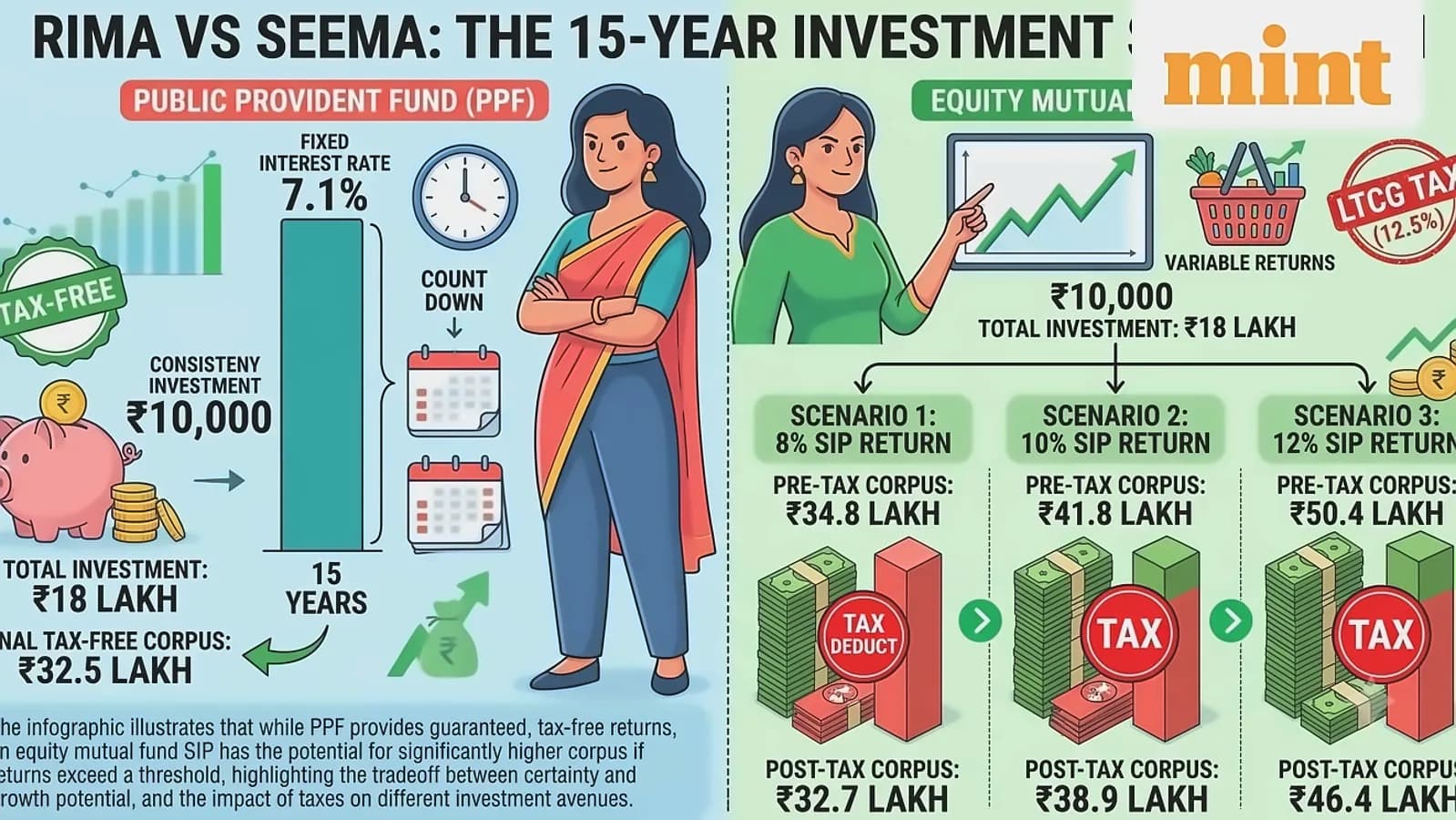
For a ₹12,500 monthly investment over 30 years, the performance differences become even more pronounced across all three investment options. Mint analysis shows that at 7.1% rate of return for PPF over 30 years, ₹12,500 invested per month accumulates a total corpus of ₹1,54,50,911 including ₹45 lakh invested amount and ₹1,09,50,911 earned interest. At 12% rate of return for SIPs over 30 years, ₹12,500 invested per month accumulates a total corpus of ₹3,53,77,847.93, representing over ₹3.53 crore in total value. However, when accounting for inflation at 6%, SIPs yield a more realistic ₹1,02,09,280.54 total corpus after 30 years. The data demonstrates that while PPF offers guaranteed returns with tax benefits, SIPs provide significantly higher potential returns for investors willing to accept market risk.

According to NDTV Profit analysis, the choice between SIPs, RDs, and PPF depends on several factors including risk tolerance, investment horizon, and income sources. For conservative investors with a 5-year investment horizon, RDs may be suitable as the difference between the two approaches remains relatively modest. However, for longer investment durations, investors should consider mutual funds based on their financial goals and risk appetite. The calculations demonstrate that while SIPs may reward investors significantly higher in longer duration periods, the optimal choice depends on individual risk profiles and investment objectives. As InvestKraft notes, before choosing an investment, consider your specific goals, whether you want safety or high returns, need regular income or long-term growth, as these factors will help determine the right investment plan for your financial journey. Mint emphasizes that both PPF and SIPs are solid long-term investment instruments that can meet financial goals such as wedding funding, children's education abroad, house buying, retirement planning, or wealth building.