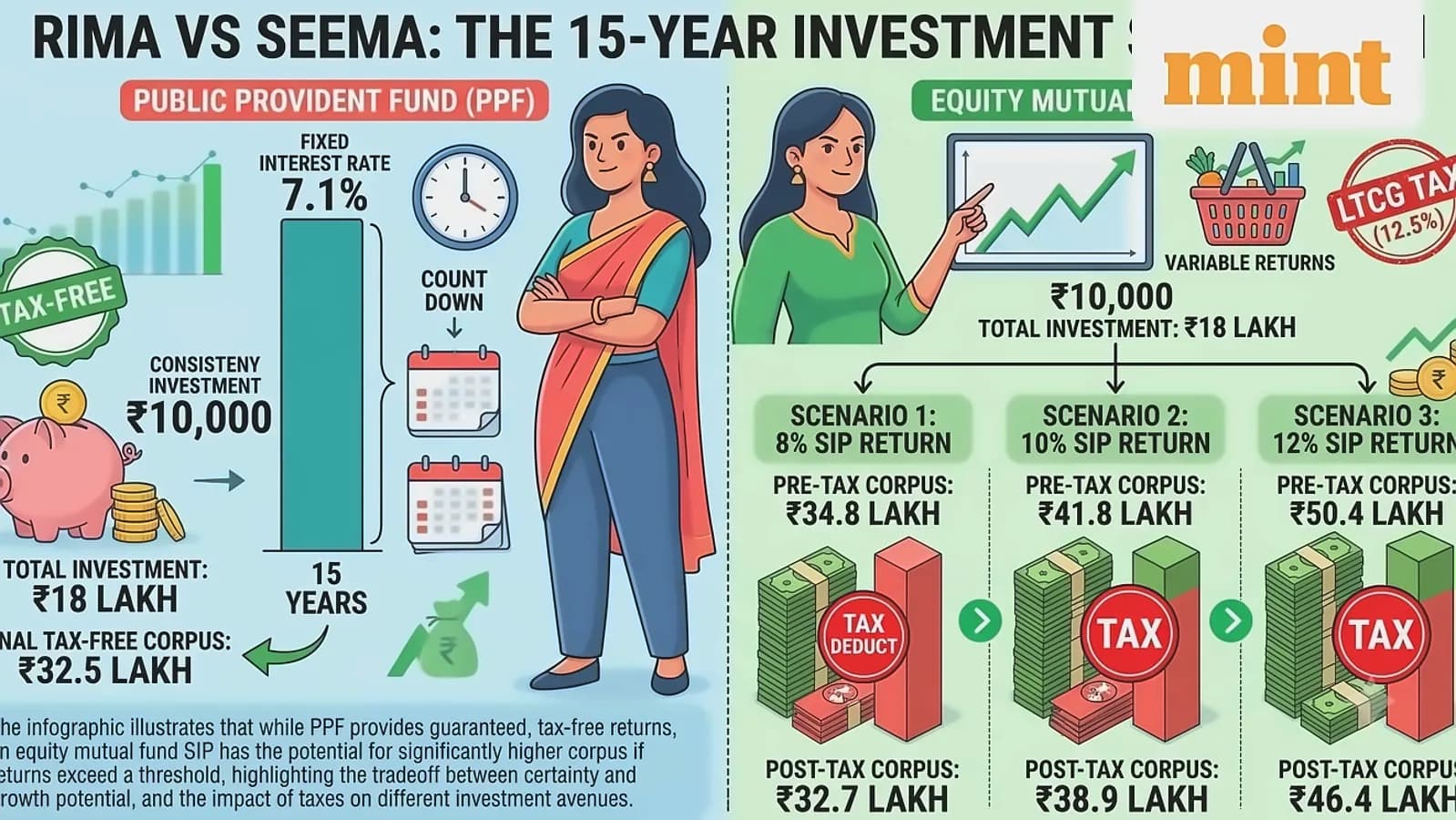
Two investors, Rima and Seema, are both investing ₹10,000 monthly over 15 years but choosing different investment approaches. According to reports from Mint, Rima invests in the Public Provident Fund (PPF) while Seema opts for an equity mutual fund through SIP. The comparison reveals significant differences in wealth creation potential based on investment type and market performance.
For Rima's PPF investment, as reported by Mint, her total investment of ₹18 lakh at the end of 15 years would generate a corpus of approximately ₹32.5 lakh at maturity. The PPF currently offers an interest rate of 7.1%, and the interest earned is exempt from income tax. Since PPF maturity proceeds are tax-free, the entire amount remains with the investor, providing complete capital protection.
For Seema's SIP investment, according to Mint analysis, her ₹18 lakh total investment would yield varying results based on market performance. In scenarios where the SIP earns 8% annually, the corpus could grow to around ₹34.8 lakh before tax, but after accounting for long-term capital gains tax of 12.5%, the post-tax corpus would be approximately ₹32.7 lakh. Higher performance scenarios show potential for ₹41.8 lakh (10% returns) and ₹50.4 lakh (12% returns) before tax, translating to ₹38.9 lakh and ₹46.4 lakh respectively after tax.
Recent analysis reveals that inflation significantly affects SIP returns when viewed in real terms rather than nominal terms. As explained by growwithsip, when SIP returns are 12% while inflation runs at 6%, the real return is approximately 5.66% - not the 6% that appears in nominal calculations. This difference becomes substantial over longer investment periods, with the gap widening as inflation rates increase. The analysis emphasizes that while nominal SIP returns can appear impressive, real returns must account for inflation to provide meaningful purchasing power protection.
The comparison reveals that when SIP returns were at 8%, the post-tax advantage over PPF is almost negligible. However, the gap widens significantly when SIP earns 10% or 12% annually, particularly when inflation is factored in. The analysis highlights that PPF provides predictable returns and capital protection, while equity SIP returns are market-linked and can fluctuate sharply. Rima benefits from certainty and tax-free wealth creation, while Seema gains the possibility of significantly higher wealth through market participation but must tolerate volatility and inflation impact.
According to the analysis from Mint, the comparison demonstrates that while both investments offer wealth creation potential, they serve different investor profiles. PPF provides certainty and tax efficiency for conservative investors seeking capital protection, while equity SIPs offer higher potential returns but require tolerance for market volatility and long-term commitment. The choice between these options depends on individual risk appetite, investment horizon, and tax planning considerations for the 15-year investment period, with inflation becoming a critical factor in SIP performance evaluation.