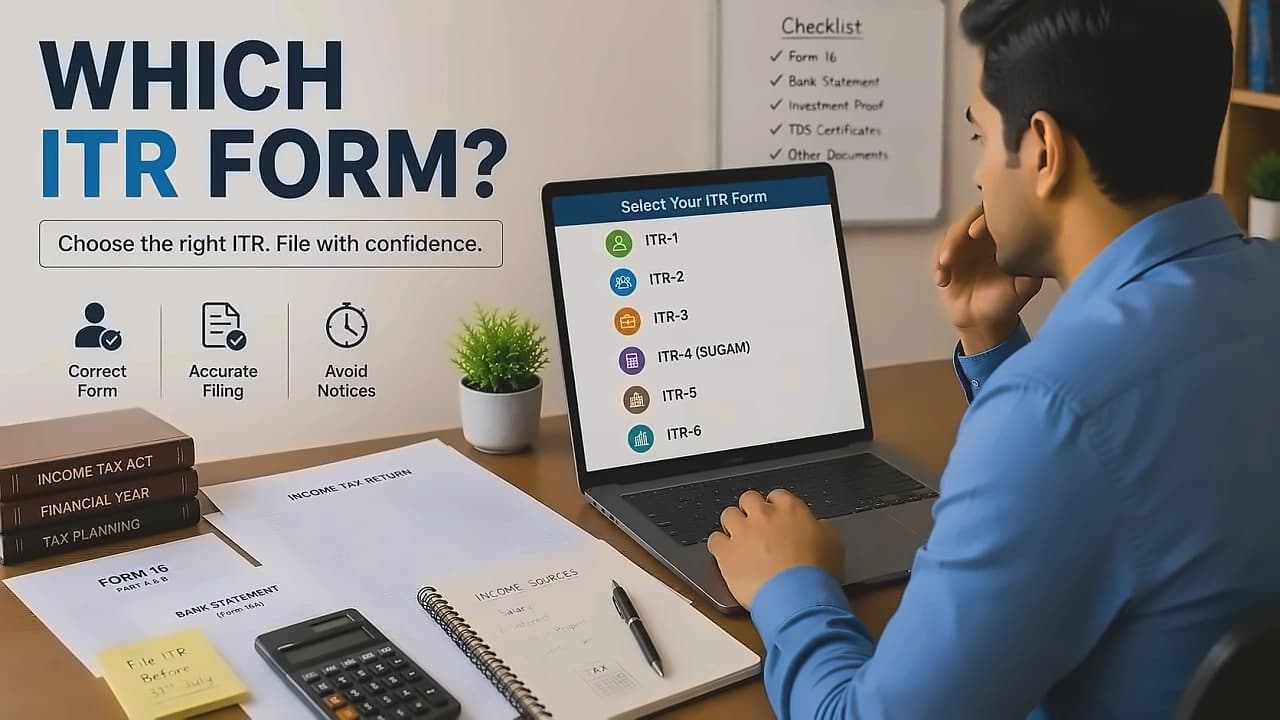
Senior citizens with bank deposit interest and mutual fund dividends face specific ITR form requirements based on their investment activities. According to personal finance expert Balwant Jain, ITR-1 cannot be used if you have any foreign income or signing authority in a foreign account. The form is also restricted when taxable income from bank deposits and mutual fund dividends exceeds ₹50 lakh. Additionally, ITR-1 cannot be used if you have redeemed any mutual fund investments during the year, as the difference between NAV at acquisition and redemption is taxed as capital gains.
The requirement to use ITR-2 instead of ITR-1 becomes mandatory if mutual fund redemptions occurred during the year, regardless of whether the gains are classified as long-term or short-term capital gains. As reported by Jain, ITR-2 is also required if you have capital losses to carry forward, as this form allows for loss carry-forward provisions. The distinction between ITR-1 and ITR-2 becomes crucial for senior citizens with mutual fund investments, as the latter form provides comprehensive capital gains calculation capabilities.
Senior citizens can choose between the old tax regime and new tax regime based on their normal income composition. According to the analysis, if normal income does not exceed ₹12 lakh but exceeds ₹5 lakh, the new tax regime offers benefits with tax rebate up to ₹60,000 against normal income tax liability. However, if taxable income does not exceed ₹5 lakh, the old tax regime may be more beneficial as it provides rebate up to ₹12,500 against tax liability on all income except long-term capital gains from equity-oriented mutual fund schemes.
For senior citizens over 75 years receiving pension and interest income from the same bank, Form 12BBA provides a simplified declaration process under Section 194P of the Income Tax Act. As per Jain's guidance, this form must be submitted annually before year-end to ensure banks deduct appropriate tax considering total tax liability on pension and interest income. Banks deduct only 10% tax at source on interest for resident taxpayers, with no surcharge deduction if interest amounts don't exceed ₹50 lakh. If excess TDS has been deducted, senior citizens can claim refunds by filing ITR, including surcharge amounts if applicable.
Even when tax liability is zero, senior citizens should consider filing a nil return for several practical reasons. According to recent guidance, filing a nil return takes less than 30 minutes online with no fee and no penalty. Key benefits include the ability to claim TDS refunds on bank interest and freelance payments, maintain a continuous ITR record for future loan applications, and preserve the option to carry forward capital losses for up to 8 years if stock or mutual fund trading occurred during the year. The filing process is identical to regular ITR, requiring only basic income details and deductions, with no late filing fees under Section 234F since there's no unpaid tax due.