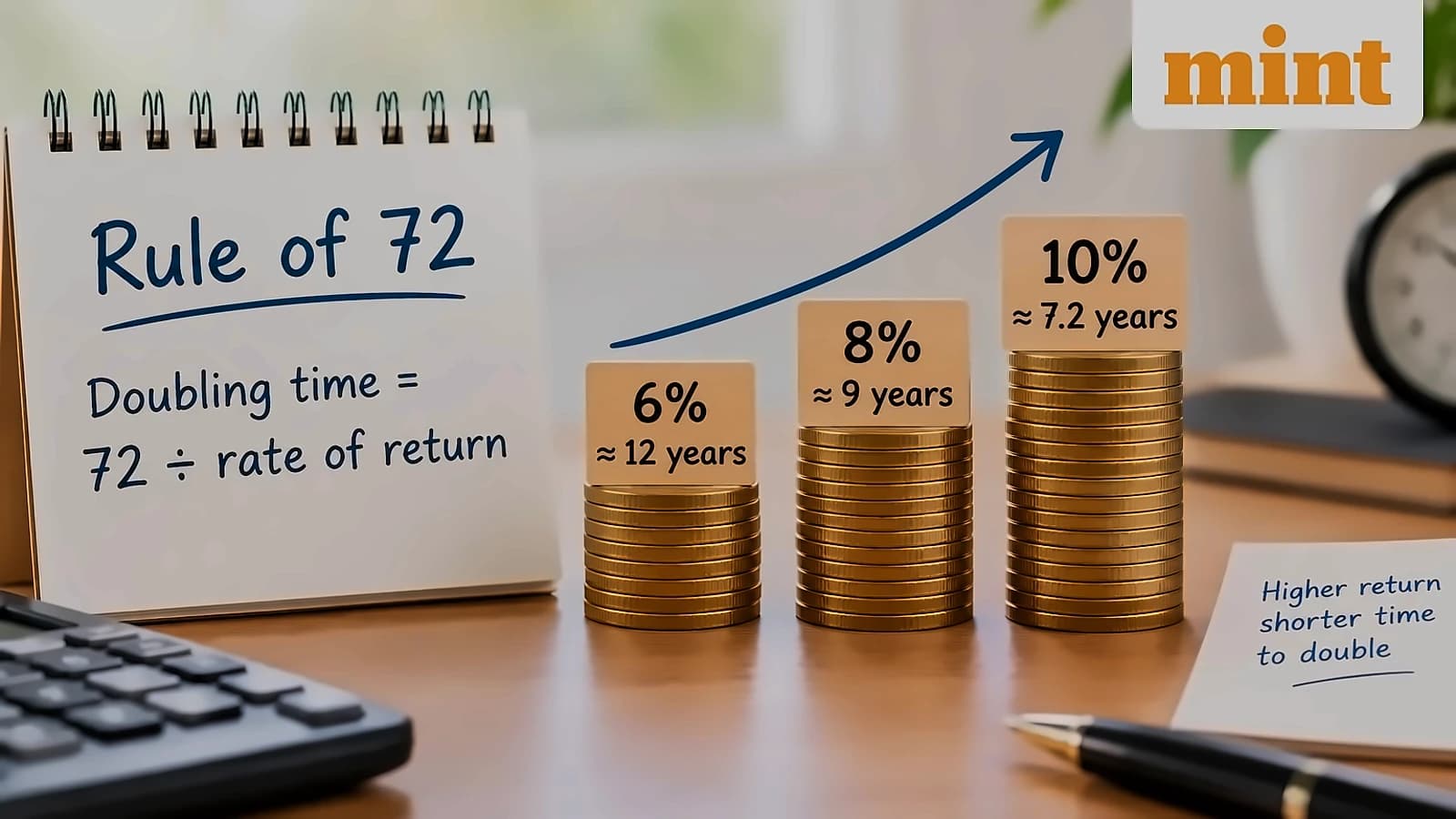
The Rule of 72 is a simple personal finance shortcut that helps investors estimate how long an investment may take to double. According to reports from Mint, the calculation formula is straightforward: Approximate doubling time = 72 ÷ annual rate of return. At a 6% annual return, ₹1 lakh would take approximately 12 years to become ₹2 lakh. Similarly, at 8% annual return, ₹1 lakh would take roughly 9 years to double, while at 10% annual return, the same amount would take about 7.2 years to reach ₹2 lakh. The rule works by dividing 72 by the annual rate of return, making it particularly helpful when comparing different rates of return without performing detailed compound-interest formula-based calculations.
The rule demonstrates how even seemingly small differences in return rates can significantly impact wealth accumulation over time. As reported by Mint, at a superlative 25% return rate, the doubling period falls to approximately 2.88 years (72 ÷ 25 = 2.88). This underlines the importance of compounding and rate of return in long-term wealth building. Given that fixed deposit rates range from 6-8.5% across various lenders nationwide, the total time required to double base investments is estimated at 8.4 to 12 years approximately, assuming an interest rate of 8.5%. The calculations showcase that even seemingly insignificant differences in return rates can have profound impacts on long-term wealth compounding.
The calculations showcase why compounding and return rates matter significantly in long-term wealth building. According to Mint, an investor starting with ₹1 lakh would see their money double in 12 years at 6% annual return, while at 9% return, the estimate drops to 8 years. However, actual investment returns can fluctuate, and factors such as taxes, fees, and inflation can impact final outcomes. The Rule of 72 should be treated as a quick estimation tool rather than a guarantee of investment returns within specified periods. For example, an investor with ₹1 lakh would see their money double in 7.2 years at 10% annual return, while the same amount would take 12 years at 6% return.
For meaningful financial planning, investors should consider investment return patterns, costs, applicable taxes, and risks alongside compounding implications. As reported by Mint, the Rule of 72 provides an approximate estimate of doubling time and is not a guarantee of investment returns. Actual outcomes may vary based on returns, taxes, fees, inflation, and investment risks. The rule serves as a useful tool for rough estimation rather than a definitive timeline for investment doubling. Given the current fixed deposit rate range of 6-8.5%, investors can expect their base investments to double within 8.4 to 12 years approximately, assuming an interest rate of 8.5%. These calculations clearly elucidate why compounding and the rate of return both matter in the long-run when building wealth, though actual investment returns can fluctuate over time.