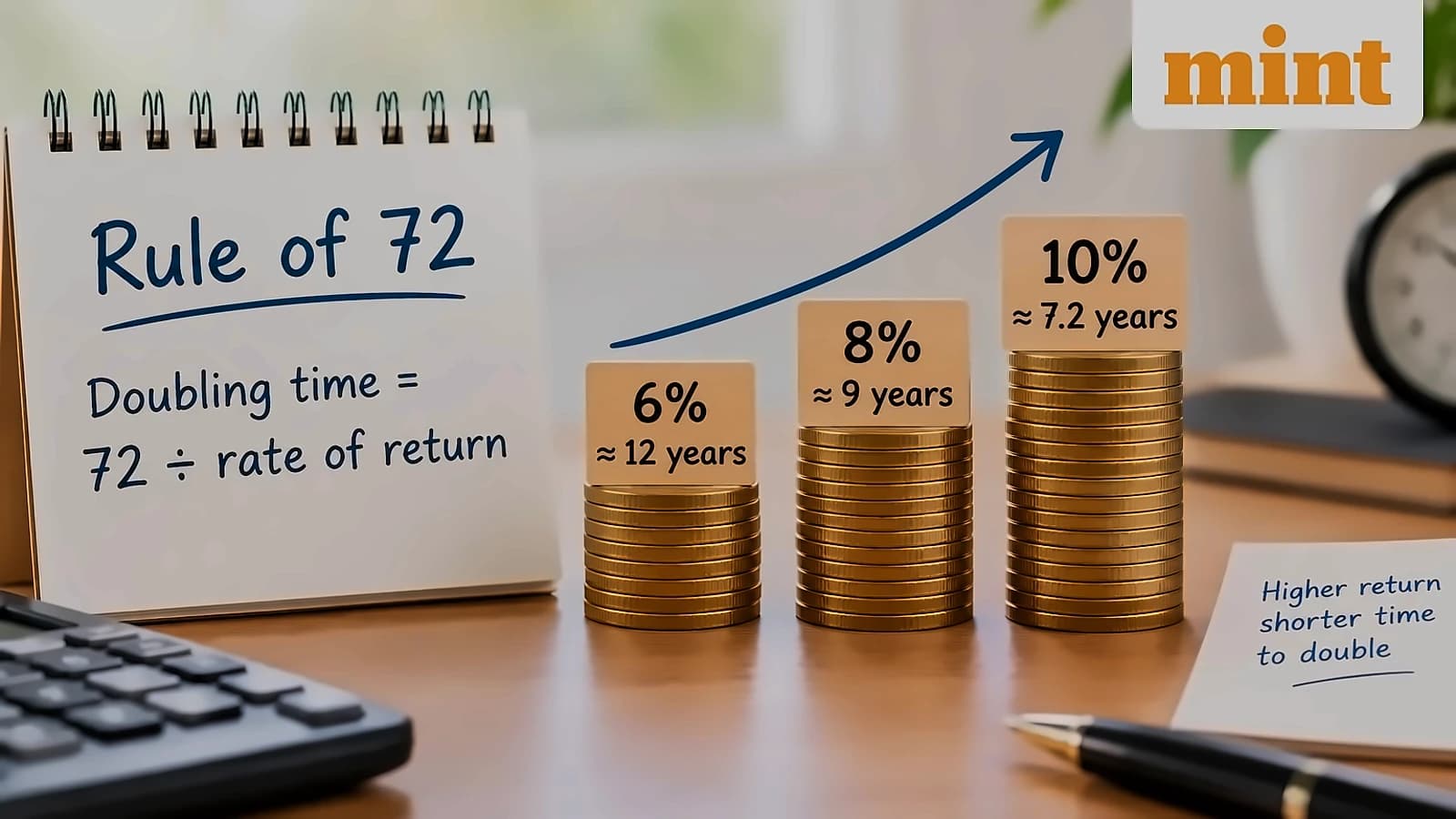
The Rule of 72 is a simple mathematical formula that provides a quick estimate of how long it takes for money to double at different annual returns. According to reports from Mint, the rule works by dividing 72 by the annual return you expect from your investment. This calculation gives a rough idea of how many years your money may take to double, though it does not provide an exact maturity date. The rule is particularly useful when comparing different rates of return and their impact on long-term wealth creation, as demonstrated by the latest analysis showing how small changes in returns can become important when money remains invested for several years.
Using the Rule of 72 with a ₹10 lakh investment, the doubling periods vary significantly based on the annual return. At 6% annual return, the calculation yields 12 years for the money to double to ₹20 lakh. At 8% annual return, the same investment would double in approximately 9 years, representing a 3-year savings compared to the 6% scenario. As reported by Mint, this demonstrates how small changes in returns can become important when money remains invested for several years. The latest analysis confirms that this works out to about 12 years for the money to double, making it a useful example for investors preferring investments with relatively moderate returns and avoiding excessive risk.
At 10% annual return, the Rule of 72 calculation results in approximately 7.2 years for the money to double, representing a little over 7 years to reach ₹20 lakh. According to Mint, this scenario shows the accelerated growth potential of higher returns. The most dramatic improvement occurs at 12% annual return, where the calculation yields 6 years for doubling, significantly faster than the 6% scenario's 12-year timeline. As reported in the latest analysis, this works out to roughly 6 years for the money to double, demonstrating how compounding accelerates growth when future returns are earned on existing gains.
The primary factor driving faster money growth over time is compounding, where future returns are earned on existing gains. As reported by Mint, this mechanism speeds up growth significantly over several years, with the latest analysis confirming that once your investment earns a return, future returns can also be earned on the gains already made. However, tax implications can impact actual returns, as taxable returns will reduce the amount available for reinvestment. The Rule of 72 serves as a quick guide for understanding return impact, but should not be treated as a definitive promise, as actual results depend on consistent returns throughout the investment period. The bigger lesson for investors remains that a reasonable return, enough time, and patience can make a big difference to long-term wealth creation.