The Employees' Provident Fund Organisation (EPFO) has implemented a new wage ceiling of ₹25,000 effective Thursday, September 17, 2026, marking a significant shift in India's social security landscape. As reported by Business Standard, this decision will directly impact over 51 lakh workers who previously fell outside mandatory social security coverage. The Union Cabinet approved the increase on September 16, 2026, making this the first revision of the ceiling in 12 years since the last increase in September 2014. Under the new framework, employees earning up to ₹25,000 as basic pay plus dearness allowance are now mandatorily required to join both EPF and EPS schemes, with the current contribution by both employer and employee set at ₹3,000 each (12% of ₹25,000). The policy change represents a decisive turning point for India's workforce landscape, particularly targeting the salary band where informal hiring previously thrived. However, as clarified by the Prime Minister's Office, this does not create new jobs but rather brings existing employees in the ₹15,000-₹25,000 wage band under mandatory coverage. The Periodic Labour Force Survey (PLFS) Annual Report 2025 showed that average monthly earnings of regular wage/salaried workers were ₹22,699 in 2025, with both men and women earning within the new ₹15,000-₹25,000 wage band.

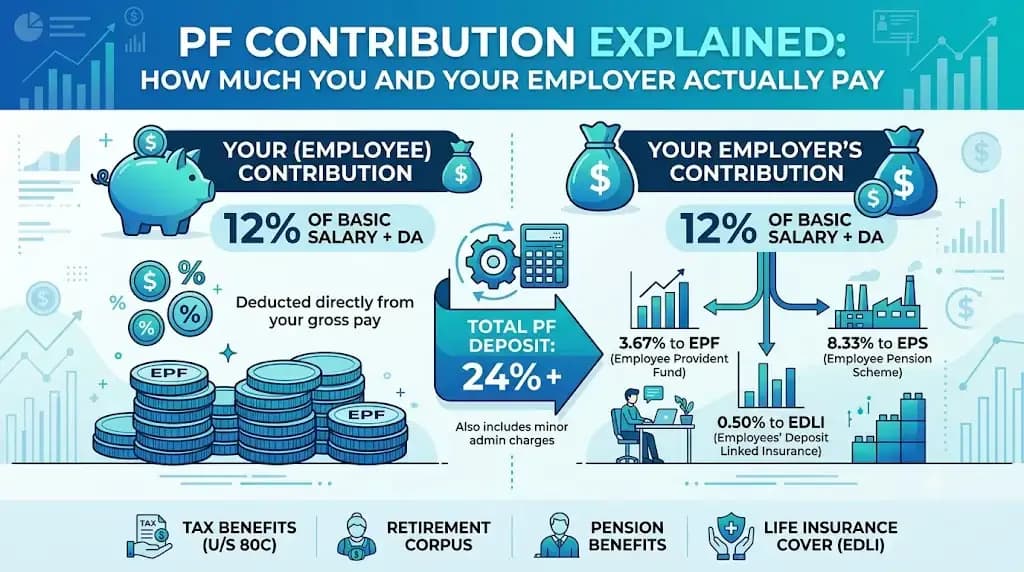
The wage ceiling revision significantly increases monthly PF contributions, with employee contributions rising from ₹1,800 to ₹3,000 at the new ₹25,000 ceiling. As reported by NDTV Profit, this represents an additional ₹1,200 monthly contribution compared to the previous ₹15,000 ceiling. The employer's 12% share would also increase to ₹3,000, with the allocation split between EPS (approximately ₹2,083) and EPF (about ₹918). This would result in roughly ₹3,918 monthly contribution into the EPF account before considering interest. The Employees' Pension Scheme (EPS) contribution remains at 8.33% of eligible wages, with the remaining portion of the employer's contribution directed towards EPF. The Employees' Deposit Linked Insurance (EDLI) maximum insurance amount has increased from ₹7 lakh to around ₹10.50 lakh, with the calculation based on average monthly salary of last 12 months x 35 capped at ₹15,000 + 50% of last 12-month average EPF balance. The Centre's annual EPFO-related expenditure is estimated to rise from ₹10,250 crore to ₹11,339 crore, mainly reflecting the 1.16% government contribution to the Employee Pension Scheme on the higher pensionable wage ceiling.
The Pension Fund Regulatory and Development Authority (PFRDA) has announced that informal employees registered on the e-Shram database will soon be able to open pension accounts through a simplified mobile phone process. According to reports from Zee News, PFRDA chairperson Sivasubramanian Ramann revealed that the pension regulator is developing a quick and seamless enrollment process through the eShram portal, developed by the Ministry of Labour and Employment. The service will enable employees to contribute amounts to their pension using UPI, with the platform available in several Indian languages to enhance accessibility. This digital approach provides unorganised and informal workers with effortless access to pension accounts and faster pension account creation, particularly benefiting workers with irregular employment and no employer-linked retirement benefits.
As reported by Zee News, PFRDA is implementing a simplified digital process by using data already available on the government's e-Shram database, which contains many of the fields required to open a pension account. The initiative makes savings for retirement easier for informal workers by letting them sign up directly on their mobile phones without the need to visit a physical office. This digital approach provides unorganised and informal workers with effortless access to pension accounts and faster pension account creation, particularly benefiting workers with irregular employment and no employer-linked retirement benefits.
The wage ceiling revision carries a direct fiscal cost, with the Prime Minister's Office estimating an additional annual government expenditure of approximately ₹11,339 crore, against existing annual budgetary support of about ₹10,250 crore. Over five years, the estimated expenditure is about ₹56,696 crore. As reported by NDTV Profit, the impact of a higher EPF ceiling extends beyond the extra money deposited each month through the compounding effect. Using an illustrative assumption of 8.25% average EPF interest rate per annum, the analysis shows that monthly contributions of ₹2,350 at the ₹15,000 ceiling accumulate to approximately ₹4.32 lakh over 10 years, while monthly contributions of ₹3,917 at the ₹25,000 ceiling accumulate to approximately ₹7.19 lakh over 10 years. This represents an additional ₹2.87 lakh in the retirement corpus over 10 years from the higher wage ceiling. The Business Standard editorial notes that there is a case that India should revise the ceiling more frequently rather than waiting for so long and increasing it substantially at one go, similar to countries such as the United States, Singapore and Brazil that periodically adjust such ceilings with reference to wages.
As reported by DeshGujarat, the National Pension System continues to strengthen as a low-cost, transparent, tax-friendly, and flexible retirement savings platform, supported by recent reforms from PFRDA. Key developments include Introduction of the Multiple Scheme Framework (MSF) for greater investment choice, enhanced flexibility in asset allocation, including higher equity exposure for long-term investors, expansion into new asset classes such as AIFs, REITs, InvITs, and Gold ETFs, and increased focus on private sector employees, self-employed individuals, and gig workers. The Retirement Income Scheme enables NPS subscribers to get a regular payout post-retirement without having to exit the NPS framework, reflecting a shift toward a more investor-centric and adaptable retirement security framework.