The Employee Provident Fund (EPF) operates as a retirement savings scheme where both employees and employers contribute a fixed percentage of salary. According to reports from NDTV Profit, EPF contributions are calculated on an employee's basic salary plus dearness allowance (DA), if applicable. The employee contributes 12% of basic salary plus DA, while the employer contributes an equivalent amount, though their contribution is split between EPF and the Employee Pension Scheme (EPS). Recent salary calculator data shows that for a basic salary of ₹40,000, both employee and employer contribute ₹4,800 each monthly, with the employee's contribution being directly deducted from salary.
Employee contributions are straightforward, representing 12% of basic salary plus DA deducted from monthly salary. As reported by NDTV Profit, for an employee with a combined basic salary and DA of ₹25,000, the monthly PF contribution would be ₹3,000. This amount is directly deducted from the employee's salary, forming the employee's portion of the total contribution. The latest salary calculator data confirms this structure, showing that for a ₹40,000 basic salary, the employee contributes ₹4,800 monthly, which is the same percentage calculation applied across different salary levels.
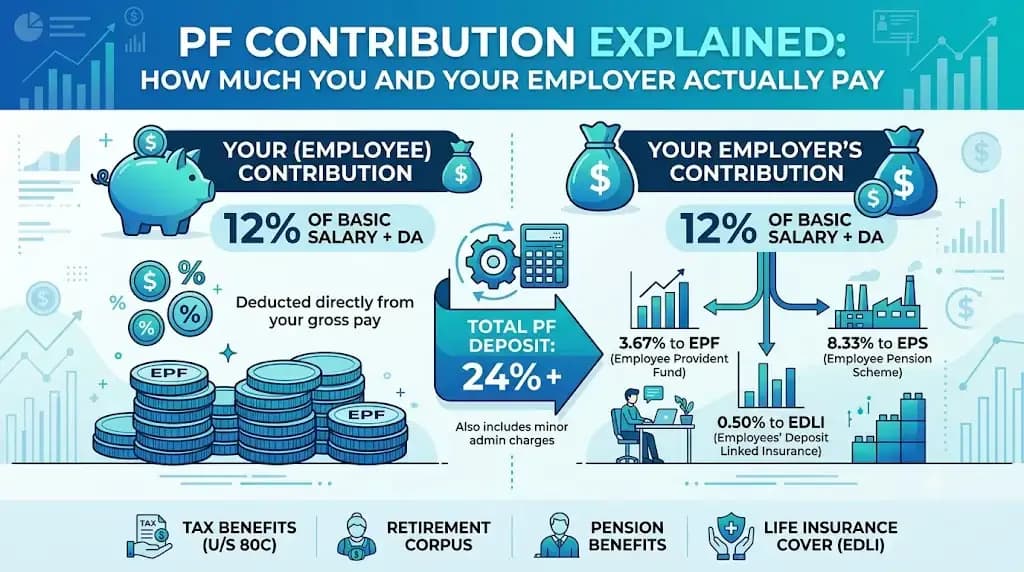
The employer's contribution follows a specific allocation pattern between EPF and EPS. According to NDTV Profit analysis, for a salary of ₹25,000, the employer contributes 3.67% (₹917.50) towards the employee's EPF account and 8.33% (₹2,082.50) towards the Employee Pension Scheme (EPS). This means the employer's total contribution is ₹3,000, but the entire amount does not go directly into the EPF account. The employer's contribution is calculated as a percentage of the employee's basic salary, ensuring consistent allocation across different salary levels.
The total EPF contribution is calculated by adding the employee's contribution of ₹3,000 to the employer's EPF portion of ₹917.50, resulting in ₹3,917.50 credited to the EPF account monthly. As reported by NDTV Profit, the remaining ₹2,082.50 from the employer's contribution goes towards the Employee Pension Scheme (EPS). This structure ensures that the employee's portion of the employer's contribution is directly credited to their EPF account. The latest salary calculator data shows this same crediting mechanism applies consistently across different salary levels.
Interest calculations on EPF balances follow a specific timeline that affects account growth. According to NDTV Profit, interest on the EPF balance is calculated monthly, but the interest amount is credited to the account at the end of the financial year. This structure provides compounding benefits over time while maintaining the monthly calculation methodology for accurate interest accrual throughout the year. The interest compounding ensures steady growth in EPF balances over time, with the monthly calculation providing regular updates while the annual crediting ensures proper accounting for the full year's interest.