The Employees' Provident Fund Organisation (EPFO) raised the wage ceiling for provident fund calculation purposes from ₹15,000 to ₹25,000 on September 17, 2026. This revision is expected to extend mandatory coverage to more than 10 million additional workers and give another push to workforce formalisation. The change affects employees whose statutory wages do not exceed ₹25,000, with those earning more than ₹15,000 but no more than ₹25,000 in statutory wages being covered by PF on a mandatory basis. The term 'wages' refers specifically to the definition provided under the Code on Social Security, 2020. As per Livemint, the revised ceiling raises the mandatory coverage threshold from ₹15,000 to ₹25,000 a month for eligible employees, with an employee joining at a monthly wage of ₹20,000 now falling within mandatory EPF and EPS coverage under the revised framework.

The labour and employment ministry has instructed employers not to cut employees' statutory wages following the increase in the EPFO wage ceiling to ₹25,000. The directive seeks to address concerns that companies may try to absorb the additional employer contribution arising from the revised ceiling by adjusting it against employees' cost to company (CTC). The ministry stated that 'the employer's statutory contribution cannot simply be treated as an employee deduction merely by describing it as part of cost-to-company (CTC)'. It has urged employers to regard their share of social security contributions as an investment in sound human resource practices, which can help improve employee satisfaction and retention.
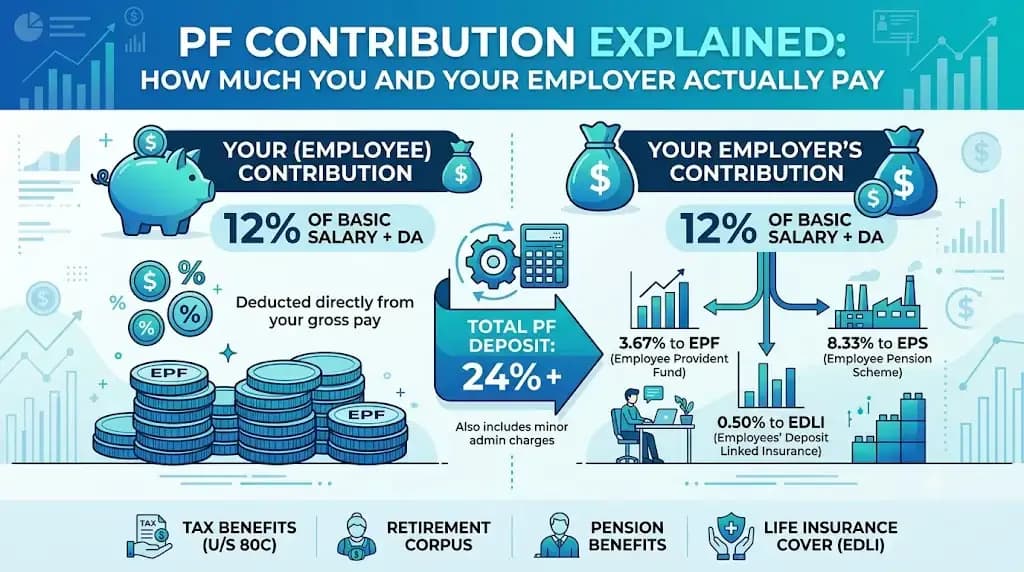
Under the revised limit, the maximum monthly contribution could increase from ₹1,800 to ₹3,000 per month for workers newly covered by the mandatory framework. For workers earning more than ₹15,000 but less than ₹25,000, the employee's mandatory 12% contribution will be deposited entirely into the EPF, while of the employer's 12% contribution, 8.33% will be allocated to EPS with the remaining portion going into the EPF. The ministry has acknowledged that the revised wage ceiling would inevitably raise employers' costs, but employers can partly offset this additional financial burden by the incentive of up to ₹3,000 per month for every additional employment created under the Pradhan Mantri Viksit Bharat Rojgar Yojana (PMVBRY).
Following the wage ceiling revision, employees with basic pay plus dearness allowance of up to ₹25,000 will have mandatory EPS contributions, while those earning above ₹25,000 will have EPS contributions based on their previous contribution history. Employees with wages ranging from ₹15,000 to ₹25,000 who were previously not part of the EPS must be enrolled under the scheme. For employees earning over ₹25,000, those with no previous EPS contributions would not have to make contributions towards the EPS account, though they may continue to have EPF membership. However, employees with previous EPS contributions must continue making EPS contributions in the future. Employers are advised to verify employees' Universal Account Number (UAN) to check previous EPS membership status before determining contribution requirements.
Employees who begin their first job with a basic wage of up to ₹25,000 can qualify for pension benefits under the Employees' Pension Scheme (EPS), 2026, subject to the scheme's eligibility conditions. If an eligible employee finds that the employer is not making the required EPS contribution, the Employees' Provident Fund Organisation (EPFO) has advised them to first take up the matter with the employer. As per Livemint, employees whose issue is not resolved by the employer can subsequently lodge a grievance through the EPFiGMS portal. The grievance process involves registering through the official portal, entering the Universal Account Number (UAN) or PF number, selecting the relevant category of grievance, and uploading supporting documents where required. Once the complaint has been registered, its status can be tracked using the reference number provided by the portal. The EPFO has also clarified that employers should approach the EPFO for rectification if an EPS contribution has been wrongly deducted or a required contribution has been missed.