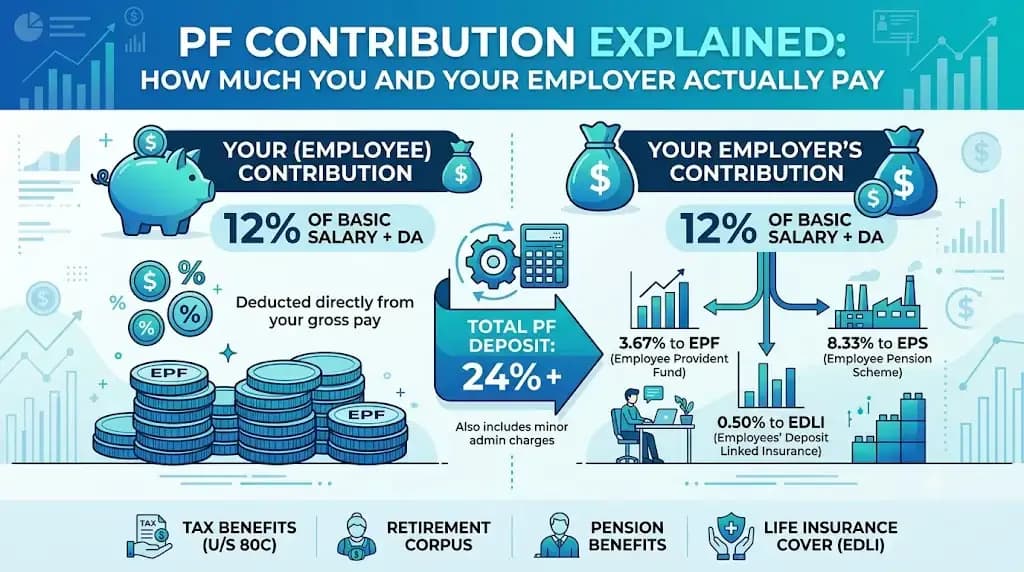
The Employee Provident Fund operates on a 24% combined contribution rate - both employee and employer contribute 12% of basic salary plus dearness allowance. For employees earning ₹15,000 or less monthly, the full 12% employee contribution goes directly to EPF, while the employer's 12% is split between 8.33% to the Employees' Pension Scheme (EPS) and 3.67% to EPF. For higher earners, the employer's pension contribution is capped at ₹1,250 monthly (8.33% of ₹15,000 ceiling), with any excess above 12% of actual salary going to EPF. According to EPFO rules, this structure ensures the EPF account receives the maximum possible contribution while maintaining the pension scheme's ceiling. The Code on Social Security, 2020 has expanded EPF coverage to all establishments with 20 or more employees, regardless of industry type, significantly increasing the number of workers eligible for social security benefits.
For a basic salary of ₹15,000, the monthly contribution breakdown shows the employee contributes ₹1,800 (12% of ₹15,000), while the employer contributes ₹1,250 to EPS and ₹550 to EPF, totaling ₹2,350 monthly EPF contribution. For higher earners with ₹30,000 basic salary, the employee contributes ₹3,600 while the employer contributes ₹2,350 (capped at ₹1,250 EPS contribution plus full 12% excess salary contribution), resulting in ₹5,950 monthly EPF contribution. As reported by EPFO, this structure ensures high earners build significantly larger EPF balances than pension contributions over their working years.

EPF balances earn interest at a government-set rate of 8.25% for FY 2025-26, maintained for the second consecutive year. Interest is calculated on the monthly running balance and credited at the end of the financial year. According to EPFO data, the compounding effect becomes significant over long careers, as contributions made in the 20s have three decades to compound before retirement. The scheme rewards early starts and unbroken contribution records far more than large contributions made late in one's career.
EPF maintains EEE status (exempt at contribution, exempt on interest, exempt at withdrawal) with specific conditions. Employee contributions qualify for deduction under Section 80C up to ₹1.5 lakh only under the old tax regime, while the new regime provides no equivalent deduction. Interest on EPF is tax-free, but excess contributions above ₹2.5 lakh annually become taxable under 'Income from Other Sources'. Withdrawals are tax-free after 5 continuous years of service, with early retirement allowed from age 55 (54 for partial withdrawals up to 90% of balance). Job loss provides access to 75% of balance after one month and remaining 25% after two months, with TDS of 10% or 30% on premature withdrawals exceeding ₹50,000. Employer contributions to EPF, NPS, and superannuation are tax-free up to a combined limit of ₹7.5 lakh in a financial year.
EPF balances remain portable across employers through the Universal Account Number (UAN) system, ensuring uninterrupted growth without resetting or paying out when changing jobs. The scheme allows partial withdrawals during working years for medical emergencies, higher education, home purchases, loan repayments, or family weddings with specific conditions. According to EPFO guidelines, this portability feature eliminates the common concern about job changes affecting retirement savings, as the balance continues earning interest without disruption. Starting from April 2021, if total annual employee contribution (EPF + VPF) exceeds ₹2.5 lakh, the interest earned on the portion exceeding ₹2.5 lakh is taxable under standard income tax slab rates.