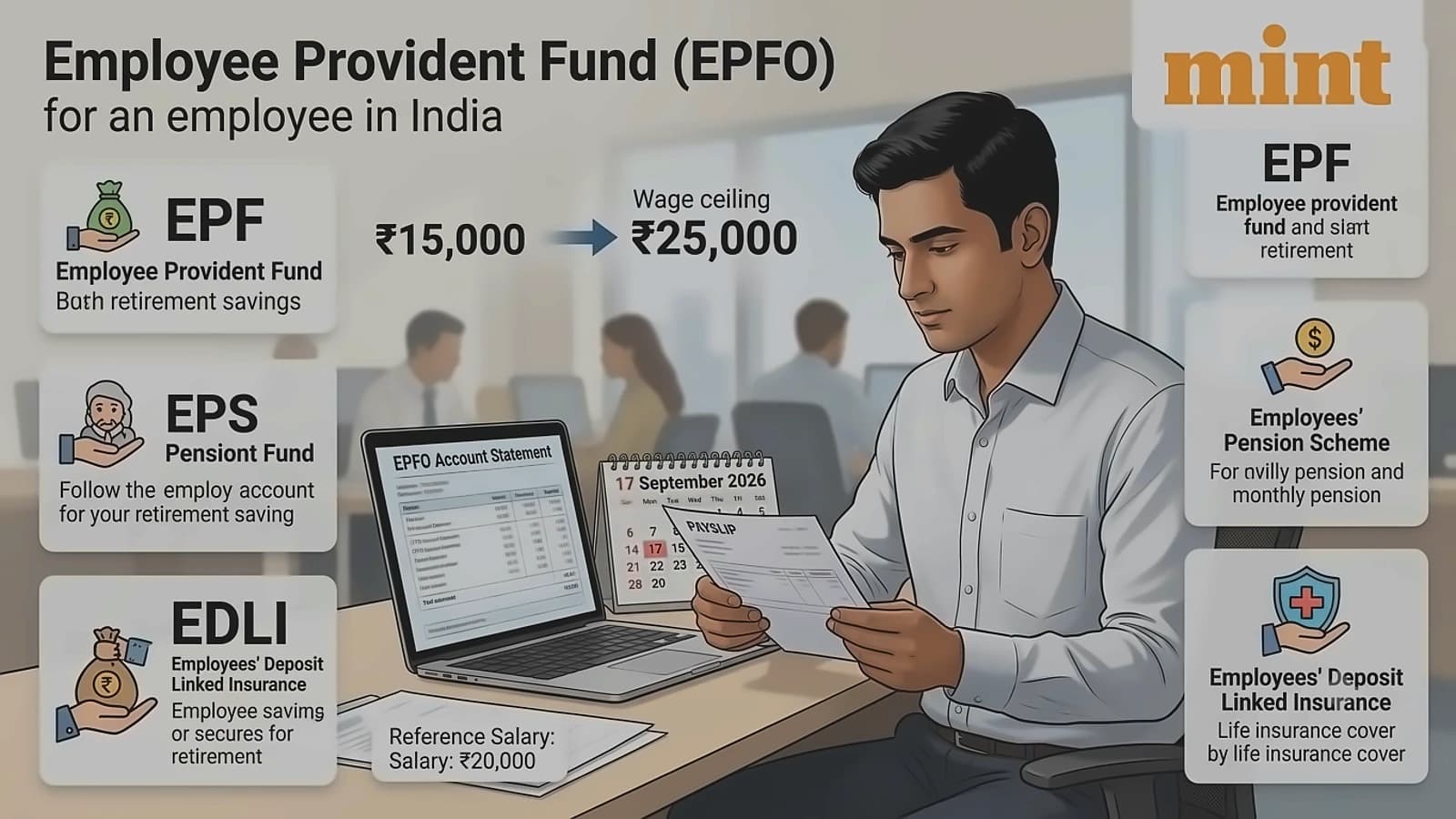
The Ministry of Labour and Employment is considering a significant proposal to increase the minimum pension under the Employees' Pension Scheme (EPS-95) beyond ₹1,000 per month, a move that could benefit millions of EPFO subscribers. Currently, the Centre contributes over ₹950 crore annually to maintain the ₹1,000 minimum pension. Labour unions and pensioners have been pushing for a hike to ₹7,500, arguing that the existing amount is insufficient to meet basic living costs. Discussions are ongoing, and a decision may be announced soon, with a parliamentary panel also backing a revision to strengthen social security.

Pension income in India is taxable based on the type of pension received, according to the Income Tax Department's guidelines. Regular pension payments are generally taxed as salary, treated in the same manner as salary income received from an employer. However, lump sum amounts or commuted pensions may be fully or partially exempt depending on the taxpayer's employment type and eligibility under income tax rules. When filing the Income Tax Return (ITR), pension income must be reported under the appropriate head, typically 'Salaries' for regular payments.
Effective April 1, the Employees' Provident Fund Organisation (EPFO) has introduced Form 121, replacing Forms 15G and 15H, to simplify the process of claiming TDS exemption on EPF withdrawals. Aligned with the Income Tax Act, 2025, the new form allows individuals with income below the taxable limit to avoid TDS on EPF withdrawals above ₹50,000. However, the form must be filed each financial year and before initiating withdrawal requests. The new system enables faster processing and reduces errors by integrating EPFO records with income tax databases, though scrutiny has become stricter with stricter KYC requirements.
EPFO reported a 38.3% surge in claim settlements in FY26, processing a record 83.1 million claims compared to 60.1 million in FY25. In April 2026 alone, 6.1 million claims were settled, with nearly 99% processed within 20 days. The government also plans to launch an Aadhaar-based portal, E-PRAAPTI, to help users track and activate inoperative EPF accounts efficiently. This initiative aims to strengthen social security and provide better access to pension benefits for subscribers.
Family pension received by family members after an employee's death is taxable under the head 'Income from Other Sources', as reported by the Income Tax Department. A deduction is allowed on family pension, equal to the lower of one-third of the pension or ₹15,000. If the family member's income is computed under the new tax regime and section 115BAC, the monetary limit is increased to ₹25,000. Additionally, family pension received by widows, children or nominated heirs of armed forces or paramilitary personnel is fully exempt from tax if the death occurred during operational duties.
A special exemption is available for disabled personnel of the armed forces, according to the Income Tax Department's website. The entire disability pension, comprising both the service element and the disability element, is fully exempt from income tax for individuals who have been invalided out of service due to a physical disability caused or aggravated by military service. However, this exemption does not apply to personnel who have retired on superannuation or otherwise. Since disability pension is exempt from tax, it does not need to be included in salary income for the purpose of tax deduction at source (TDS).